
Chemical synthesis method of 6-chloropurine
A technology for chemical synthesis and chloropurine, applied in the field of chemical synthesis of 6-chloropurine, can solve problems such as environmental pollution, and achieve the effects of reducing a large amount of waste water, high yield, and easy availability of raw materials
Patent Information
- Authority / Receiving Office
- CN · China
- Patent Type
- Applications(China)
- Current Assignee / Owner
- Publication Date
- 2012-02-01
Smart Images
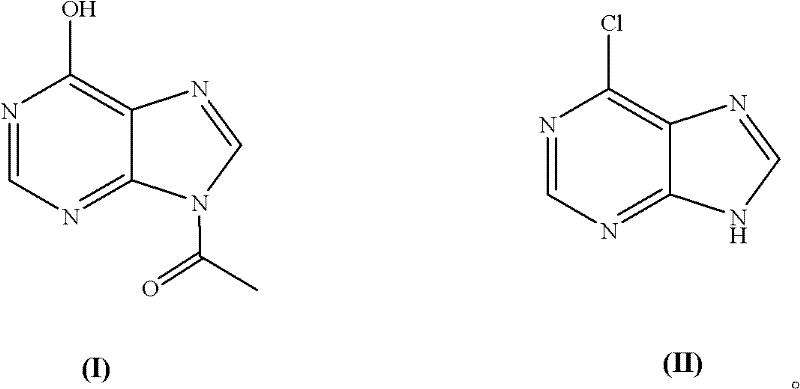
Figure 1 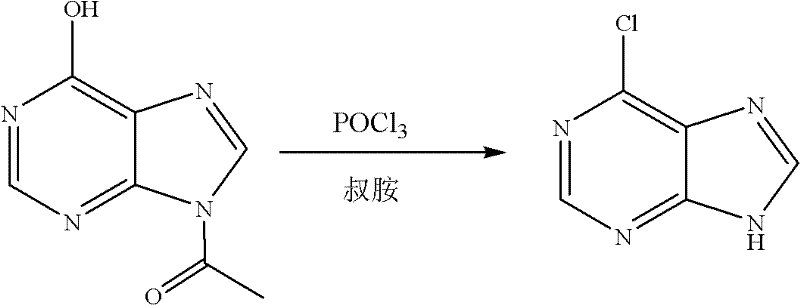
Figure 2 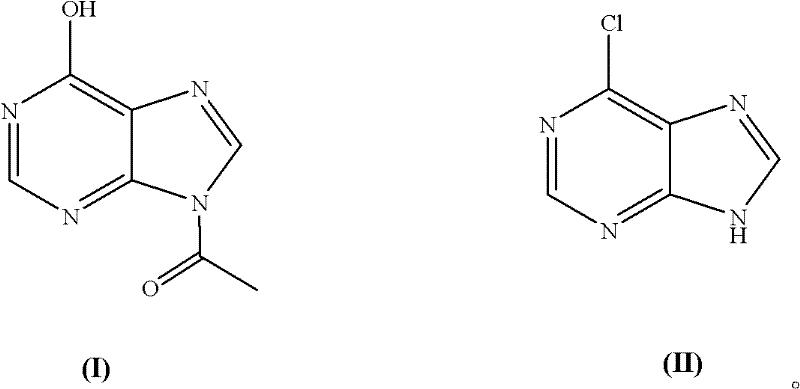
Figure 3
Abstract
Description
(1) Technical field
[0001] The invention relates to a chemical synthesis method for 6-chloropurine, in particular to a chemical synthesis method for preparing 6-chloropurine with acetyl hypoxanthine as the main raw material. (2) Background technology
[0002] 6-chloropurine is mainly used in the synthesis of adenine and mercaptopurine. Adenine and its derivatives are widely used in the fields of medicine and agricultural chemicals. synthetic vitamin B 4 , anti-hepatitis B virus drug adefovir dipivoxil, anti-HIV drug tenofovir, etc. 6-Benzyladenine can promote plant cell division and expansion, and is a plant growth hormone.
[0003] Before the present invention was made, the preparation method of 6-chloropurine was generally obtained by reacting hypoxanthine with chlorination reagents such as phosphorus oxychloride. Such as USSR 1089093; J Am Chem Soc1954, 76, 6073-7; JP05170766; J Heterocyclic Chem 1983, 20(2), 295-9; CN101602766, etc. The raw material hypoxanthine use...
Examples
Embodiment 1
[0019] Embodiment 1: The molar ratio of feeding materials is acetyl hypoxanthine: phosphorus oxychloride: N, N-dimethylaniline is 1.0: 5.0: 1.0
[0020] In a 500mL three-necked flask equipped with a thermometer and mechanical stirring, add 35.6g acetyl hypoxanthine (0.20mol), 152153.0g phosphorus oxychloride (1.00mol), 24.2g N,N-dimethylaniline (0.20 mol), start stirring, heat to 105°C, keep warm for 4 hours, and evaporate unreacted phosphorus oxychloride. Cool to 0°C, add 100 mL of ice water, and adjust the pH to 8 with 0.1M NaOH solution. After cooling, a large amount of yellow solid precipitated out. Filter, wash with cold water, and dry to obtain 27.6 g of 6-chloropurine, with a yield of 90.0% (calculated as acetyl hypoxanthine, the same below.), and a purity of 99.0% after testing (high performance liquid chromatography area normalization method, referred to as HPLC, the same below). MS (EI): M (100), M+2 (33).
Embodiment 2
[0021] Example 2 The amount ratio of the feeding material is changed to acetyl hypoxanthine: phosphorus oxychloride: N, N-dimethylaniline is 1.0: 20.0: 1.0
[0022] In a 500mL three-neck flask equipped with a thermometer and mechanical stirring, add 35.6g acetyl hypoxanthine (0.20mol), 612.0g phosphorus oxychloride (4.00mol), 24.2g N,N-dimethylaniline (0.20 mol), start stirring, heat to 105°C, keep warm for 4 hours, and evaporate unreacted phosphorus oxychloride. Cool to 0°C, add 100 mL of ice water, and adjust the pH to 8 with 0.1M NaOH solution. After cooling, a large amount of yellow solid precipitated out. After filtering, washing and drying, 27.3 g of 6-chloropurine was obtained, with a yield of 89.2% and a purity of 99.0% after testing.
Embodiment 3
[0024] The amount ratio of the feed material is changed to acetyl hypoxanthine: phosphorus oxychloride: N, N-dimethylaniline is 1.0: 10.0: 1.0, in a 500mL three-necked flask equipped with a thermometer and mechanical stirring, add 35.6g Acetyl hypoxanthine (0.20mol), 306.0g phosphorus oxychloride (2.00mol), 24.2g N,N-dimethylaniline (0.20mol), other conditions and preparation steps are the same as in Example 1. 27.9 g of 6-chloropurine was obtained with a yield of 91.2% and a purity of 99.0% after testing.