
Power-assisting bicycle using sensor with multiple non-uniformly distributed magnetic blocks in shell
A power-assisted bicycle, evenly distributed technology, is applied in the direction of using electric/magnetic devices to transmit sensing components, convert sensor outputs, instruments, etc.
Patent Information
- Authority / Receiving Office
- CN · China
- Patent Type
- Applications(China)
- Current Assignee / Owner
- Publication Date
- 2012-12-19
Smart Images
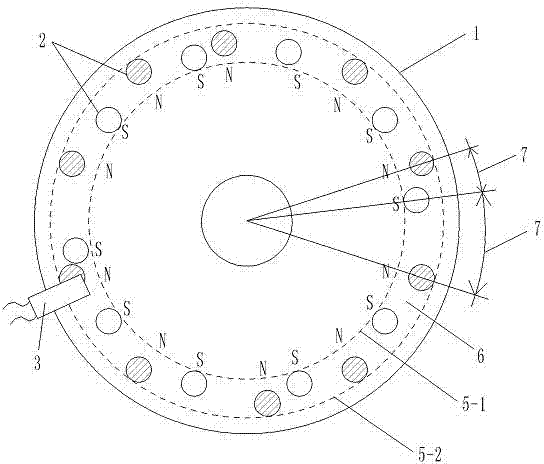
Figure 1 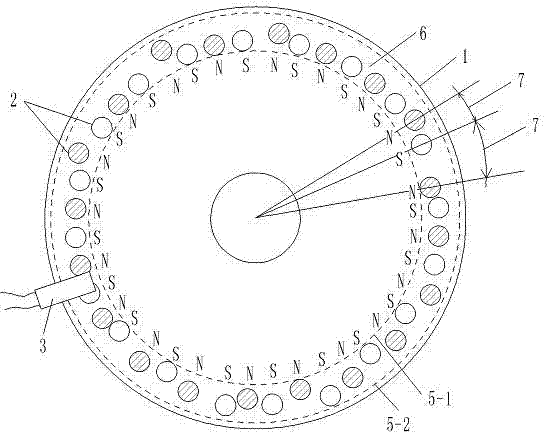
Figure 2 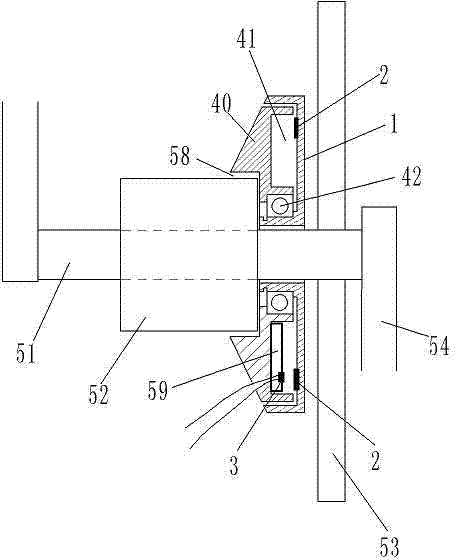
Figure 3
Abstract
Description
technical field
[0001] The invention belongs to the technical field of power-assisted bicycles, in particular to an electric power-assisted bicycle that performs multi-point magnetic induction on a rotating part to provide power-assisted signals. Background technique
[0002] The Chinese patent 201020295192.0 "Claw Type Torque Sensing Device" applied by Yebao Vehicle Material Industry (Kunshan) Co., Ltd. discloses a sensing device for power-assisted bicycles. The sensing device includes a magnetic part and an elastic part to sense the torque. sensing device. After a long time of use, the change of the elastic coefficient of the elastic member will lead to changes in the sensing signal and the control effect of the controlled motor, and the power-assisted effect will not match the power-assisted needs of people. Moreover, the design structure of the elastic member is complex and the manufacturing cost is high.
[0003] The Chinese patent 01201843.0 "Automatic Detection Devi...
Examples
Embodiment 1
[0123] Embodiment 1, the power-assisted bicycle with the uneven distribution sensor of multi-magnetic blocks in the housing
[0124] Such as figure 1 , 3 , 4, 6, the sensor among the present invention is installed on the central axis 51 of existing electric bicycle, the signal output line of sensor is connected with the motor controller 29 of electric bicycle, just obtains power-assisted bicycle of the present invention.
[0125] 1. The components and structure of the electric bicycle related to the installation of the sensor: the electric bicycle has a central shaft 51, and the middle section of the central shaft 51 is covered with a bushing 52, and the central shaft 51 is connected to the bushing 52 in rotation; the chain disc 53 is fixed on the central shaft 51 The two ends of the central axis 51 are respectively fixed with pedals 54; the inner surface of the casing 52 is connected to the central axis 51 in rotation, and the outer surface of the casing 52 is fixedly conne...
Embodiment 2
[0149] Embodiment 2, a high-density power-assisted bicycle with unevenly distributed sensors with multiple magnetic blocks in the housing
[0150] Such as figure 2 , 3 , 4, 6, the diameter of the annular groove rotating disk 1 in the hollow ring 41 is 10.0 centimeters, and 40 permanent magnet blocks 2 are established at the annular groove rotating disk 1, and the diameters of the 40 permanent magnet blocks 2 are respectively 0.6 centimeters, The magnetic flux is 146---279(B·H)max / KJ·m -3 one of the values in . Hall 3 keeps a distance of 0.2 cm from each permanent magnet 2 in the rotating state, so that when each rotating permanent magnet 2 passes through Hall 3, Hall 3 can generate a corresponding rectangular wave electric signal output. The structures of other annular groove rotating disk 1, permanent magnet block 2 and Hall 3 are the same as those in embodiment 1.
Embodiment 3
[0151] Embodiment 3, a power-assisted bicycle with a specific circuit and a sensor with uneven distribution of multiple magnetic blocks in the housing
[0152] Such as figure 1 , 3 , 5, 6, as in embodiment 1, the sensor includes a sensing element connected in sequence, a booster model processor 21, a digital-to-analog converter 27 and an operational amplifier 28;
[0153] [1] The Hall 3 in the sensing element is UGN3075; the structure of other elements and elements in the sensing element is the same as that in Embodiment 1;
[0154] [2] The auxiliary model processor 21 selects the single-chip microcomputer 31 to complete all functions, and the single-chip microcomputer 31 selects AT89S52. That is, the AT89S52 single-chip microcomputer 31 completes all functions of the analog-to-digital conversion and the wave width identifier 22 , the power-assisted starting point selector 23 , the magnet speed calculator 24 , the power-assisted model memory 25 and the power-assisted model ...