
Multilayer coil part
A technology of stacking coils and components, applied in transformer/inductor components, electrical components, transformer/inductor coils/windings/connections, etc., can solve problems such as inductance reduction and inability to obtain DC superposition characteristics
Patent Information
- Authority / Receiving Office
- CN · China
- Current Assignee / Owner
- Publication Date
- 2014-02-19
Smart Images
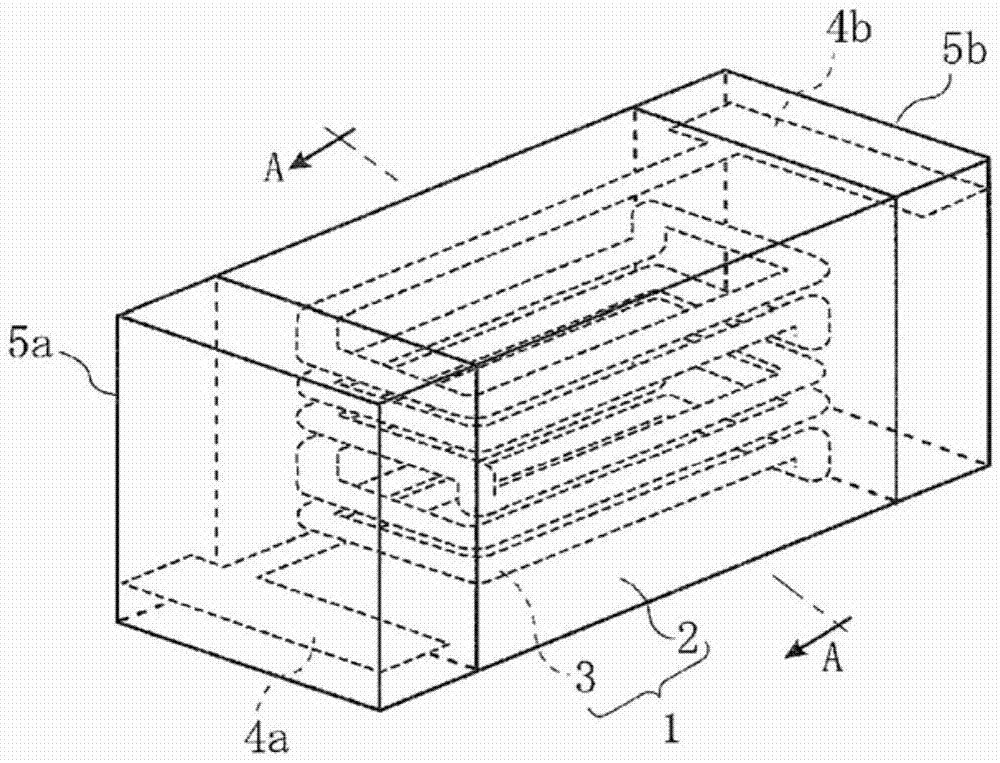
Figure 1 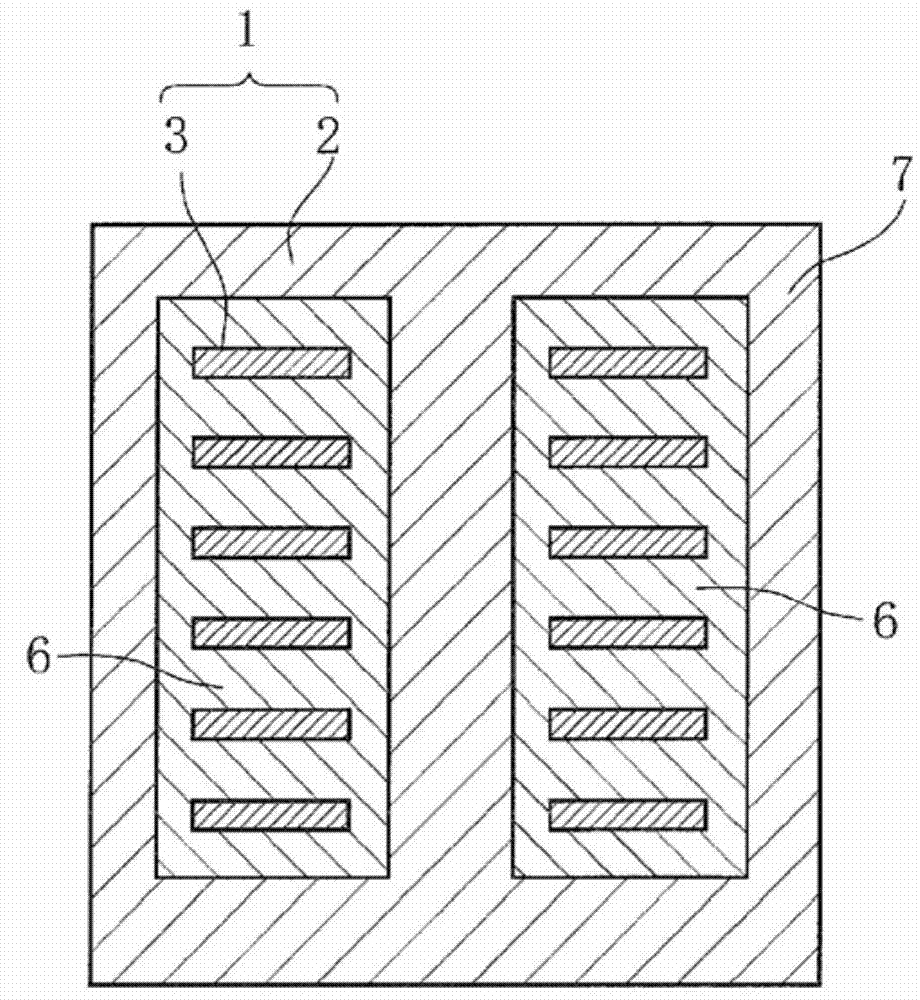
Figure 2 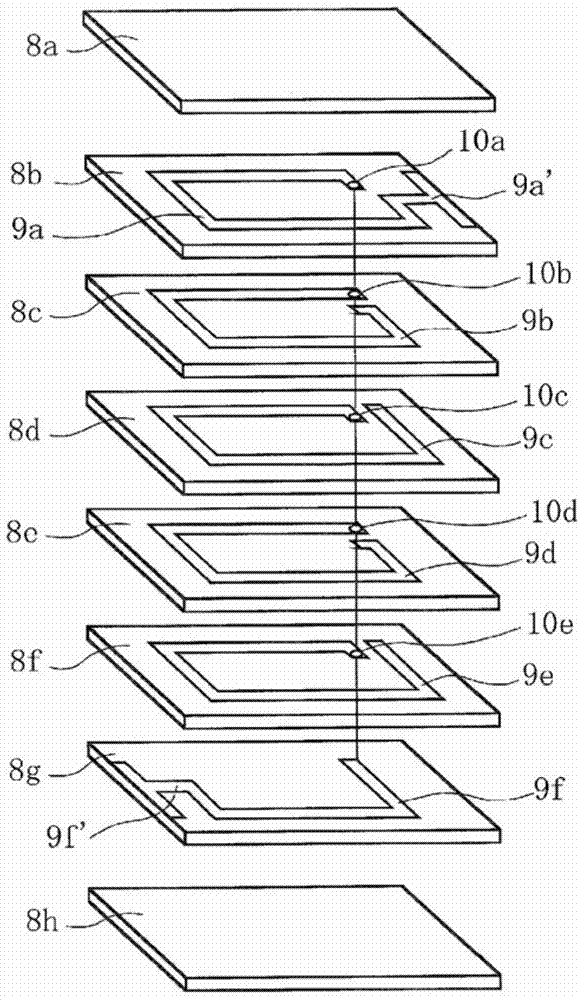
Figure 3
Abstract
Description
technical field
[0001] The present invention relates to a laminated coil component, and more specifically, to a laminated coil component such as a laminated inductor having a magnet portion made of a ferrite material and a coil conductor mainly composed of Cu. Background technique
[0002] Conventionally, laminated coil components using ferrite magnets such as Ni—Zn having a spinel crystal structure have been widely used, and development of ferrite materials has also been actively carried out.
[0003] Such a laminated coil component has a structure in which a conductor part wound in a coil shape is embedded in a magnet part, and usually the conductor part and the magnet part are formed by simultaneous firing.
[0004] However, in the above-mentioned laminated coil component, the linear expansion coefficient is different between the magnet portion made of ferrite material and the conductor portion mainly composed of conductive material. Stress deformation occurs inside duri...
Examples
Embodiment 1
[0099] (production of samples)
[0100] [Magnet production]
[0101] As a ferrite raw material, prepare Fe 2 o 3 , Mn 2 o 3 , ZnO, NiO, and CuO, according to the composition of Table 1, weigh these ceramic raw materials. That is, take Fe 2 o 3 : 46.5mol%, Mn 2 o 3 : 2.5mol%, ZnO: 30.0mol%, CuO varies from 0.0 to 8.0mol%, and the rest is adjusted by NiO.
[0102] [Table 1]
[0103]
[0104] Next, these weighed objects were put into a ball mill made of vinyl chloride together with pure water and PSZ balls, thoroughly mixed and pulverized by a wet method, evaporated and dried, and then calcined at a temperature of 850°C.
[0105] Next, these pre-fired products are put into a ball mill made of vinyl chloride together with polyvinyl butyral-based binder (organic binder), ethanol (organic solvent), and PSZ balls, and are thoroughly mixed and pulverized. Get a slurry.
[0106] Next, the slurry was shaped into a sheet with a thickness of 25 μm using a doctor blade metho...
Embodiment 2
[0139] Fe ready to form the main component of the ferrite material 2 o 3 , Mn 2 o 3 , ZnO, NiO, and CuO, and SnO as a subcomponent material 2 . Then Fe 2 o 3 : 46.5mol%, Mn 2 o 3 : 2.5mol%, ZnO: 30.0mol%, CuO: 1.0mol%, and NiO: 20.0mol% were weighed, and SnO was further weighed at 0.0 to 3.0 parts by weight relative to 100 parts by weight of the main component. 2 .
[0140] Except for this, the samples of sample numbers 11-14 were produced according to the method and procedure similar to Example 1.
[0141] Next, for each of the samples of sample numbers 11 to 14, the content weight and average crystal grain size of CuO were measured, and a thermal shock test and a DC superposition test were performed.
[0142] Table 3 shows the measurement results of each sample of sample numbers 11-14.
[0143] [table 3]
[0144]
[0145] It is obvious from sample numbers 11 to 14 that there is basically no difference in the inductance change rate ΔL in the thermal shock test,...