
Ammonia synthesis technology for improving ammonia separation effect through temperature swing adsorption
A technology of temperature swing adsorption and ammonia separation, which is applied in ammonia preparation/separation, chemical industry, sustainable manufacturing/processing, etc. It can solve the problems of increased power consumption of ice machines, reduce consumption, reduce operating pressure, and reduce compression work. Effect
Patent Information
- Authority / Receiving Office
- CN · China
- Patent Type
- Applications(China)
- Current Assignee / Owner
- Publication Date
- 2014-05-28
- Estimated Expiration
- Not applicable · inactive patent
Smart Images
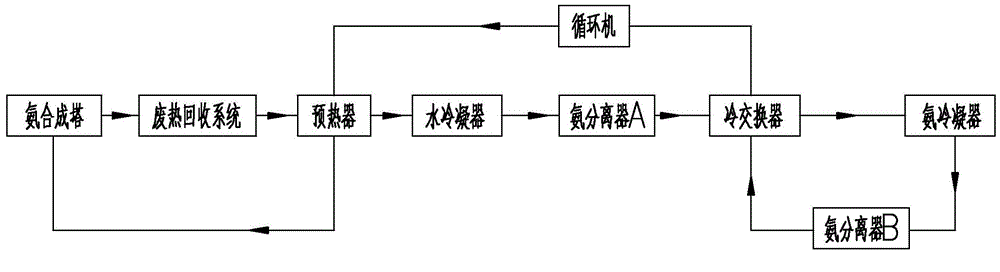
Figure 1 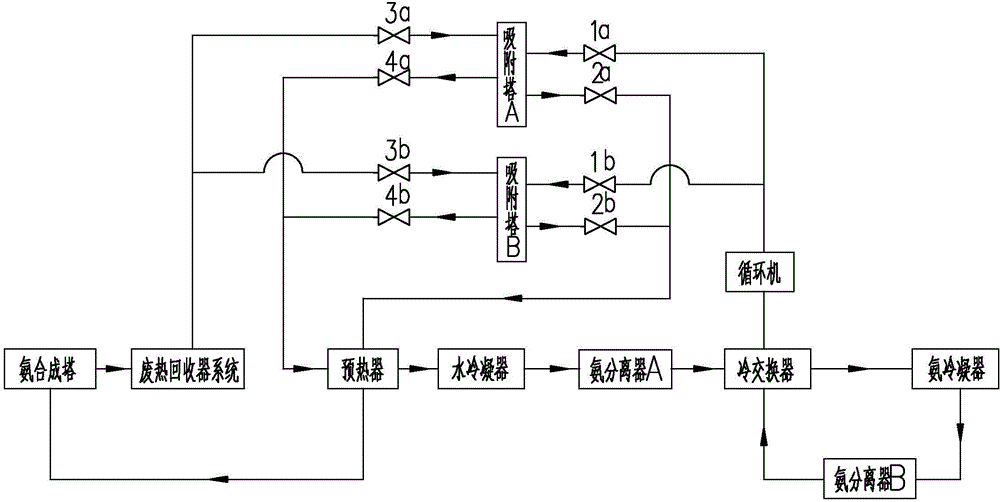
Figure 2
Abstract
Description
technical field
[0001] The invention relates to a temperature-swing adsorption ammonia synthesis process, in particular to a process for reducing the ammonia content of circulating gas entering a synthesis tower by using temperature-swing adsorption. technical background
[0002] Synthetic ammonia is a chemical product of great significance to agriculture and is mainly used as a raw material for the production of fertilizers and other nitrogenous fertilizers. The synthesis of ammonia is the core part of the whole synthetic ammonia production process. The ammonia synthesis reaction is affected by thermodynamics and kinetics. In actual production, the reaction cannot reach equilibrium. In addition to considering the influence of temperature, pressure, hydrogen-nitrogen ratio, etc. The initial ammonia content should be considered. When other conditions are constant, the lower the ammonia content in the gas entering the tower, the greater the net ammonia value and the higher the...
Examples
Embodiment Construction
[0014] Such as figure 2 Shown, the temperature swing adsorption ammonia synthesis process of the present invention is as follows:
[0015] The synthesis gas from the ammonia synthesis tower recovers the reaction heat through the waste heat recovery system. At least two sets of adsorption and desorption towers are connected in parallel at the outlet of the waste heat recovery device. This embodiment is the parallel connection of adsorption and desorption tower A and adsorption and desorption tower B. The synthesis gas enters the inlet of the desorption end of the adsorption and desorption tower A after passing through the switching valve 3a, and the synthesis gas with desorbed ammonia at the outlet of the desorption end of the adsorption and desorption tower A passes through the switching valve 4a and enters the preheater and the water condenser to cool down in turn through the pipeline , and then enter the ammonia separator A to separate the liquid ammonia, the synthetic gas ...