
Microbial fuel cell potted plant and method for in-situ remediation of soil chromium pollution
A fuel cell and in-situ remediation technology, applied in biochemical fuel cells, botanical equipment and methods, restoration of contaminated soil, etc., can solve problems such as environmental impact, cumbersome process, and multiple processing, and achieve no management and simple operation Effect
Patent Information
- Authority / Receiving Office
- CN · China
- Patent Type
- Patents(China)
- Current Assignee / Owner
- Publication Date
- 2016-01-20
Smart Images
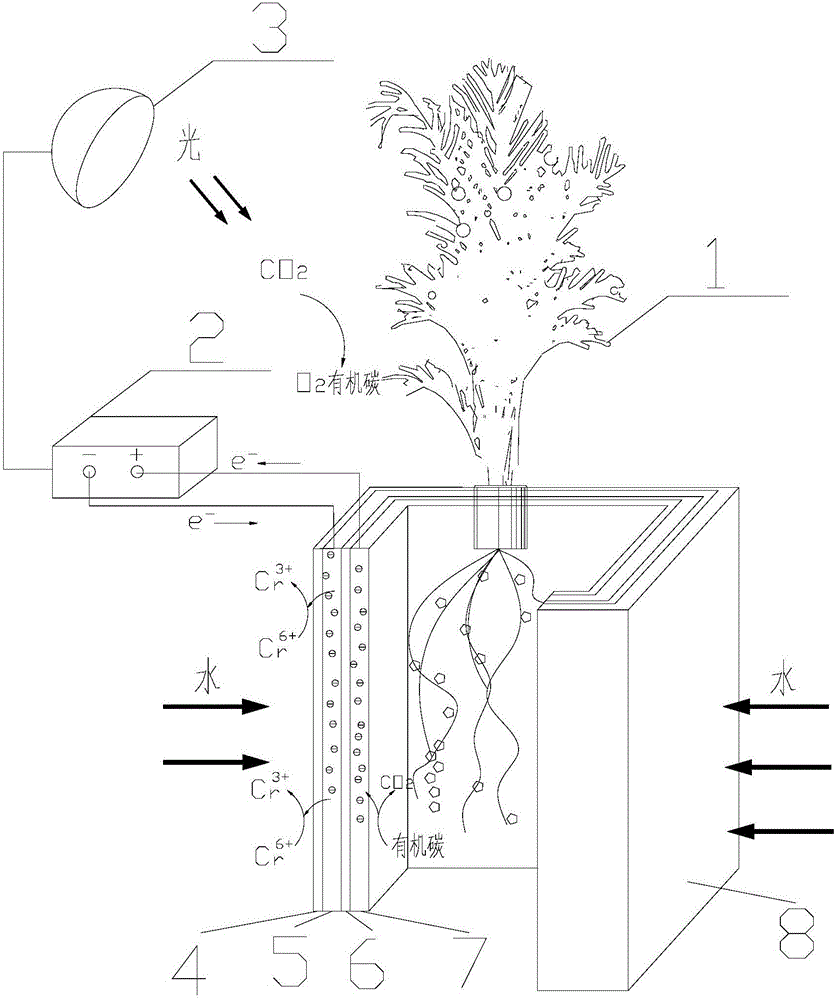
Figure 1
Abstract
Description
technical field
[0001] The invention relates to soil microbial fuel cell technology, in particular to a microbial fuel cell potted plant for in-situ restoration of soil hexavalent chromium pollution. Background technique
[0002] Chromium compounds can produce toxic effects, among which hexavalent chromium, which has the ability to oxidize and penetrate the body membrane, is the most toxic, 100 times that of trivalent chromium, causing great toxicity to the human body, organisms and vegetation, leading to skin cancer, glandular diseases such as cancer.
[0003] Chromium pollution in soil is due to its carrier, which makes its treatment more difficult. Today's soil hexavalent chromium pollution can be divided into two categories, the lower layer is slightly polluted soil, and the upper layer is heavily polluted soil. The main treatment method for the lightly polluted soil in the lower layer is bioremediation. A large number of trees and grasses suitable for the local enviro...
Examples
Embodiment 1
[0041] Such as figure 1 As shown, a microbial fuel cell potted plant includes a flower pot 8 , a plant 1 planted in the flower pot 8 , a storage battery 2 and a light source 3 .
[0042] The basin wall structure of flower pot 8 is followed by plastic mesh film layer 4, graphite cathode layer 5, glass fiber layer 6 and graphite anode layer 7 from outside to inside; The material of plastic mesh film layer 4 plastic mesh film layer 4 is hard Polytetrafluoroethylene; the aperture of the plastic mesh film layer is 1-10mm, the graphite cathode layer 5 is detachably connected between the plastic mesh film layer 4 and the glass fiber layer 6, and the graphite cathode layer can be removed from the plastic mesh film Between layer 4 and glass fiber layer 6, graphite anode layer 7 is bonded to glass fiber layer 6.
[0043] The graphite cathode layer 5 and the graphite anode layer 7 are connected to the storage battery 2 by wires, and the storage battery 2 is connected to the light source...
Embodiment 2
[0049] The plant selected in this embodiment is sweet potato, the potted plant diameter is 50cm, and the potted plant spacing is 50cm.
[0050] In this example, the content of hexavalent chromium in the polluted soil is 800 mg / Kg, and after 70 days, the content of hexavalent chromium drops to 207 mg / kg, and the total chromium drops to 250 mg / kg, reaching the allowable standard of GB15618-1995 in my country's "Soil Environmental Quality Standards" , after 140 days, the hexavalent chromium content dropped to 45mg / kg, and the total chromium dropped to 50mg / kg.