
Hartree approximation method for achieving acceleration through GPU
A technique of approximation methods and procedures, applied in the field of Hartree approximation, which can solve problems such as accuracy problems
Patent Information
- Authority / Receiving Office
- CN · China
- Patent Type
- Applications(China)
- Current Assignee / Owner
- Publication Date
- 2014-12-24
- Estimated Expiration
- Not applicable · inactive patent
Smart Images
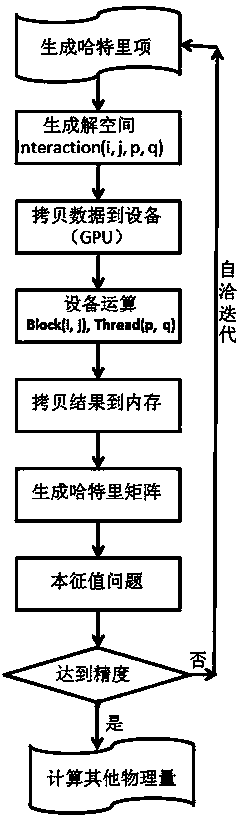
Figure 1
Abstract
Description
technical field
[0001] The invention relates to the field of high-performance computing, in particular to a Hartree approximation method accelerated by GPU. Background technique
[0002] With the continuous progress of human society and the development of science and technology, people's understanding of nature has become more and more extensive, and gradually deepened into physical systems such as micro and nano. At the same time, the needs of biotechnology, chemical production and pharmaceuticals also urgently require people to accurately grasp the properties of objects at the microscopic level, especially at the electronic, atomic or molecular scale. But unfortunately, the microscopic system often includes tens of thousands of electrons and atoms. From a theoretical point of view, there is no strict analytical solution to the many-body problem. Therefore, solving the many-body problem has always been a difficult problem in the field of physics. In order to break through...
Examples
Embodiment Construction
[0019] A GPU-accelerated Hartree approximation method of the present invention will be described in detail below in conjunction with the accompanying drawings.
[0020] like figure 1 Shown, a kind of Hartree approximation method that utilizes GPU to accelerate of the present invention, its basic program structure and organizational flow are:
[0021] (1) Select the base vector and construct a tentative single-particle state, generate a Hartree term, and store it in a linear memory as an initial parameter;
[0022] (2) Generate the solution space of the problem;
[0023] (3) Divide the calculation grid, transfer the input parameters to the video memory, and put the parameters that need to be frequently accessed in the calculation into the shared memory of the GPU;
[0024] (4) Call the device-side function to calculate the particle-particle interaction, and store the results corresponding to each thread in the video memory;
[0025] (5) Copy the calculated results from the v...