
Method for preparing 2-C-methyl-D-ribotide-1,4-lactone
A technology of 2-C-ribose acid, which is applied in the field of preparing 2-C-methyl-D-ribose-1,4-lactone and lactone compounds, which can solve the problem of low yield, high cost and risk factor Advanced problems, to achieve the effect of high yield, short reaction time and low cost
Patent Information
- Authority / Receiving Office
- CN · China
- Patent Type
- Applications(China)
- Current Assignee / Owner
- Publication Date
- 2015-06-10
- Estimated Expiration
- Not applicable · inactive patent
Smart Images
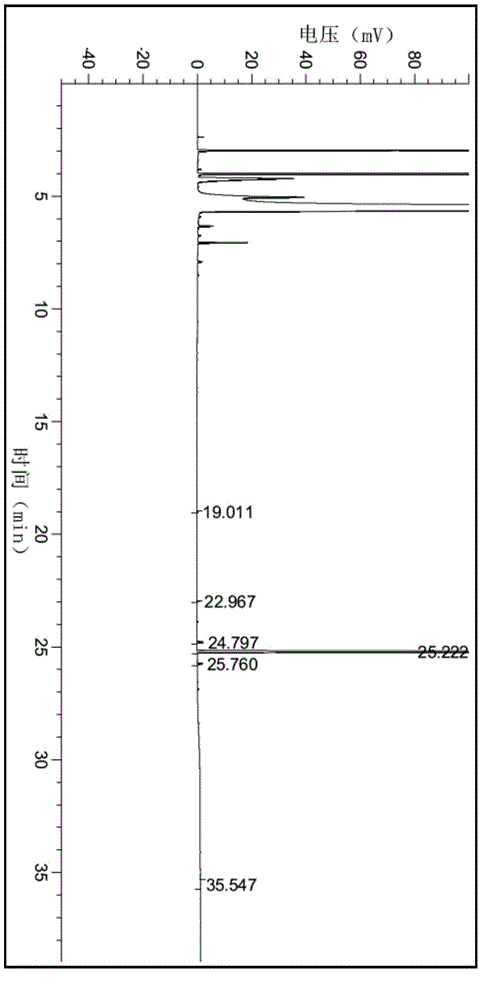
Figure 1 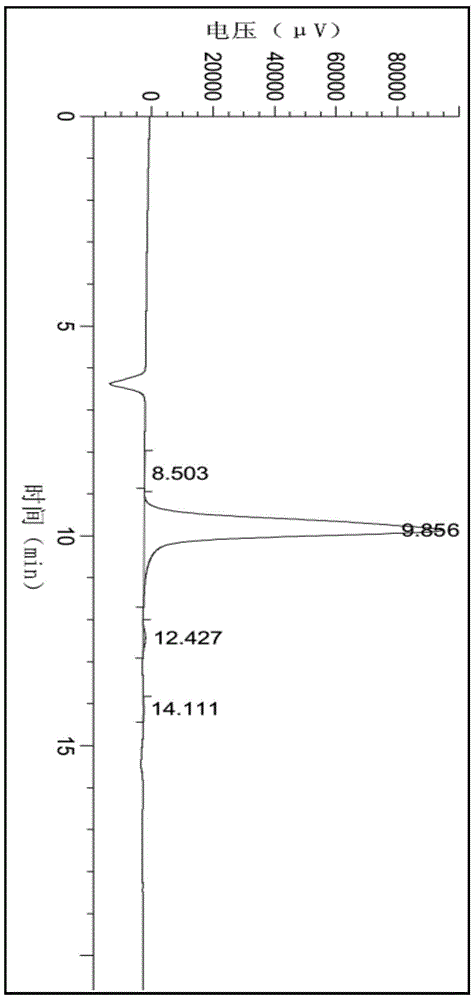
Figure 2 
Figure 3
Abstract
Description
technical field
[0001] The invention belongs to the field of chemical industry and relates to a lactone compound, in particular to a method for preparing 2-C-methyl-D-ribonic acid-1,4-lactone. Background technique
[0002] 2-C-methyl-D-ribonic acid-1,4-lactone is an important pharmaceutical intermediate, which can be used to prepare nucleoside drugs. Nucleoside drugs have broad application fields in antiviral and antitumor aspects, such as anti-hepatitis C virus (abbreviated as HCV) drugs.
[0003]
[0004] Boiling point: 396.13°C, its structural formula is shown in the right formula.
[0005] Currently, there are three known main preparation methods of 2-C-methyl-D-ribono-1,4-lactone, which are:
[0006] The first method (Hong-Se 2, Han-Young K.Tetrahedron, 2010,66:4307-4317) uses D-glucose as the starting material, and under the effect of ethanol, acetic acid and dimethylamine, isomerizes into D-fructose, and then through multi-step operations such as the formation o...
Examples
Embodiment 1
[0027] (1) The materials for the first step reaction are shown in the table below. At room temperature, add D-glucose, dibenzylamine, acetic acid, and ethanol to the one-mouth bottle, and heat to 70°C.
[0028] raw material name Specification MW (g / mol) Feeding amount mol% (eq) D-glucose 99% 180.16 60g 1.0 Dibenzylamine industry. 197.12 75g 1.0 acetic acid CP. -- 18ml -- ethanol industry -- 420ml 7(v / m)
[0029] After reacting for 3 hours, a white solid was formed, followed by TLC until the raw material disappeared, and cooled to room temperature. The precipitated solid was filtered, and the filter cake was washed with 200 ml of absolute ethanol, sucked dry, and dried. 112 g of white solid 1-deoxy-1-(N,N-amino)-D-fructose was obtained, HPLC≥98%, yield 90%.
[0030] (2) The materials for the second step reaction are shown in the table below. At room temperature, add 80g of 1-deoxy-1-(N,N-amino)-D-fructose, calcium o...
Embodiment 2
[0034] (1) The materials for the first step reaction are shown in the table below. At room temperature, add D-glucose, dibenzylamine, acetic acid, and ethanol into the one-mouth bottle, and heat to 75°C.
[0035] raw material name Specification MW (g / mol) Feeding amount mol% (eq) D-glucose 99% 180.16 60g 1.0 Dibenzylamine industry. 197.12 82.5g 1.1 acetic acid CP. -- 18ml -- ethanol industry -- 420ml 7(v / m)
[0036] After reacting for 4 hours, a white solid was formed, followed by thin-layer chromatography until the raw material disappeared, and cooled to room temperature. The precipitated solid was filtered, and the filter cake was washed with 200 ml of absolute ethanol, sucked dry, and dried. 118 g of white solid 1-deoxy-1-(N,N-amino)-D-fructose was obtained, HPLC≥98.3%, yield 91%.
[0037] (2) The materials for the second step reaction are shown in the table below. At room temperature, add 80g of 1-deoxy-1-(N,N-...
Embodiment 3
[0042] (1) The materials for the first step reaction are shown in the table below. At room temperature, add D-glucose, dibenzylamine, acetic acid, and ethanol to the one-mouth bottle, and heat to 80°C.
[0043] raw material name Specification MW (g / mol) Feeding amount mol% (eq) D-glucose 99% 180.16 60g 1.0 Dibenzylamine industry. 197.12 90g 1.2 acetic acid CP. -- 18ml -- ethanol industry -- 420ml 7(v / m)
[0044] After reacting for 5 hours, a white solid was formed, followed by TLC until the raw material disappeared, and cooled to room temperature. The precipitated solid was filtered, and the filter cake was washed with 200 ml of absolute ethanol, sucked dry, and dried. 111 g of white solid 1-deoxy-1-(N,N-amino)-D-fructose was obtained, HPLC≥97.8%, yield 89.5%.
[0045] (2) The materials for the second step reaction are shown in the table below. At room temperature, add 80g of 1-deoxy-1-(N,N-amino)-D-fructose, calci...