
Biodegradable rare-earth fluorescent film taking polyhydroxybutyrate as matrix as well as preparation method and application of biodegradable rare-earth fluorescent film
A polyhydroxybutyrate, biodegradable technology, used in chemical instruments and methods, luminescent materials, plant protection covers, etc., can solve the problems of poor light energy conversion efficiency, non-degradability, and unsustainability, and achieve thermal stability. Good performance, low cost, and solving unsustainable effects
Patent Information
- Authority / Receiving Office
- CN · China
- Patent Type
- Applications(China)
- Current Assignee / Owner
- Publication Date
- 2015-11-11
Smart Images
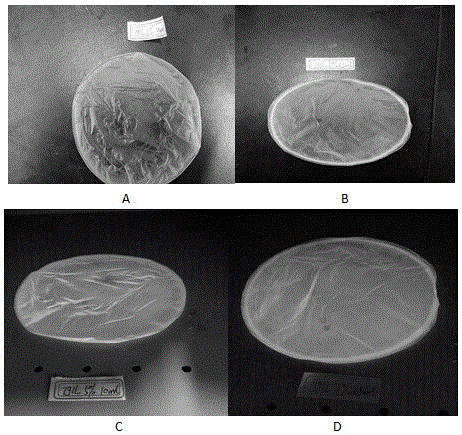
Figure 1 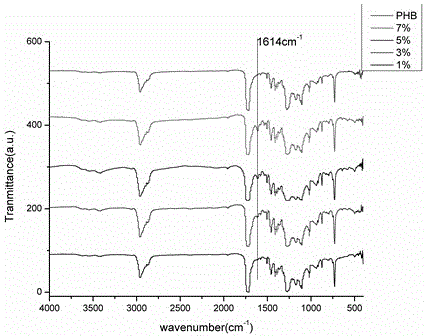
Figure 2 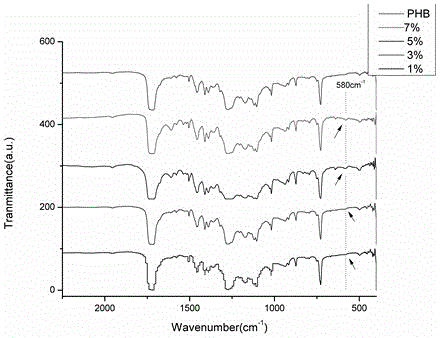
Figure 3
Abstract
Description
Technical field
[0001] The present invention is the field of rare earth element application technology and biodegradable film manufacturing technology. It specifically involves a rare earth fluorescence film and its preparation methods and applications that can be degraded by polycatic acid ester as the matrix. Background technique
[0002] At present, agricultural plastic film materials usually cannot perform biodegradation under natural conditions, so there are problems such as unsustainability, poor optical energy conversion efficiency, and extremely prone to white pollution.As the world pays more and more attention to environmental protection issues, while the rapid development of science and technology, it must not be at the cost of sacrificing the environment.
[0003] The ions of rare earth elements have a unique structure and properties, which gives it a unique luminous mechanism and luminous performance, which also makes it occupy an important position in the field of ...
Examples
example 1
[0033] The following method is used to prepare the biodegradable rare earth fluorescent film with polyhydroxybutyrate as the matrix:
[0034] 1) Accurately weigh 0.0025g Eu(TTA) 2 TPY-OCH 3 Add to the beaker, then measure 3mL of THF into the beaker, stir at room temperature until Eu(TTA) 2 TPY-OCH 3 Completely dissolve, forming Eu(TTA) with a mass fraction of 0.094% 2 TPY-OCH 3 Transparent solution, spare;
[0035] 2) Weigh 0.2496g of PHB into the beaker, then measure 50mL of dichloromethane into the beaker, stir at room temperature until the PHB is completely dissolved and form a PHB solution with a mass fraction of 0.375% for use;
[0036] 3) Pour the above two solutions into the reaction flask and stir at room temperature to obtain a transparent mixed solution;
[0037] 4) Use a dropper to drop the above mixed solution into an evaporating dish, cover the surface with a fresh-keeping film with holes, let the solution evaporate at room temperature for 8 hours, after the solvent is com...
example 2
[0040] The following method is used to prepare the biodegradable rare earth fluorescent film with polyhydroxybutyrate as the matrix:
[0041] 1) Accurately weigh 0.0125g of Eu (TTA) 2 TPY-OCH 3 Add to the beaker, then measure 4mL of THF into the beaker, stir at room temperature until Eu(TTA) 2 TPY-OCH 3 Completely dissolve to form Eu(TTA) with a mass fraction of 0.351% 2 TPY-OCH 3 Transparent solution, spare;
[0042] 2) Weigh 0.2529g of PHB into the beaker, then measure 50mL of dichloromethane and pour into the beaker, stir at room temperature until the PHB is completely dissolved and form a PHB solution with a mass fraction of 0.380%, ready for use;
[0043] 3) Pour the above two solutions into the reaction flask and stir at room temperature to obtain a transparent mixed solution;
[0044] 4) Drop the above mixed solution into an evaporating dish with a dropper, cover the surface with a fresh-keeping film with holes, and let the solution evaporate at room temperature for 18 hours. Af...
example 3
[0047] The following method is used to prepare the biodegradable rare earth fluorescent film with polyhydroxybutyrate as the matrix:
[0048] 1) Accurately weigh 0.0172g of Eu (TTA) 2 TPY-OCH 3 Add to the beaker, then measure 5mL of THF into the beaker, stir at room temperature until Eu(TTA) 2 TPY-OCH 3 Completely dissolved, forming Eu(TTA) with a mass fraction of 0.386% 2 TPY-OCH 3 Transparent solution, spare;
[0049] 2) Weigh 0.2532g of PHB into the beaker, then measure 50mL of dichloromethane and pour into the beaker, stir at room temperature until the PHB is completely dissolved and form a PHB solution with a mass fraction of 0.380%, ready for use;
[0050] 3) Pour the above two solutions into the reaction flask and stir at room temperature to obtain a transparent mixed solution;
[0051] 4) Use a dropper to drop the above mixed solution into an evaporating dish, cover the surface with a fresh-keeping film with holes, and let the solution evaporate at room temperature for 24 hours...