
A light-weight, high-strength, high-toughness single green composite fiber and its preparation method
A composite fiber, high-toughness technology, applied in fiber processing, plant fibers, textiles and papermaking, etc., can solve the problems of few reports of single green composite fibers, complex process, non-degradable, etc., to achieve easy availability of renewable raw materials. , the preparation method is simple, the operation is convenient
Patent Information
- Authority / Receiving Office
- CN · China
- Patent Type
- Patents(China)
- Current Assignee / Owner
- Publication Date
- 2017-10-17
Smart Images

Figure 1 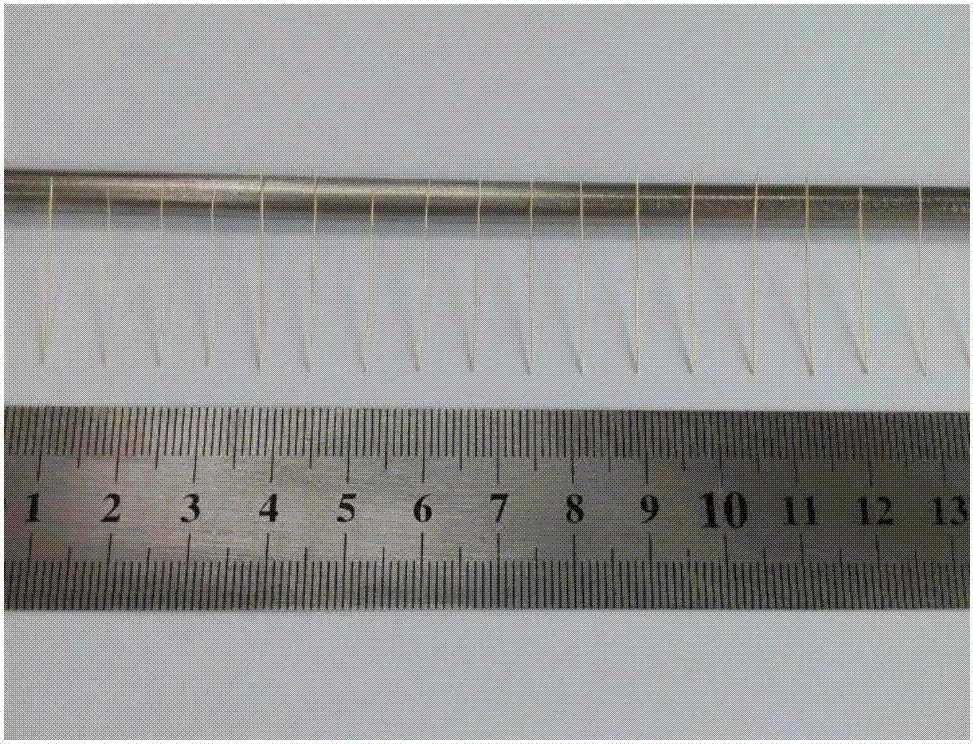
Figure 2 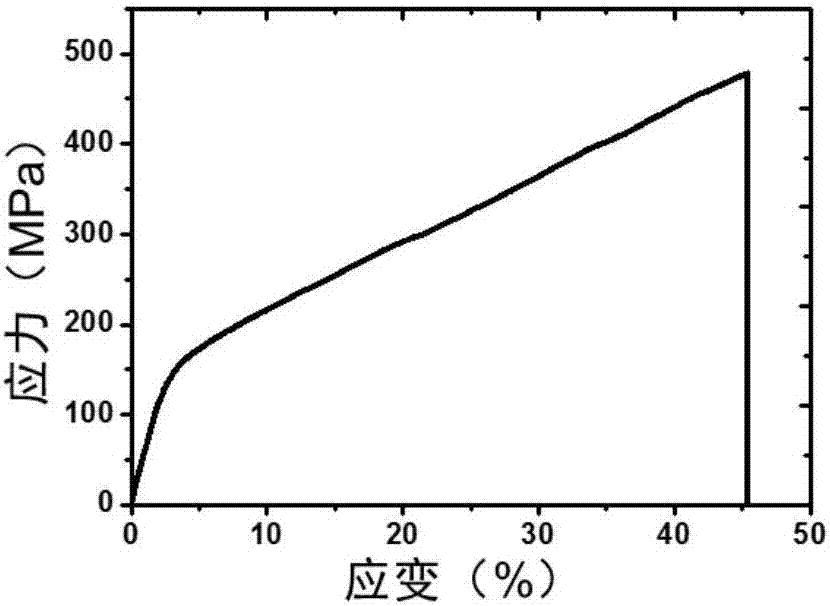
Figure 3
Abstract
Description
technical field
[0001] The invention belongs to a method for preparing a light-weight, high-strength, high-tough single green composite fiber in the field of chemical and biological engineering, and in particular relates to a light-weight, high-strength, high-toughness single green composite fiber and a preparation method thereof. Background technique
[0002] With the aggravation of environmental problems and the scarcity of resources, green and renewable composite materials have attracted more and more attention. Among them, the green single fiber is an important part of the preparation of high-strength composite materials, and its mechanical properties are particularly important for the actual production and application of materials. At present, the commonly used method for preparing high-strength fibers is the wet spinning and twisting method, which is complicated and most of its raw materials are high-cost and non-degradable materials, such as graphene, carbon nanotubes...
Examples
Embodiment 1
[0030] The coir fiber is cleaned and cut to obtain a group of coir fibers with an average diameter of 0.23 mm and a length of 3 cm. combine figure 1 , the coconut shell fiber is placed in NaOH with a mass concentration of 5wt%, soaked for 20h, taken out, washed with ethanol and deionized water, and dried at room temperature to obtain fiber A1 with a porous structure. Then put the fiber into PVA with a mass concentration of 1 wt%, soak for 10 hours, take it out, and dry it at room temperature. Finally, cross-linking treatment with glutaraldehyde can obtain a group of light-weight, high-strength and high-toughness single green composite fibers, such as figure 2 , the prepared composite fibers have uniform morphology. Its mechanical curve is as image 3 As shown, the tensile strength of the fiber is 478MPa, the modulus is 2GPa, and the toughness is 30MJ m -3 .
Embodiment 2
[0032] Clean and cut the loofah fibers to obtain a group of loofah fibers with an average diameter of 0.5-1 mm and a length of 1 cm. Then the loofah fibers are placed in a NaOH solution with a mass concentration of 1wt%, soaked for 80h, taken out, cleaned with ethanol and deionized water, and dried at room temperature to obtain fibers with exposed nanofibril structures and nanoflower cluster structures A1. Next, fiber A1 was put into CS with a mass concentration of 10wt%, immersed for 50 hours, taken out, and dried at room temperature. Finally, genipin is used for cross-linking treatment to obtain a single green composite fiber with light weight, high strength and high toughness. It was found that the tensile strength of the fiber was 60MPa, the modulus was 5.1GPa, and the toughness was 10MJ m -3 .
Embodiment 3
[0034] The lotus leaf stem fibers are cleaned and cut to obtain a group of lotus leaf stem fibers with an average diameter of 0.05 mm and a length of 2 cm to 3 cm. Then the lotus leaf stem fiber is placed in the H that mass concentration is 10wt%. 2 o 2 , soaked for 2 hours, taken out, washed with ethanol and deionized water, and dried at room temperature to obtain fiber A1 with a bare nanofibril structure. Then put H 2 o 2 The treated fibers were placed in PLA with a mass concentration of 15 wt%, soaked for 20 hours, taken out, and dried at room temperature. Finally, it is cross-linked by heating to obtain a single green composite fiber with light weight, high strength and high toughness. The test results show that the tensile strength of the fiber is 560MPa, the modulus is 7.2GPa, and the toughness is 50MJ m -3 .