

6-bromo-4-chloroquinoline preparation method
A technology of chloroquinoline and bromoquinoline, applied in the field of medicinal chemistry, can solve the problems of long process steps, difficult reactions, complicated operations, etc., and achieve the effects of simplifying the reaction process and post-processing process, reducing production costs, and simple operation
Patent Information
- Authority / Receiving Office
- CN · China
- Current Assignee / Owner
- Publication Date
- 2017-02-22
Smart Images
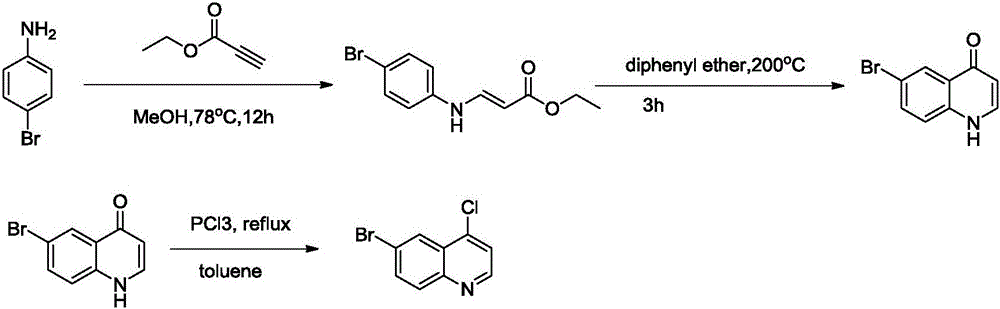
Figure 1 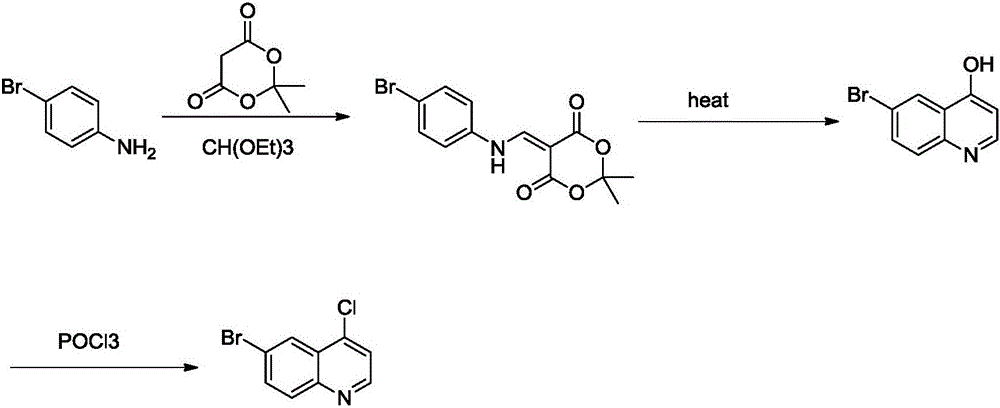
Figure 2 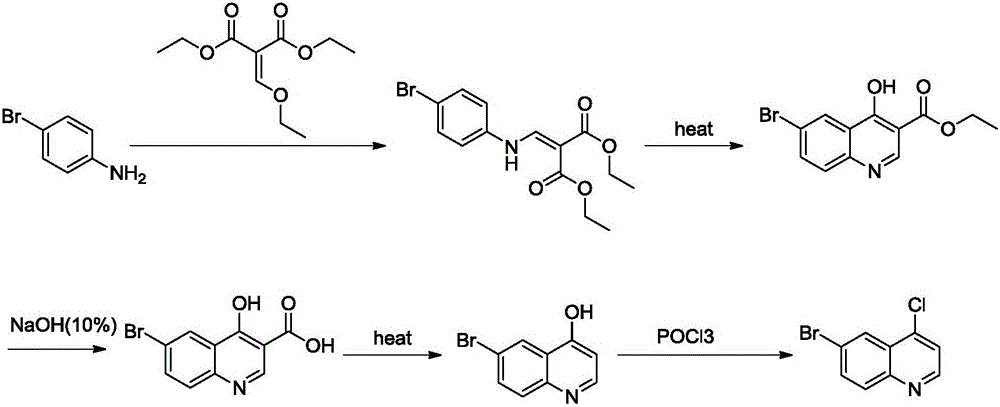
Figure 3
Abstract
Description
technical field
[0001] The invention belongs to the field of medicinal chemistry, in particular to a preparation method of 6-bromo-4-chloroquinoline. Background technique
[0002] Omipalisib (GSK2126458, GSK458) is a highly selective and potent inhibitor of p110α / β / γ / δ and mTORC1 / 2, which is mainly used for the treatment of solid tumors, lymphomas, idiopathic pulmonary fibrosis and Drugs for the treatment of idiopathic pulmonary fibrosis.
[0003] 6-Bromo-4-chloroquinoline English name is 6-Bromo-4-chloroquinoline, molecular formula is C 9 H 5 BrClN, an important intermediate of Omipalisib.
[0004] Since Omipalisib is currently in the clinical research stage, there are few reports on the synthesis of this drug at home and abroad.
[0005] Similarly, as an important intermediate of omipalisib, there are few studies on its synthetic route in the prior art. As described in the subsequent comparative examples 1-2, the existing synthesis process yield of 6-bromo-4-chloroqui...
Examples
Embodiment 1
[0022] The first step: the synthesis of 3-(4-bromoaniline) ethyl acrylate
[0023] 28.51g (290.66mmol) of ethyl propiolate was added to a 1L three-necked flask containing 50g (290.66mol) of 4-bromoaniline and methanol (500ml) under nitrogen protection with stirring, heated to 40°C, and stirred for 48h , TLC detected that after the reaction was completed, the solvent was spin-dried to obtain 3-(4-bromoaniline) ethyl acrylate (78 g, yield 99%) as a crude product which was directly used in the next step.
[0024] The second step: the synthesis of 6-bromoquinolin-4(1H)-one
[0025] Dissolve 78 g of crude 3-(4-bromoaniline) ethyl acrylate in 150 ml of diphenyl ether, and slowly drop it into a 1L three-necked bottle containing diphenyl ether (470 ml) at 200°C. After 2 hours of reaction, the spot of starting material disappeared. The reaction solution was cooled to room temperature, poured into 1500 ml of petroleum ether, left standing overnight and filtered, the filter residue was...
Embodiment 2
[0032] The first step: the synthesis of 3-(4-bromoaniline) ethyl acrylate
[0033] 57.02g (581.32mmol) of ethyl propiolate was added to a 1L three-necked flask containing 50g (290.66mol) of 4-bromoaniline and methanol (500ml) under nitrogen protection with stirring, heated to 30°C, and stirred for 72h , TLC detected that after the reaction was completed, the solvent was spin-dried to obtain 3-(4-bromoaniline) ethyl acrylate (80 g, yield 100%) as a crude product which was directly used in the next step.
[0034] The second step: the synthesis of 6-bromoquinolin-4(1H)-one
[0035] Dissolve 80 g of crude 3-(4-bromoaniline) ethyl acrylate in 150 ml of diphenyl ether, and slowly drop it into a 1L three-necked bottle containing diphenyl ether (400 ml) at 220°C. After 10 hours of reaction, the starting point of the spot plate disappeared. The reaction solution was cooled to room temperature, poured into 1500 ml of petroleum ether, left standing overnight and filtered, the filter re...
Embodiment 3
[0041] The first step: the synthesis of 3-(4-bromoaniline) ethyl acrylate
[0042] 42.76g (435.99mmol) of ethyl propiolate was added to a 1L three-necked flask containing 50g (290.66mol) of 4-bromoaniline and methanol (500ml) under nitrogen protection with stirring, heated to 50°C, and stirred for 32h. , TLC detected that after the reaction was completed, the solvent was spin-dried to obtain 3-(4-bromoaniline) ethyl acrylate (80 g, yield 100%) as a crude product which was directly used in the next step.
[0043] The second step: the synthesis of 6-bromoquinolin-4(1H)-one
[0044] Dissolve 80 g of crude 3-(4-bromoaniline) ethyl acrylate in 150 ml of diphenyl ether, and slowly drop it into a 1L three-necked bottle containing diphenyl ether (250 ml) at 220°C. After 2 hours of reaction, the spot of starting material disappeared. The reaction solution was cooled to room temperature, poured into 1500 ml of petroleum ether, left to stand overnight, and filtered. The filter residue ...