
Photosensitizer and photoelectric conversion element
A technology for photoelectric conversion elements and photosensitizers, applied in the fields of photosensitizers and photoelectric conversion elements, can solve problems such as conversion efficiency and durability that have not yet reached a practical level, and achieve improved photoelectric conversion efficiency, durability, and high molar absorption coefficient. Effect
Patent Information
- Authority / Receiving Office
- CN · China
- Patent Type
- Applications(China)
- Current Assignee / Owner
- Publication Date
- 2017-02-22
Smart Images
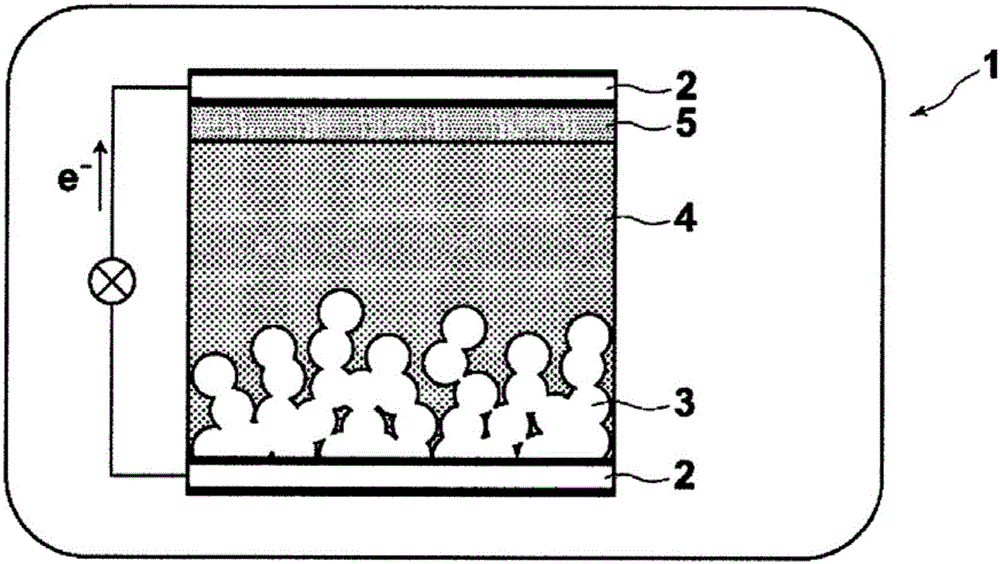
Figure 1 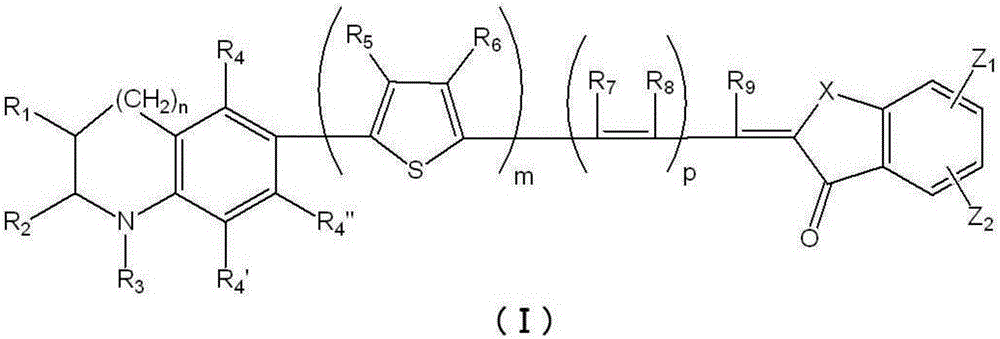
Figure 2 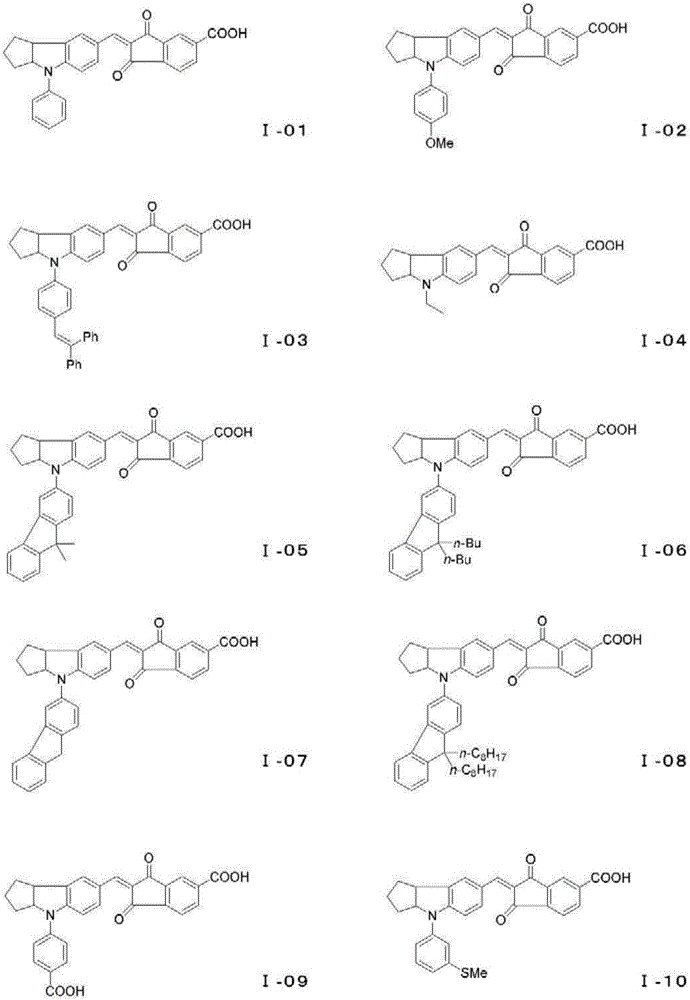
Figure 3
Abstract
Description
technical field
[0001] The present invention relates to a photosensitizer and a photoelectric conversion element using the photosensitizer. Background technique
[0002] Among organic solar cells attracting attention as next-generation solar cells in recent years, there are broadly divided into organic thin-film type and dye-sensitized type. Organic thin-film solar cells combine organic materials to make p-n junctions and utilize them. The working mechanism is exactly the same as that of inorganic solar cells represented by silicon. In contrast, dye-sensitized solar cells (Dye Sensitized Solar Cells, DSCs) are characterized by the use of modified electrodes that combine organic dyes as photosensitizers with inorganic semiconductors such as titanium oxide and zinc oxide. , In addition, the working mechanism of dye-sensitized solar cells is completely different from that of inorganic solar cells, rather close to photosynthesis. This solar cell, which should be called an inor...
Examples
Embodiment 1
[0163]
[0164] Aldehyde (B-01) (0.88 g) and intermediate (C-01) (0.50 g) were dissolved in acetic acid (10 mL), and heated and stirred at 100° C. for 4 hours. The reaction mixture was cooled to room temperature and solidified. The crude crystals were separated by filtration, and were separated by column chromatography (silica gel, developer: CHCl 3 / MeOH=100 / 1) was separated and purified, whereby 0.85 g of a pigment (I-03) was obtained as a brown solid (69% yield). λmax=545nm (CHCl 3 ).
[0165] The structure of the obtained pigment (I-03) was identified by NMR analysis.
[0166] 1 H NMR (400MHz, DMSO-d 6 )
[0167] δ (ppm) = 13.65 (1H, br.s), 8.67 (1H, br.s), 8.33 (1H, dd, J = 8.0, 7.6Hz), 8.24 (1H, d, J = 11.6Hz), 8.20 (1H,br.s),7.94(1H,dd,J=7.6,7.6Hz),7.65(1H,s),7.41-7.49(3H,m),7.30-7.38(5H,m),7.19-7.23 (4H,m),7.11(1H,s),7.07(2H,d,J=8.4Hz),6.87(1H,d,J=8.8Hz),5.07-5.11(1H,m),3.82-3.87( 1H,m),2.03-2.12(1H,m),1.69-1.83(2H,m),1.59-1.67(2H,m),1.27-1.38(1H,m)
Embodiment 2
[0168]
[0169] Using the same method as in Example 1, and using an aldehyde intermediate (B-02), a pigment (I-05) was obtained as a black solid. λmax=541nm (CHCl 3 ).
[0170] The structure of the obtained pigment (I-05) was identified by NMR analysis.
[0171] 1 H NMR (400MHz, DMSO-d 6 )
[0172] δ(ppm)=13.63(1H,br.s),8.72(1H,br.s),8.35(1H,d,J=8.0Hz),8.28(1H,br.s),8.25(1H,d, J=11.6Hz),7.95(1H,dd,J=8.0,7.6Hz),7.90(1H,d,J=8.4Hz),7.83(1H,d,J=7.2Hz),7.69(1H,s) ,7.67(1H,d,J=1.6Hz),7.56(1H,d,J=7.2Hz),7.41(1H,dd,J=8.0,1.2Hz),7.36(1H,dd,J=8.0,7.2 Hz), 7.32(1H,dd,J=8.4,7.2Hz),6.87(1H,d,J=8.4Hz),5.24-5.27(1H,m),3.90-3.94(1H,m),2.08-2.18 (1H,m),1.74-1.88(3H,m),1.64-1.73(1H,m),1.50(3H,s),1.47(3H,s),1.37-1.53(1H,m)
Embodiment 3
[0173]
[0174] Using the same method as in Example 1, and using an aldehyde intermediate (B-03), a pigment (I-06) was obtained as a black solid. λmax=546nm (CHCl 3 ).
[0175] The structure of the obtained pigment (I-06) was identified by NMR analysis.
[0176] 1 H NMR (400MHz, DMSO-d 6 )
[0177] δ (ppm) = 13.07 (1H, br.s), 8.17 (1H, br.s), 7.81 (1H, dd, J = 7.6, 7.2Hz), 7.73 (2H, d, J = 9.6Hz), 7.41 (1H,d,J=8.0Hz),7.34(1H,d,J=8.4Hz),7.27(1H,d,J=7.2Hz),7.14(1H,s),6.99(1H,s),6.92 (1H,d,J=6.8Hz),6.88(1H,d,J=8.0Hz),6.83(1H,dd,J=7.2,6.0Hz),6.80(1H,dd,J=7.2,6.4Hz) ,6.30(1H,d,J=8.4Hz),4.72-4.75(1H,m),3.36-3.40(1H,m),1.57-1.65(1H,m),1.43-1.56(4H,m),1.28 -1.35(1H,m),1.11-1.26(3H,m),0.84-0.95(1H,m),0.45-0.59(4H,m),0.16(3H,t,J=7.2Hz),0.10(3H ,t,J=7.2Hz),0.02-0.04(4H,m)