
Use of pteridinone derivatives as flt3 inhibitors
A kind of use and drug technology, applied in the field of treatment of FLT3-mediated diseases, can solve the problems of no practical application value and unsatisfactory clinical effect
Patent Information
- Authority / Receiving Office
- CN · China
- Patent Type
- Patents(China)
- Current Assignee / Owner
- Publication Date
- 2021-03-16
Smart Images
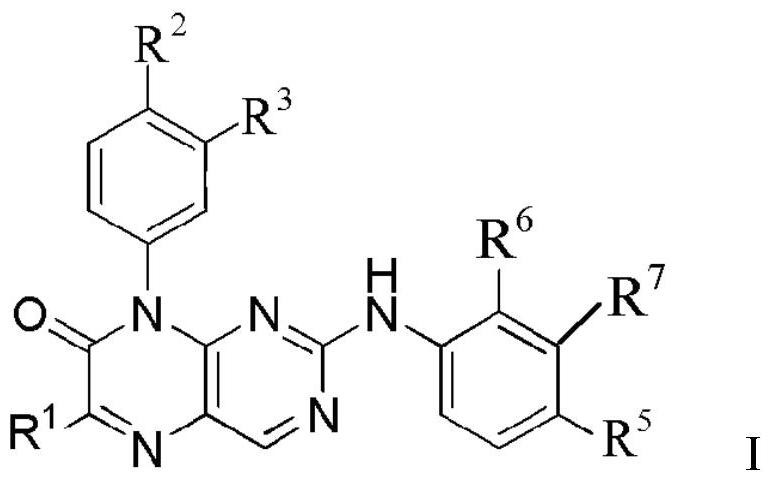
Figure 1 
Figure 2 
Figure 3
Abstract
Description
technical field
[0001] The present invention relates to the field of medicinal chemistry; Specifically, the present invention relates to novel pteridinone derivatives, its synthesis method and its role as FMS-like tyrosine kinase 3 (FMS-like tyrosine kinase 3, FLT3) inhibitor in the treatment of FLT3 mediated diseases such as tumor applications. Background technique
[0002] Protein tyrosine kinase (protein tyrosine kinase) is a class of proteins that catalyze the transfer of γ-phosphate on ATP to specific amino acid residues in proteins. It plays a very important role in intracellular signal transduction pathways and regulates cell growth, A series of physiological processes such as differentiation and death. It has been shown that more than 50% of proto-oncogenes and their products have protein tyrosine kinase activity, and their abnormal expression will lead to the disorder of cell life cycle, and then lead to the occurrence of tumors. In addition, abnormal expression o...
Examples
Embodiment 1
[0113] The concrete synthetic method of above-mentioned steps a-f is as follows:
[0114] Synthesis of tert-butyl (4-(2-chloro-5-nitropyrimidine-4-amino)phenyl)carbamate (step a)
[0115]
[0116] Weigh 2,4-dichloro-5-nitropyrimidine (190mg, 0.98mmol), add 6mL 1,4-dioxane, place in a 25mL round bottom flask, stir at room temperature, take (4-aminobenzene Base) tert-butyl carbamate (200mg, 0.96mmol), N,N-diisopropylethylamine (137mg, 1.06mmol) were dissolved in 4mL 1,4-dioxane, and slowly added dropwise to the above reaction solution After the dropwise addition, the mixture was stirred at room temperature for about 1 hour, and the reaction was completely converted as monitored by TLC. The solvent was removed by rotary evaporation, and the crude product was separated by silica gel column chromatography (petroleum ether / ethyl acetate=10:1, v / v) to obtain (4-(2-chloro-5-nitropyrimidine-4-amino)phenyl ) tert-butyl carbamate orange solid 301 mg, yield 82%. 1 H NMR (400MHz, DMS...
Embodiment 2
[0179] Biological Activity Test Section
[0180] The in vitro inhibitory effect experiment of the compounds provided by the invention on FLT3 kinase activity was carried out as follows, wherein FLT3 was purchased from BPS, MLN518 and AC220 were used as reference compounds, and the reference compounds were purchased from Selleck. The two structures were as follows:
[0181]