
Preparation methods of neodymium and nickel co-doped bismuth ferrite photocatalyst and composite catalyst thereof
A technology of photocatalyst and bismuth ferrite, which is applied in the field of photocatalysis, can solve the problems of difficult recycling, weak magnetism, and insufficient catalytic activity, and achieve the effects of easy recycling, good magnetism, and optimized hydrothermal process
Patent Information
- Authority / Receiving Office
- CN · China
- Patent Type
- Applications(China)
- Current Assignee / Owner
- Publication Date
- 2018-02-02
- Estimated Expiration
- Not applicable · inactive patent
Smart Images
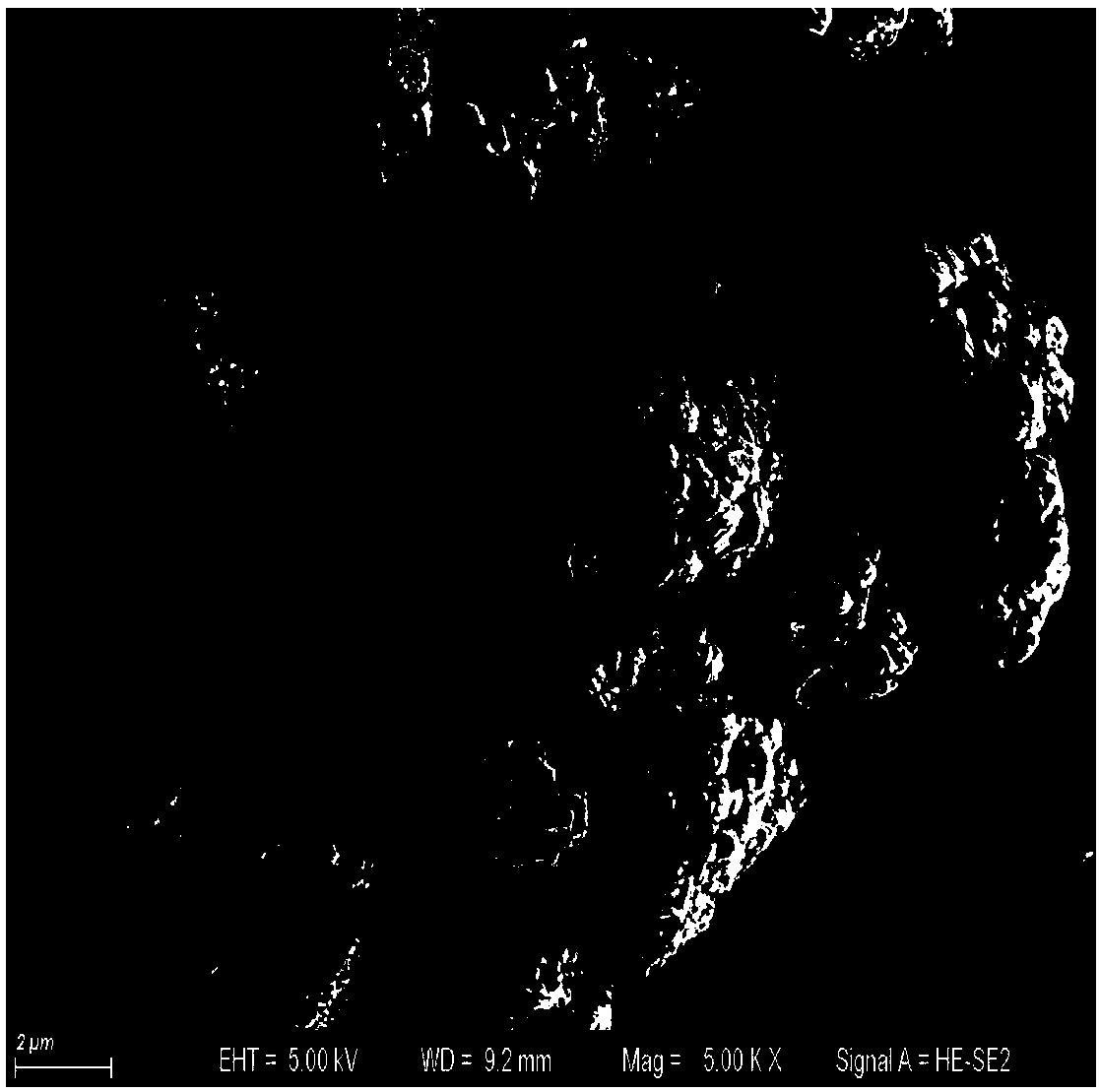
Figure 1 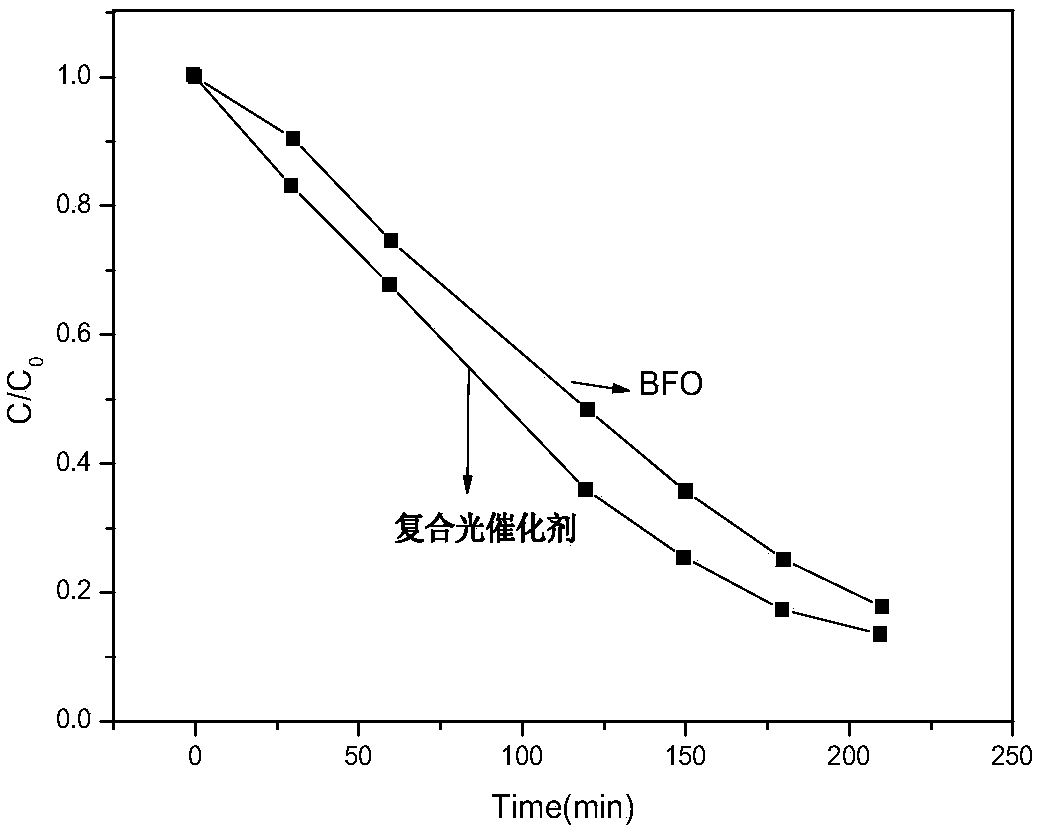
Figure 2
Abstract
Description
technical field
[0001] The invention belongs to the field of photocatalysis, and relates to a catalyst, in particular to a neodymium and nickel co-doped bismuth ferrite photocatalyst and a method for preparing the composite catalyst. Background technique
[0002] Bismuth ferrite (BiFeO 3 ) has a perovskite structure with a narrow bandgap of about 2.18eV. Studies have shown that BiFeO 3 It has a good application prospect in the field of photocatalysis. It is almost the only multiferroic material that exists stably at room temperature, and it is one of the few photocatalysts that can be used repeatedly. BiFeO 3 Can respond to traditional photocatalyst TiO 2 Unresponsive to infrared light. Ion doping improves BiFeO 3 Photocatalytic, speed up the catalytic speed, doping with nickel can enhance its magnetic properties and facilitate its repeated use, doping with neodymium can increase its catalytic activity through the synergistic effect with nickel ions, and enhance the re...
Examples
Embodiment 1
[0032] (1) Prepare a KOH solution with a molar concentration of 7mol / L;
[0033] (2) Measure the KOH solution, then weigh the Bi(NO 3 ) 3 ·5H 2 O, Fe(NO 3 ) 3 9H 2 O, Nd(NO 3 ) 3 ·6H 2 O and Ni(NO 3 ) 2 ·6H 2 O, dissolve them in the above-mentioned KOH solution, stir for 1 h after ultrasonication for 10 min to obtain a uniform suspension;
[0034] (3) Control the temperature of the suspension obtained in step (2) to 190° C. for hydrothermal reaction for 10 h, and then naturally cool to room temperature to obtain a reaction solution;
[0035] (4) Ultrasonic wash the reaction solution obtained in step (3) with deionized water, let it stand until the upper and lower layers are clearly separated, pour off the supernatant, and dry the resulting precipitate at a temperature of 60°C to obtain neodymium and nickel co-doped Bismuth ferrite photocatalyst.
[0036] The XRD diffractometer of model D / MAX 2200PC produced by Hitachi, Japan was used for characterization, and the ...
Embodiment 2
[0038] The difference between this example and Example 1 is that the KOH concentration is 10mol / L, the hydrothermal conditions are reaction temperature 200°C, reaction time 12h, Fe(NO 3 ) 3 9H 2 O: Ni(NO 3 ) 3 ·5H 2 O=0.99:0.01.
[0039] (1) Prepare a KOH solution with a molar concentration of 10mol / L;
[0040] (2) Measure the KOH solution, then weigh the Bi(NO 3 ) 3 ·5H 2 O, Fe(NO 3 ) 3 9H 2 O, Nd(NO 3 ) 3 ·6H 2 O and Ni(NO 3 ) 2 ·6H 2 O, dissolve them in the above-mentioned KOH solution, stir for 1 h after ultrasonication for 10 min to obtain a uniform suspension;
[0041] (3) Control the temperature of the suspension obtained in step (2) to 200° C. for hydrothermal reaction for 12 hours, and then naturally cool to room temperature to obtain a reaction solution;
[0042] (4) Ultrasonic wash the reaction solution obtained in step (3) with deionized water, let it stand until the upper and lower layers are clearly separated, pour off the supernatant, and dry t...
Embodiment 3
[0045] The difference between this example and Example 1 is that the raw materials are weighed at a molar ratio of Bi:Nd:Fe:Ni=0.95:0.05:0.925:0.075.
[0046] (1) Prepare a KOH solution with a molar concentration of 7mol / L;
[0047] (2) Measure the KOH solution, then weigh the Bi(NO 3 ) 3 ·5H 2 O, Fe(NO 3 ) 3 9H 2 O, Nd(NO 3 ) 3 ·6H 2 O and Ni(NO 3 ) 2 ·6H 2 O, dissolve them in the above-mentioned KOH solution, stir for 1 h after ultrasonication for 10 min to obtain a uniform suspension;
[0048] (3) Control the temperature of the suspension obtained in step (2) to 190° C. for hydrothermal reaction for 10 h, and then naturally cool to room temperature to obtain a reaction solution;
[0049] (4) Ultrasonic wash the reaction solution obtained in step (3) with deionized water, let it stand until the upper and lower layers are clearly separated, pour off the supernatant, and dry the resulting precipitate at a temperature of 60°C to obtain neodymium and nickel co-doped ...