
PM2.5 monitoring method and device based on cubesat satellite
A PM2.5 and satellite technology, applied in the field of PM2.5 monitoring, can solve the problems of inability to observe PM2.5 in all directions, and achieve the effect of accurate concentration and distribution
Patent Information
- Authority / Receiving Office
- CN · China
- Current Assignee / Owner
- Publication Date
- 2019-11-08
Smart Images
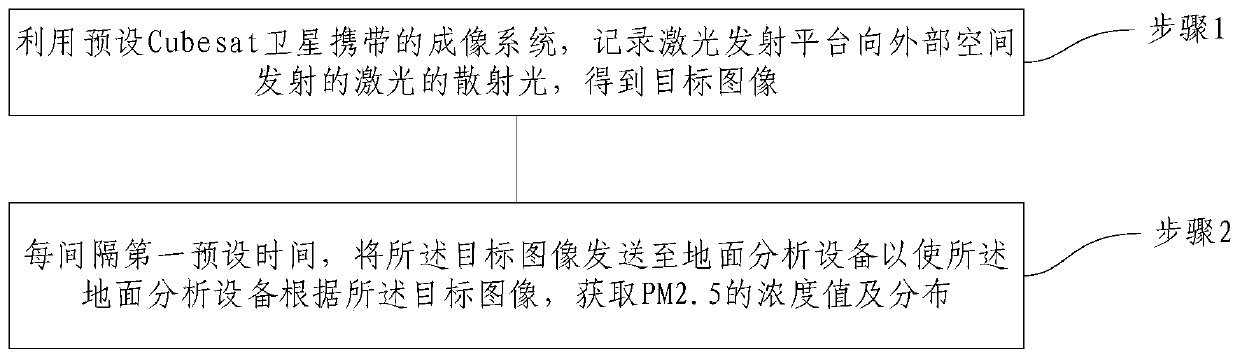
Figure 1 
Figure 2 
Figure 3
Abstract
Description
Technical field
[0001] The present invention relates to the technical field of satellite design, and more specifically, to a method and device for monitoring PM2.5 based on Cubesat satellites. Background technique
[0002] PM2.5 refers to particulate matter with an aerodynamic equivalent diameter of 2.5 microns or less in ambient air. It has small particle size, large area, strong activity, easy to carry toxic and harmful substances (for example, heavy metals, microorganisms, etc.), and has a long residence time in the atmosphere and long transportation distance, which has a great impact on human health and atmospheric environmental quality. . Therefore, monitoring the concentration of PM2.5 is of great significance for air quality monitoring and the formulation of air quality improvement measures.
[0003] In the prior art, methods for monitoring the concentration of PM2.5 mainly include: ground monitoring station monitoring method, satellite remote sensing monitoring method, an...
Examples
Embodiment Construction
[0024] The specific embodiments of the present invention will be described in further detail below in conjunction with the drawings and embodiments. The following examples are used to illustrate the present invention, but not to limit the scope of the present invention.
[0025] Such as figure 1 As shown, according to one aspect of the present invention, a PM2.5 monitoring method based on Cubesat satellites is provided. The method includes: Step 1, using a preset imaging system carried by the Cubesat satellites to record the laser launch platform launching to the outer space The scattered light of the laser is used to obtain the target image; step 2, every first preset time interval, the target image is sent to the ground analysis device so that the ground analysis device obtains the PM2.5 concentration value according to the target image And distribution.
[0026] In this embodiment, a laser transmitter, such as a space-based laser transmitter, is provided on the laser emitting p...