
A method and device for automatically generating structured requirement use cases
An automatically generated and structured technology, applied in the computer field, that can solve problems such as unspecified completion requirements, loss of user or company interests, and lack of system performance management.
Patent Information
- Authority / Receiving Office
- CN · China
- Patent Type
- Patents(China)
- Current Assignee / Owner
- Publication Date
- 2021-06-15
Smart Images
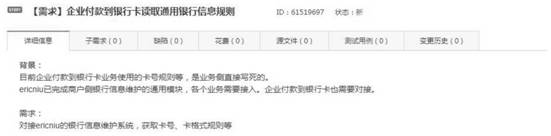
Figure 1 
Figure 2 
Figure 3
Abstract
Description
technical field
[0001] The invention relates to the field of computers, in particular to a method and device for automatically generating structured demand use cases. Background technique
[0002] The requirements involved in Internet research and development are various, and are usually presented in the form of requirements records. like figure 1 As shown, the requirements record usually takes documents as the carrier, and mainly involves the background of the requirements, the flow chart of the requirements, and the UI interaction process. This requirement record is difficult to use for automated analysis, and also has the following disadvantages:
[0003] (1) It does not specify which systems are needed to assist in completing the function of the requirement;
[0004] (2) It is impossible to verify whose interests are considered in the process of realizing the requirement;
[0005] (3) In many cases, it is a schematic or a process, which cannot clearly express the bus...
Examples
Embodiment Construction
[0033] In order to enable those skilled in the art to better understand the solutions of the present invention, the following will clearly and completely describe the technical solutions in the embodiments of the present invention in conjunction with the drawings in the embodiments of the present invention. Obviously, the described embodiments are only It is an embodiment of a part of the present invention, but not all embodiments. Based on the embodiments of the present invention, all other embodiments obtained by persons of ordinary skill in the art without making creative efforts shall fall within the protection scope of the present invention.
[0034] It should be noted that the terms "first" and "second" in the description and claims of the present invention and the above drawings are used to distinguish similar objects, but not necessarily used to describe a specific sequence or sequence. It is to be understood that the data so used are interchangeable under appropriate ...