
Method and system for product remaining life prediction based on q-type Weibull distribution
A Weibull distribution, life prediction technology, applied in prediction, data processing applications, instruments, etc., can solve problems such as inconvenient engineering practice, complex calculation process, and huge amount of calculation.
Patent Information
- Authority / Receiving Office
- CN · China
- Patent Type
- Patents(China)
- Current Assignee / Owner
- Publication Date
- 2020-07-07
Smart Images
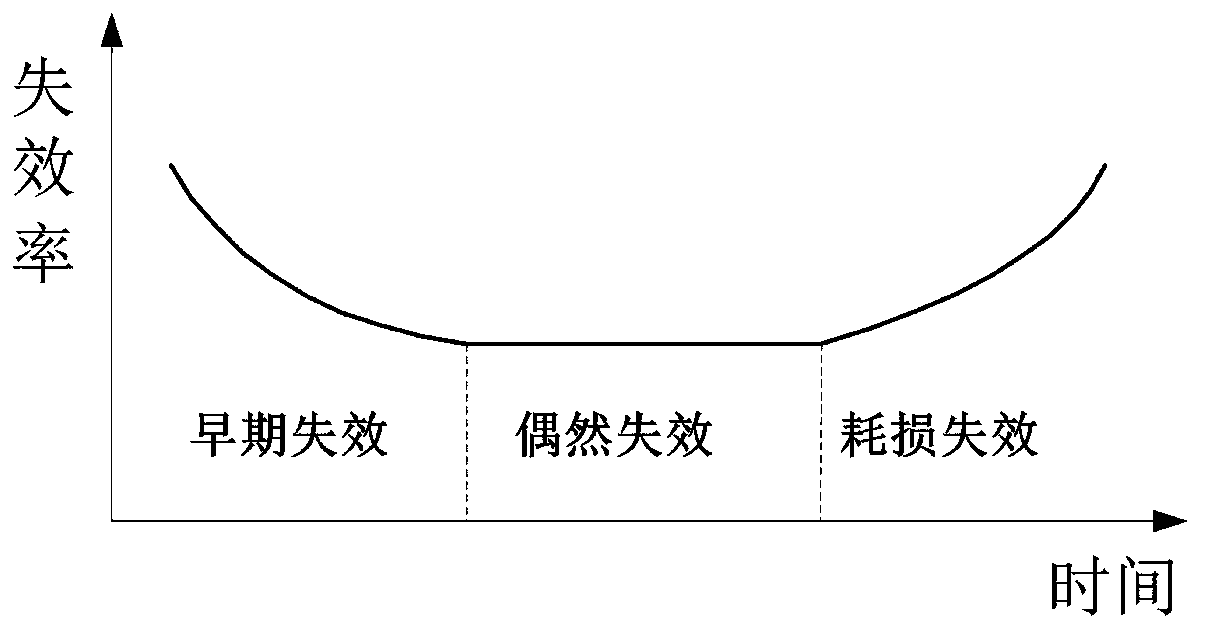
Figure 1 
Figure 2 
Figure 3
Abstract
Description
Technical field
[0001] The invention relates to the field of reliability evaluation, and in particular to a method and system for predicting product remaining life based on q-type Weibull distribution and contour error function. Background technique
[0002] In the field of reliability evaluation, it often involves the evaluation of product reliability. The remaining life is one of the common reliability indicators, which represents the remaining normal working time of the product after the current moment. The key to predict the remaining life of the product is to use the sample data of the product life test to estimate the parameters in the distribution that the product life obeys, and then combine the life distribution of the product to predict the remaining life.
[0003] Existing research shows that such as figure 1 As shown, the failure law of the product in the full life cycle satisfies the "bathtub curve", which is composed of three curves, representing the early failure, ac...
Examples
Embodiment Construction
[0062] In order to make the objectives, technical solutions, and advantages of the present invention clearer, the present invention will be further described in detail below in conjunction with specific embodiments and the accompanying drawings. It should be noted that, in the drawings or description of the specification, the undescribed content and part of the English abbreviated content are well-known to those of ordinary skill in the art. Some specific parameters given in this embodiment are only for demonstration, and the values can be changed to appropriate values in different real-time modes.
[0063] This example uses the existing literature [Reference: Xu M, Droguett E, Lins I. On the q-weibull distribution for reliability applications: an adaptive hybrid artificial beecolony algorithm for parameter estimation. Reliability Engineering and SystemSafety, 2017,158:93–105 ], the calculation example is the 36 failure time data of 500 MW generator, the specific data are 0.0...