
optical lens
An optical lens and lens technology, applied in the field of optics, can solve problems such as inability to satisfy resolution performance, small focusing range, and short focal length at the same time, and achieve telephoto large field of view, high resolution capability, and large telephoto The effect of large field of view
Patent Information
- Authority / Receiving Office
- CN · China
- Patent Type
- Patents(China)
- Current Assignee / Owner
- Publication Date
- 2021-12-17
Smart Images
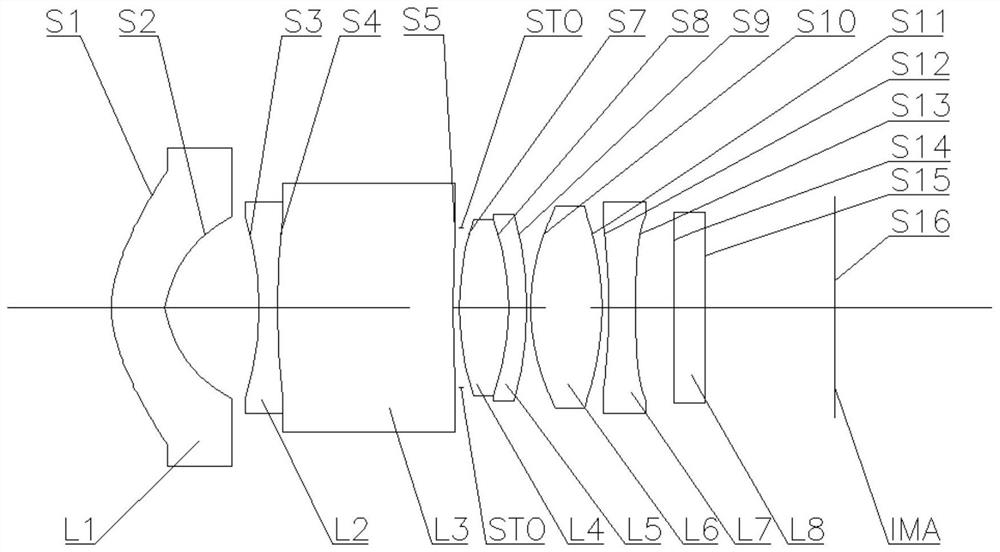
Figure 1 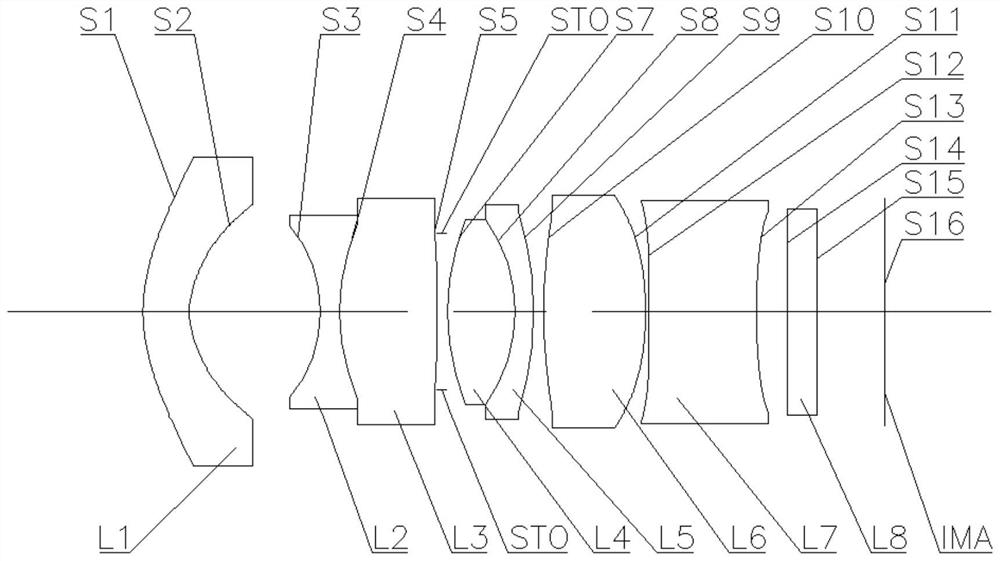
Figure 2 
Figure 3
Abstract
Description
technical field
[0001] The present application relates to the field of optics, in particular to an optical lens, and more specifically to an optical lens including seven lenses. Background technique
[0002] In recent years, with the development of active safety in the automotive industry, the requirements for vehicle front-view cameras have been continuously increasing.
[0003] Large field of view, miniaturization, and high pixels are already necessary conditions for this type of lens. At the same time, the requirements for the recognition of environmental objects are getting higher and higher, specifically, the optical system is required to have a larger angular resolution. The angular resolution of the lens reflects the strength of the optical system's ability to distinguish the smallest distance between two adjacent objects.
[0004] However, due to the large field of view, the focus range (DOF) of such optical lenses is generally small, and the focal length is genera...
Examples
Embodiment 1
[0064] Refer to the following figure 1 An optical lens according to Embodiment 1 of the present application is described. figure 1 A schematic structural diagram of the optical lens according to Embodiment 1 of the present application is shown.
[0065] Such as figure 1 As shown, the optical lens sequentially includes a first lens L1, a second lens L2, a third lens L3, a fourth lens L4, a fifth lens L5, a sixth lens L6 and a seventh lens along the optical axis from the object side to the imaging side. Lens L7.
[0066] The first lens L1 is a meniscus lens with a negative refractive power and a convex surface facing the object side, the object side S1 is convex, and the image side S2 is concave. The second lens L2 is a biconcave lens with negative refractive power, and its object side S3 and image side S4 are both concave. The third lens L3 is a meniscus lens with positive refractive power, the object side S4 is convex, and the image side S5 is concave. The fourth lens L4 ...
Embodiment 2
[0084] Refer to the following figure 2 An optical lens according to Embodiment 2 of the present application is described. figure 2 A schematic structural view of the optical lens according to Embodiment 2 of the present application is shown.
[0085] Such as figure 2 As shown, the optical lens sequentially includes a first lens L1, a second lens L2, a third lens L3, a fourth lens L4, a fifth lens L5, a sixth lens L6 and a seventh lens from the object side to the imaging side along the optical axis. Lens L7.
[0086] The first lens L1 is a meniscus lens with a negative refractive power and a convex surface facing the object side, the object side S1 is convex, and the image side S2 is concave. The second lens L2 is a biconcave lens with negative refractive power, and its object side S3 and image side S4 are both concave. The third lens L3 is a biconvex lens with positive refractive power, and its object side S4 and image side S5 are both convex. The fourth lens L4 is a b...