
Black box depth model adversarial sample generation method
A deep model and adversarial sample technology, applied in neural learning methods, biological neural network models, character and pattern recognition, etc., can solve problems such as high overhead and achieve the effect of reducing the number of queries
Patent Information
- Authority / Receiving Office
- CN · China
- Patent Type
- Applications(China)
- Current Assignee / Owner
- Publication Date
- 2020-08-07
Smart Images
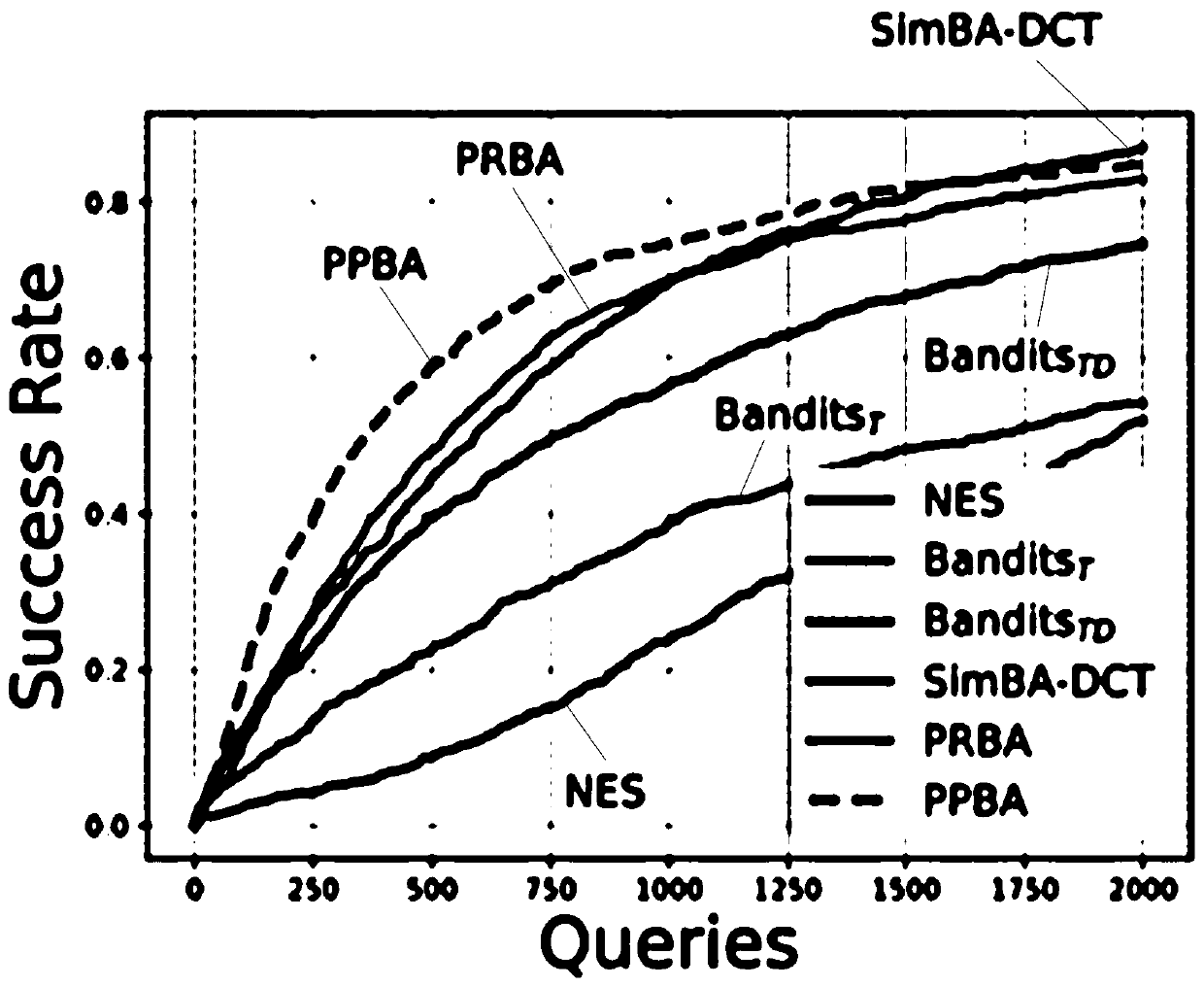
Figure 1 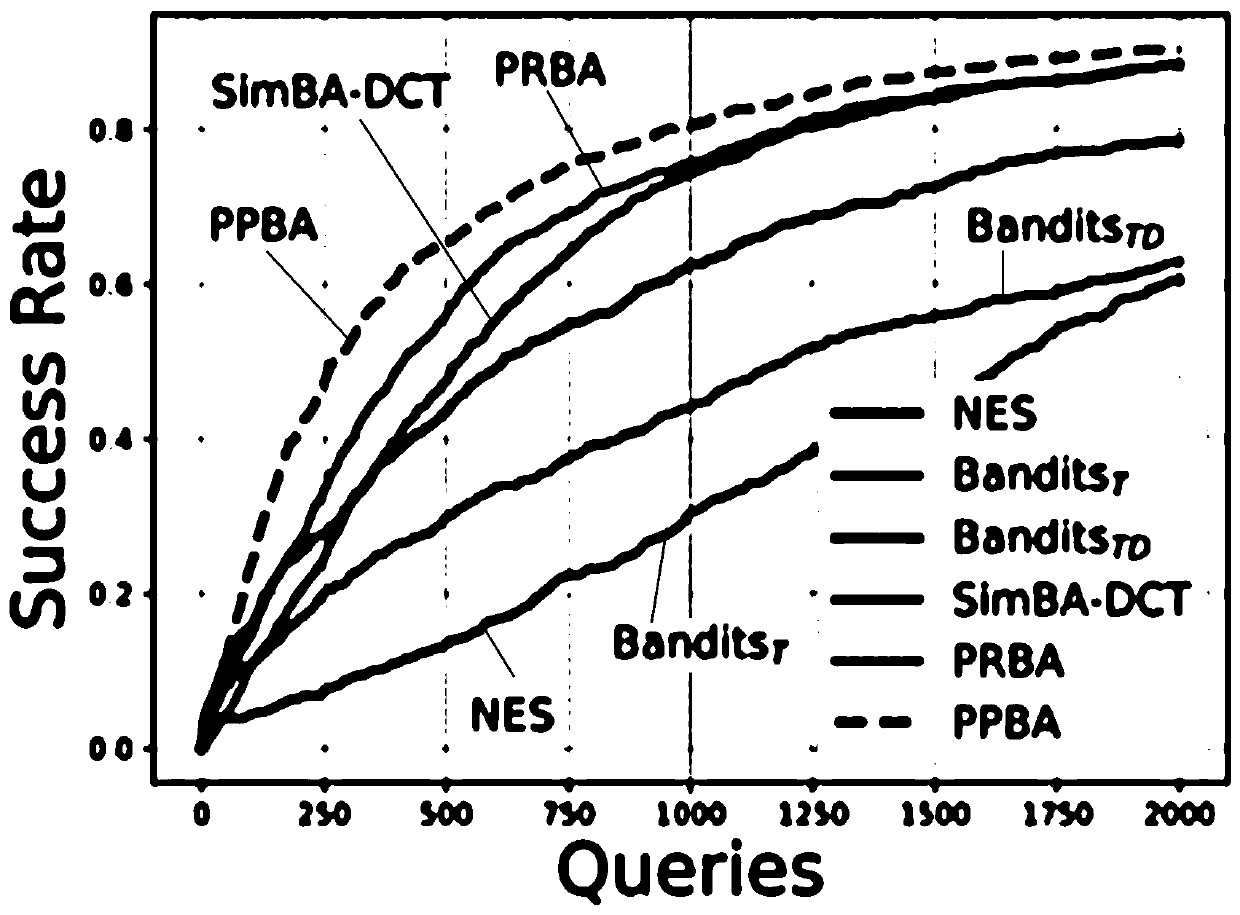
Figure 2 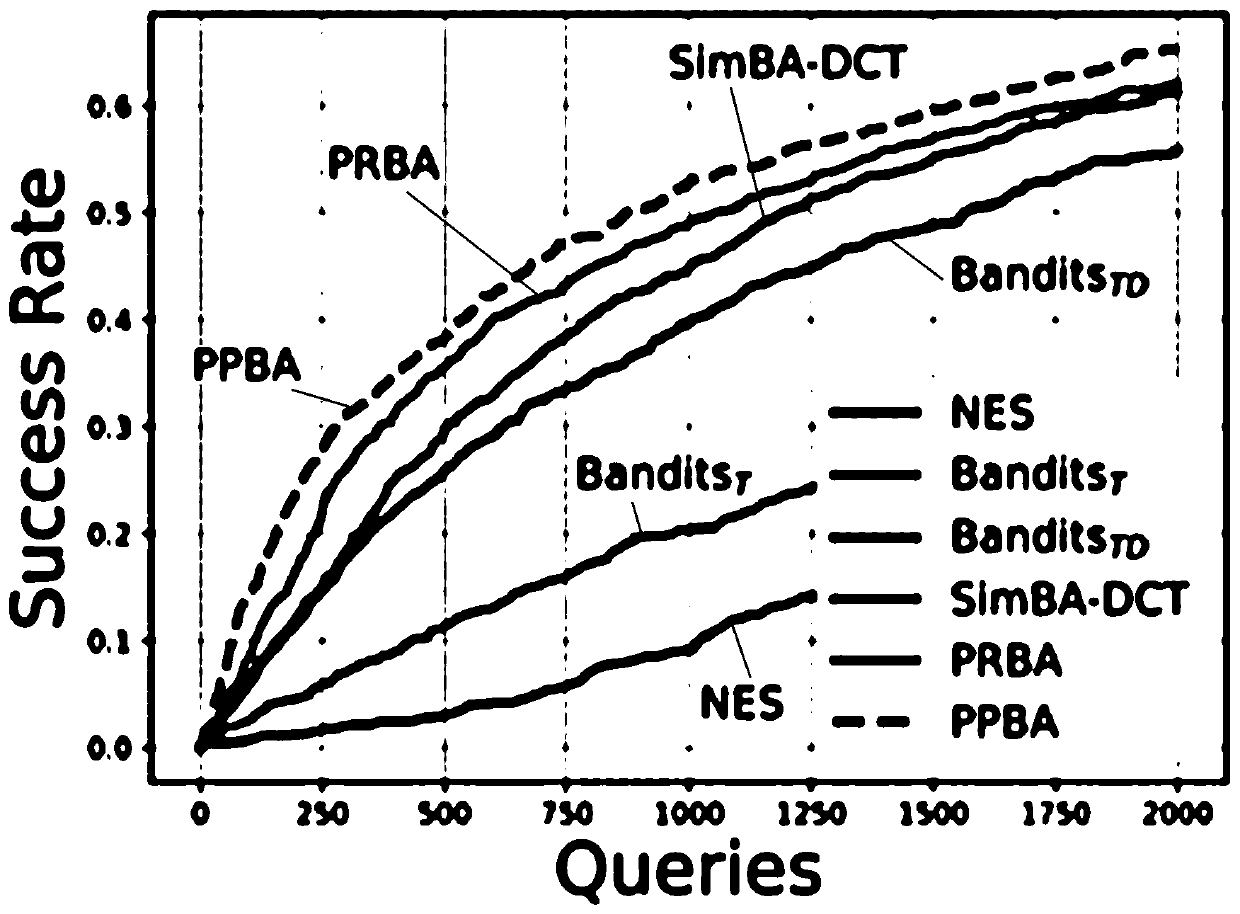
Figure 3
Abstract
Description
technical field
[0001] The invention relates to the field of black-box attacks, in particular to a method for generating black-box depth model adversarial samples. Background technique
[0002] In recent years, with the rapid development of hardware GPU and the advent of the era of big data, deep learning has developed rapidly and has swept all fields of artificial intelligence, including speech recognition, image recognition, video tracking, natural speech processing, etc. , Video field. Deep learning technology breaks through traditional technical methods and greatly improves the recognition performance in various fields. However, deep neural networks have been proven to be vulnerable to small perturbations, which has raised security concerns in many fields such as autonomous driving and face verification.
[0003] Black-box attack refers to the attack scenario where the attacker does not know the internal information of the attacked model, such as the network architectu...
Examples
Embodiment 1
[0048] In this embodiment, a black-box depth model adversarial sample generation method is as follows:
[0049] Step 1. Input the dimension d of the image x, set the number of frequencies m, the low frequency limit parameter r and the maximum number of queries max_iter;
[0050] Step 2. Construct a dimensionality reduction projection matrix W;
[0051] Step 2.1, initialize the dimensionality reduction projection matrix W with all zeros, and initialize the frequency j=0;
[0052] Step 2.2, if the frequency j is less than the number of frequencies m, from the matrix I r×d Randomly pick a base v from j , let W[j,:]=DCT(v j ), j=j+1;
[0053] Step 2.3, repeating step 2.2 until the frequency j is equal to the number of frequencies m; at this time, the dimensionality reduction projection matrix W is output;
[0054] Step 3, optimize the amplitude α;
[0055] Step 3.1, initializing the amplitude α=0, query times t=0;
[0056] Step 3.2. Randomly sample the vector Δα within a ce...
Embodiment 2
[0060] On the basis of the first embodiment, when optimizing the amplitude, the amplitude is constrained to a discrete three-valued space. In this embodiment, a black-box depth model adversarial sample generation method is as follows:
[0061] Step 1. Input the dimension d of the image x, set the number of frequencies m, the low frequency limit parameter r and the maximum number of queries max_iter;
[0062] Step 2. Construct a dimensionality reduction projection matrix W;
[0063] Step 2.1, initialize the dimensionality reduction projection matrix W with all zeros, and initialize the frequency j=0;
[0064] Step 2.2, if the frequency j is less than the number of frequencies m, from I r×d Randomly pick a base v from j , let W[j,:]=DCT(v j ), j=j+1;
[0065] Step 2.3, repeating step 2.2 until the frequency j is equal to the number of frequencies m; at this time, the dimensionality reduction projection matrix W is output;
[0066] Step 3, optimize the amplitude α;
[0067...
Embodiment 3
[0072] In this embodiment, on the basis of the first embodiment, when optimizing the amplitude, the amplitude is constrained to a discrete three-valued space, and a probability-driven optimal sampling method is adopted. A black-box depth model adversarial sample generation method in this embodiment is specifically as follows:
[0073] Step 1. Input the dimension d of the image x, set the number of frequencies m, the low frequency limit parameter r and the maximum number of queries max_iter;
[0074] Step 2. Construct a dimensionality reduction projection matrix W;
[0075] Step 2.1, initialize the dimensionality reduction projection matrix W with all zeros, and initialize the frequency j=0;
[0076] Step 2.2, if the frequency j is less than the number of frequencies m, from I r×d Randomly pick a base v from j , let W[j,:]=DCT(vj), j=j+1;
[0077] Step 2.3, repeating step 2.2 until the frequency j is equal to the number of frequencies m; at this time, the dimensionality red...