
Long-life-cycle anti-torsion cable for offshore wind power
A life cycle, offshore wind power technology, used in power cables, power cables for overhead applications, insulated cables, etc., to solve problems such as low tensile strength, conductor fatigue and core breakage, and insulation core deformation
Patent Information
- Authority / Receiving Office
- CN · China
- Current Assignee / Owner
- Publication Date
- 2021-06-04
Smart Images
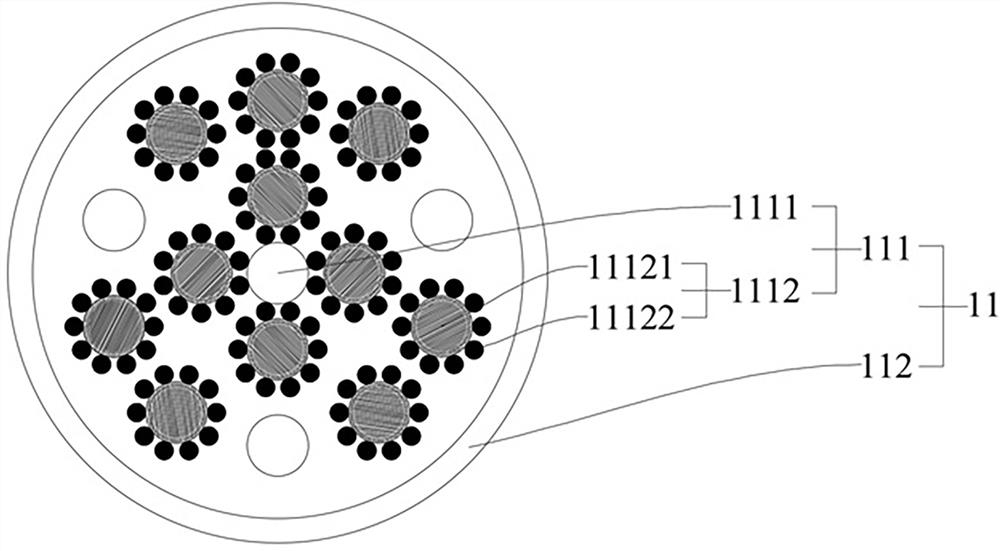
Figure 1 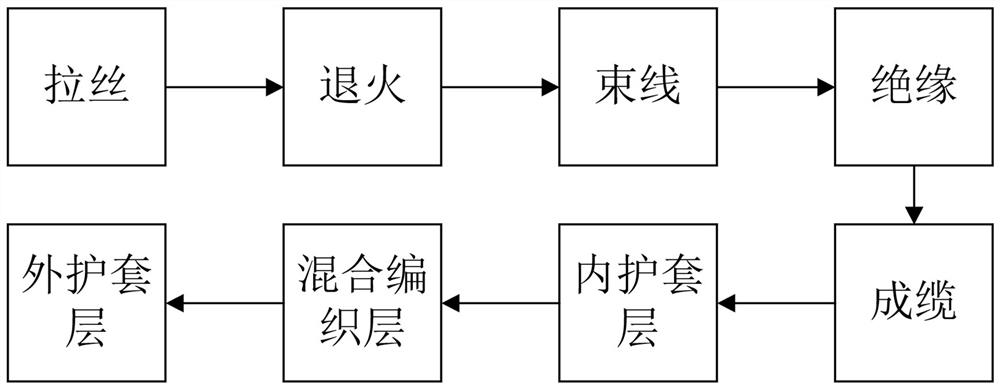
Figure 2 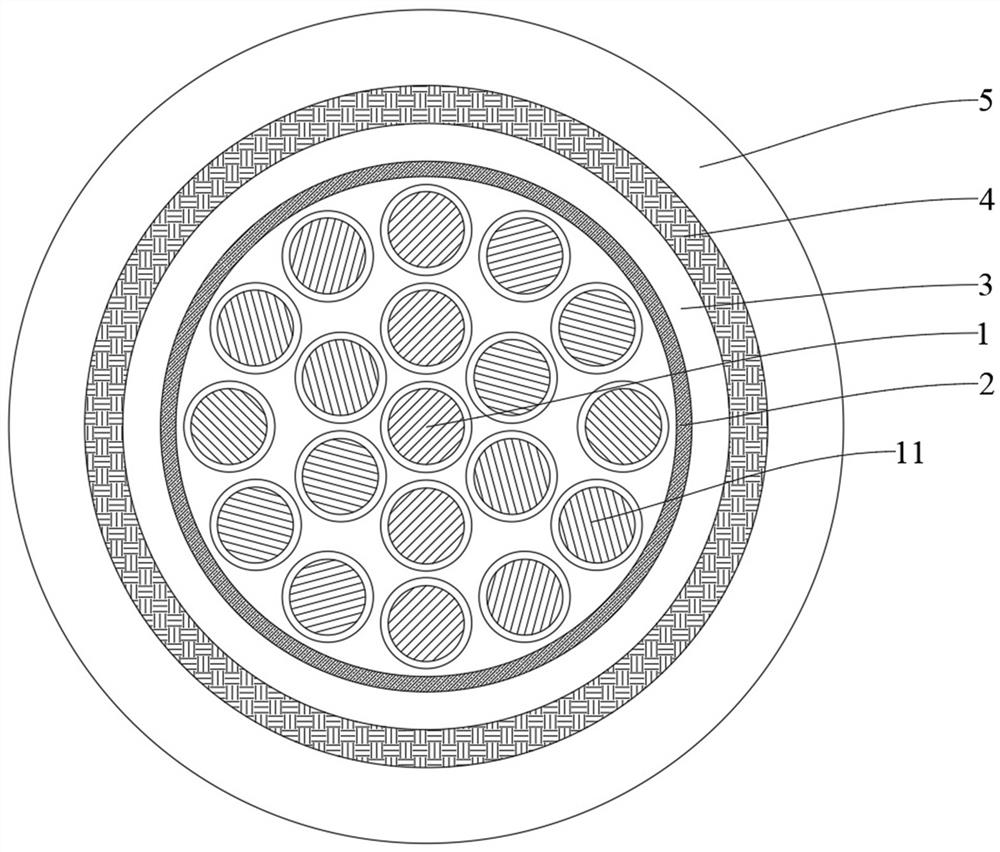
Figure 3
Abstract
Description
technical field
[0001] The invention relates to the field of power cables, in particular to a high-life-cycle torsion-resistant cable for offshore wind power. Background technique
[0002] As my country's wind power generation technology becomes more and more mature, onshore wind power resources are gradually developed, and offshore wind power is also gradually developed. Compared with onshore wind power, offshore wind power has the characteristics of rich resources, stable wind direction, long wind duration, no damage to forest land, high power generation utilization hours, and suitable for large-scale development. It has huge potential, and offshore wind power is increasingly favored by people. .
[0003] The power of offshore wind turbines has gradually developed towards large megawatts. At present, it has developed into models with different powers such as 3MW, 5MW, 7MW, 8MW, and 10MW. The distance from offshore wind turbines to land ranges from hundreds of meters to te...
Examples
Embodiment 1
[0051] Such as figure 1 and figure 2 As shown, a high-life-cycle torsion-resistant cable for offshore wind power includes a cable core 1 composed of a plurality of insulated cores 11, and a tape layer 2 coated on the surface of the cable core 1;
[0052] The outer surface of the tape layer 2 is covered with an inner sheath layer 3; the outer surface of the inner sheath layer 3 is covered with a mixed braided layer 4; the outer surface of the mixed braided layer 4 is covered with an outer sheath jacket 5;
[0053] The insulated core 11 includes a conductor 111 and an insulating layer 112 coated on the conductor 111; the conductor 111 is formed by mixing and winding a plurality of copper wires 1111 and a plurality of fiber copper composite wires 1112;
[0054] The fiber copper composite wire 1112 includes an organic fiber 11121 at the center and two layers of copper foil 11122 spirally wound on the outer surface of the organic fiber 11121 .
[0055] In order to further achie...
Embodiment 2
[0076] The organic fiber 11121 adopts the aramid fiber with a fiber count of 50D, and the fiber copper composite wire 1112 adopts a diameter of 0.1mm; the elastomer compound is changed to the following parts by weight Ingredients: 18 parts of polypropylene, 33 parts of styrene-ethylene-butylene-styrene block copolymer SEBS-501, 23 parts of white oil, 5 parts of calcium carbonate, 8 parts of high-impact polystyrene HIPS, 0.2 part of antioxidant 1010, 0.1 part of high molecular weight hindered amine anti-ultraviolet stabilizer 783; described cable core 1 is made of multi-layer insulated wire core 11 according to the same direction of cabling and 30 times the pitch diameter Than cabling; the said wrapping layer 2 adopts double-layer polyester tape materials to overlap and wrap, and the overlapping rate is controlled at 10%; the braiding density of the mixed braided layer 4 is controlled at 60%, The angle is controlled at 20°, the diameter of the metal wire is 0.1mm, and the metal...
Embodiment 3
[0078] The organic fiber 11121 adopts the aramid fiber with a fiber count of 300D, and the fiber copper composite wire 1112 adopts a diameter of 0.25mm; the elastomer compound is changed to the following parts by weight Ingredients: 25 parts of polypropylene, 37 parts of styrene-ethylene-butylene-styrene block copolymer SEBS-501, 27 parts of white oil, 8 parts of calcium carbonate, 13 parts of high-impact polystyrene HIPS, 0.6 parts of antioxidant 1010, 0.3 parts of high molecular weight hindered amine anti-ultraviolet stabilizer 783; said cable core 1 is made of multi-layer insulated wire core 11 according to the same cable forming direction and 40 times the pitch diameter Than cabling; the said wrapping layer 2 adopts single-layer polyester tape material to be overlapped and wrapped, and the overlap rate is controlled at 25%; the braiding density of the mixed braided layer 4 is controlled at 90%, and the braiding angle Control at 65°, the diameter of the wire is 0.3mm, and t...