
Cobalt-based amorphous alloy ribbon, preparation method thereof and application thereof
A technology of amorphous alloys and thin strips, which is applied in the field of cobalt-based amorphous alloy thin strips and its preparation, can solve the problems of poor soft magnetic properties, achieve high magnetic flux density, good amorphous forming ability, and improved soft magnetic properties Effect
Patent Information
- Authority / Receiving Office
- CN · China
- Patent Type
- Applications(China)
- Current Assignee / Owner
- Publication Date
- 2021-10-01
Smart Images
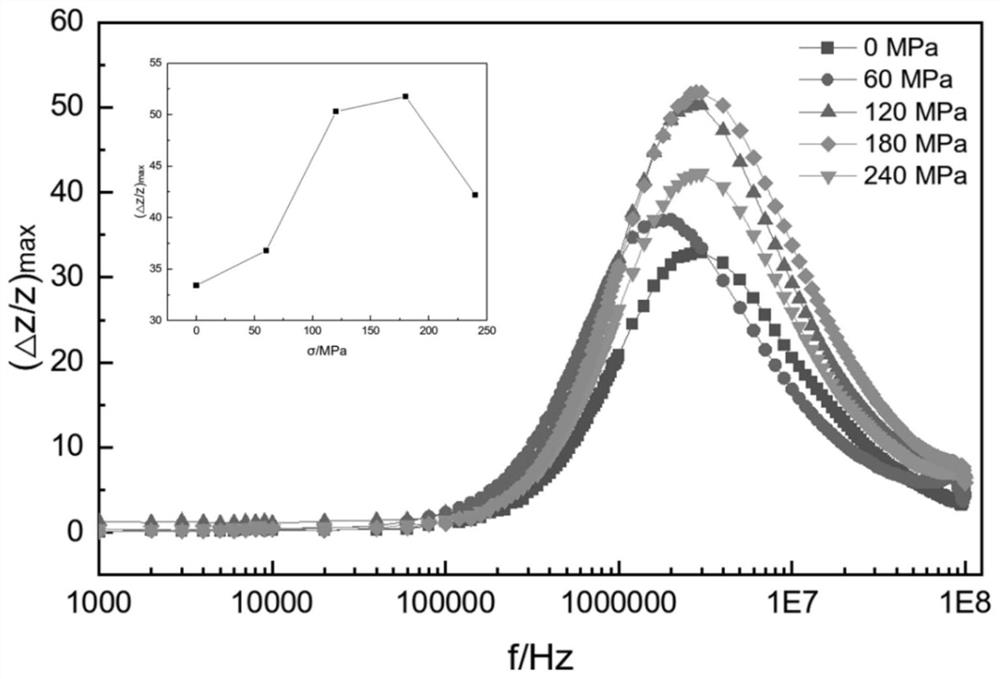
Figure 1 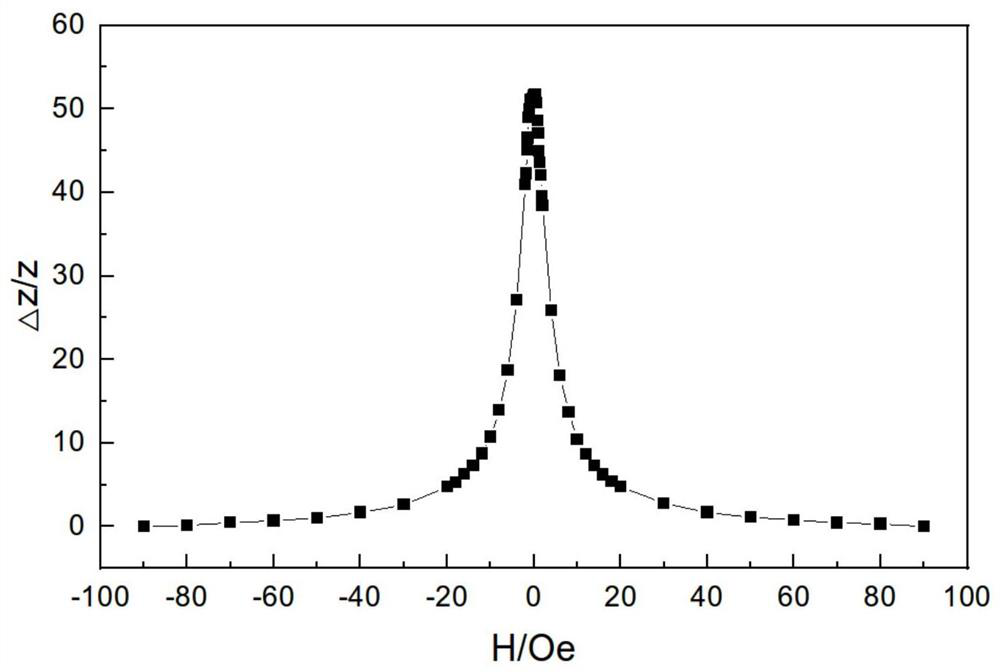
Figure 2 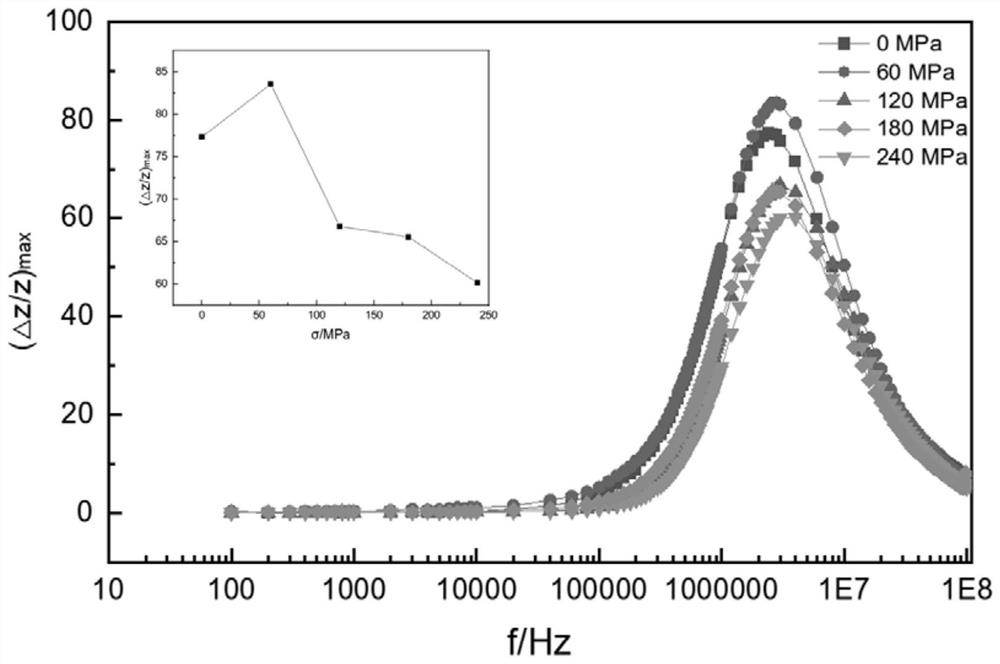
Figure 3
Abstract
Description
technical field
[0001] The invention belongs to the technical field of magnetic materials, and in particular relates to a cobalt-based amorphous alloy thin strip, a preparation method and application thereof. Background technique
[0002] The giant magneto-impedance (Giant Magneto-impedance GMI) effect refers to the phenomenon that the AC impedance of the material changes significantly with the external magnetic field. This phenomenon was first discovered in 1992 from the cobalt-based amorphous wire. The GMI performance can be characterized by the impedance change rate, that is, the GMI ratio. The formula is GMI ratio=(△z / z)=(z(H)-z(H max )) / z(H max ), where z(H) is the AC impedance of the material at a magnetic field strength of H, and z(H max ) is the AC impedance of the material when the magnetic field strength reaches its maximum value. At present, the main scope of research on the GMI effect is not limited to amorphous wires, but also includes amorphous ribbons and f...
Examples
Embodiment 1
[0052] In this example, the preparation chemical formula is Co 68 Fe 6.5 Si 12.5 B 10 Nb 2 Ni 1 A cobalt-based amorphous alloy thin strip, comprising the steps of:
[0053] 1) Co, B, Ni, FeB, FeSi, FeNb with a purity of not less than 99.99% are represented by the chemical formula Co 68 Fe 6.5 Si 12.5 B 10 Nb 2 Ni 1 Carry out batching, add up to 50g.
[0054] 2) Mix the obtained ingredients and put them into a crucible of a vacuum induction melting furnace, melt at 1500° C. for 20 minutes in an argon atmosphere, melt for 3 times, and then cast into an alloy ingot.
[0055] 3) Break the obtained alloy ingot, then put the broken alloy ingot into absolute ethanol for ultrasonic cleaning for 5 minutes, then take it out and dry it; put the dried block alloy ingot into a high vacuum single-roller spin quenching belt In the machine, the molten alloy ingot is sprayed onto a copper roller with a rotating linear speed of 30m / s to cool, and an amorphous ribbon with a width of ...
Embodiment 2
[0061] In this example, the preparation chemical formula is Co 68 Fe 6.5 Si 12.5 B 10 Nb 1 Ni 2 A cobalt-based amorphous alloy thin strip, comprising the steps of:
[0062] 1) Co, B, Ni, FeB, FeSi, FeNb with a purity of not less than 99.99% are represented by the chemical formula Co 68 Fe 6.5 Si 12.5 B 10 Nb 1 Ni 2 Carry out batching, add up to 50g.
[0063] 2) Mix the obtained ingredients and put them into a crucible of a vacuum induction melting furnace, melt at 1500° C. for 20 minutes in an argon atmosphere, melt for 3 times, and then cast into an alloy ingot.
[0064] 3) Break the obtained alloy ingot, then put the broken alloy ingot into absolute ethanol for ultrasonic cleaning for 5 minutes, then take it out and dry it; put the dried block alloy ingot into a high vacuum single-roller spin quenching belt In the machine, the molten alloy ingot is sprayed onto a copper roller with a rotating linear speed of 20m / s to cool, and an amorphous thin strip with a width...
Embodiment 3
[0069] In this example, the preparation chemical formula is Co 68 Fe 6.5 Si 12.5 B 10 Nb 0.5 Ni 2.5 A cobalt-based amorphous alloy thin strip, comprising the steps of:
[0070] 1) Co, B, Ni, FeB, FeSi, FeNb with a purity of not less than 99.99% are represented by the chemical formula Co 68 Fe 6.5 Si 12.5 B 10 Nb 0.5 Ni 2.5 Carry out batching, add up to 50g.
[0071] 2) Mix the obtained ingredients and put them into the crucible of a vacuum induction melting furnace, melt at 1500° C. for 20 minutes in an argon atmosphere, melt for 3 times, and then cast into an alloy ingot.
[0072] 3) Break the obtained alloy ingot, then put the broken alloy ingot into absolute ethanol for ultrasonic cleaning for 5 minutes, then take it out and dry it; put the dried block alloy ingot into a high vacuum single-roller spin quenching belt In the machine, the molten alloy ingot is sprayed onto a copper roller with a rotating linear speed of 30m / s to cool, and an amorphous ribbon with a...