
Tag Recommendation Method for Online Question Answering Platform Based on Knowledge Graph and Tag Association
A technology of knowledge graph and recommendation method, applied in the fields of artificial intelligence, recommendation system, and natural language processing, can solve problems such as poor recommendation effect, achieve the effect of improving effect, alleviating long-tail problem, and enriching the form of expression
Patent Information
- Authority / Receiving Office
- CN · China
- Patent Type
- Patents(China)
- Current Assignee / Owner
- Publication Date
- 2022-05-10
Smart Images
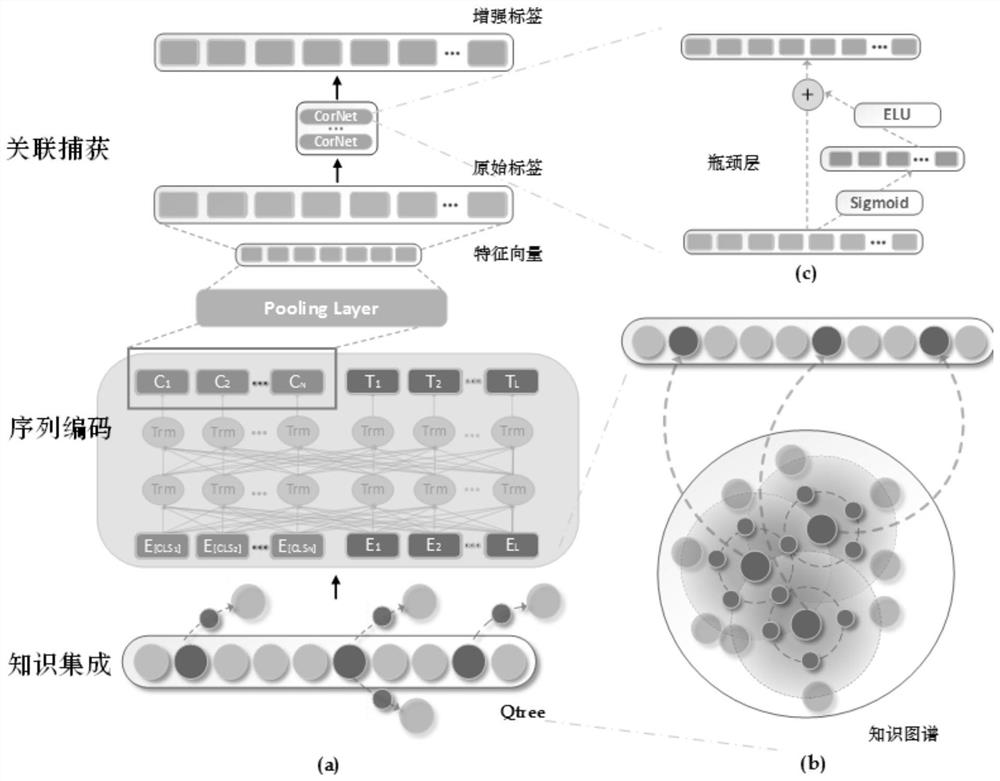
Figure 1 
Figure 2 
Figure 3
Abstract
Description
technical field
[0001] The invention relates to the technical fields of artificial intelligence, natural language processing, and recommendation systems, and in particular to a tag recommendation method for an online question answering platform based on knowledge graphs and tag associations. Background technique
[0002] With the rapid development of the Internet, the Internet has become more and more popular and applied in various industries. Enterprises in various fields such as e-commerce, Internet finance, life services, games, etc. are committed to better recommending products or services to users through the Internet. services to tap user needs, increase user traffic, and improve service quality. Question-and-answer websites have enriched the sources of information and accelerated the diffusion of information, but at the same time caused problems such as information overload, increased search load, and reduced information quality. Then, how can users obtain appropriat...
Examples
specific Embodiment approach 1
[0015] Specific Embodiment 1: In this embodiment, the tag recommendation method of the online question-and-answer platform based on knowledge graph and tag association is as follows: input the question text and external knowledge graph of the online Q&A platform into the trained KOCIN model to obtain recommended tags.
[0016] The KOCIN model includes: a knowledge integration layer, a sequence encoding layer, and an association capture layer;
[0017] The knowledge integration layer is used to learn from the question text and external knowledge graph Extract the knowledge triples from the knowledge triples, and then integrate the knowledge triples into the question text to generate a sentence tree Qtree;
[0018] The sequence encoding layer adopts a sequence encoder based on BERT, which is used to convert Qtree into a dense vectorized representation of Qtree and then obtain the original label of the predicted question text;
[0019] The association capture layer includes: a ...
specific Embodiment approach 2
[0020] Specific implementation mode two: the knowledge integration layer is used to learn from the question text and external knowledge graph Extract the knowledge triples from the knowledge triples, and then integrate the knowledge triples into the question text to generate a sentence tree Qtree, including the following steps:
[0021] Step 11. For each entity e in the question text qi j Perform knowledge query to extract the set of knowledge triples. The specific process is:
[0022]
[0023] Among them, E={(e j ,r j1 ,e j1 ),...,(e j ,r jk ,e jk )} is the same as e j set of matched knowledge triples, r j1 is the entity e j The relationship with the first matched knowledge triplet, e j1 is the entity e j The entity of the first matched knowledge triplet, (e j ,r jk ,e jk ) is the kth knowledge triplet, and K_Query() is a query function;
[0024] Steps 1 and 2, insert all the knowledge triples in E into the corresponding positions in the question text qi, a...
specific Embodiment approach 3
[0028] Specific embodiment three: the sequence encoding layer adopts a sequence encoder based on BERT, which is used to convert Qtree into a dense vectorized representation of Qtree and then obtain the original label of the predicted question text, including the following steps:
[0029] Step 21, insert multiple [CLS] tags at the beginning of the Qtree obtained in steps 12:
[0030] Qtree_CLS={[CLS 1 ],...,[CLS c ],w 1 ,w 2 ,... e j {(r j1 ,e j1 ),...,(r jk ,e jk )},...,w n}
[0031] where c is the total number of [CLS] tags inserted and entity e j is the word wi matched to the knowledge triplet;
[0032] Step 22. Use Qtree_CLS to obtain the hidden state vector marked by [CLS], and then obtain the dense vectorized representation of Qtree according to the hidden state vector marked by [CLS]:
[0033] Using the method of dynamic maximum pooling, the information captured by multiple [CLS] is summarized, and a comprehensive feature vector u is generated:
[0034]
...