
Coaxial series-parallel feed omnidirectional biconical dipole sleeve antenna
A dipole antenna and sleeve antenna technology, applied in the fields of communication and radar, can solve the problems of narrowing of the working frequency band, complex feeding structure, affecting the omnidirectional performance of the antenna, etc., and achieves good impedance matching, low transmission loss and structural simple effect
Patent Information
- Authority / Receiving Office
- CN · China
- Current Assignee / Owner
- Publication Date
- 2022-01-18
Smart Images
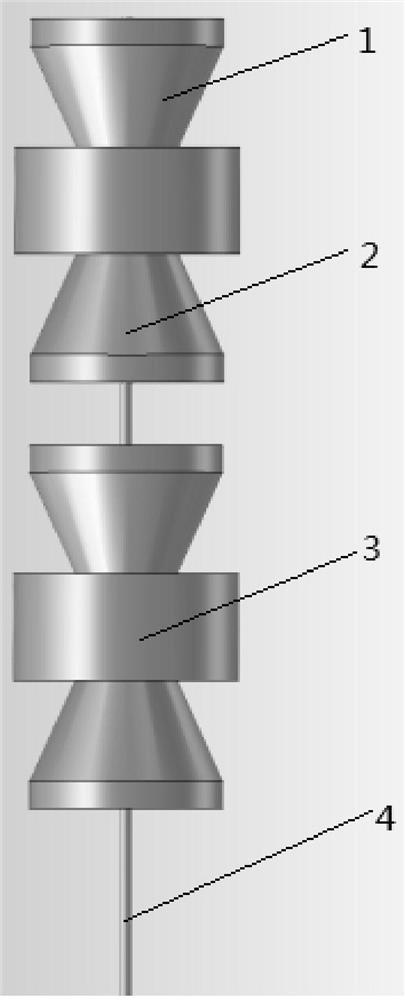
Figure 1 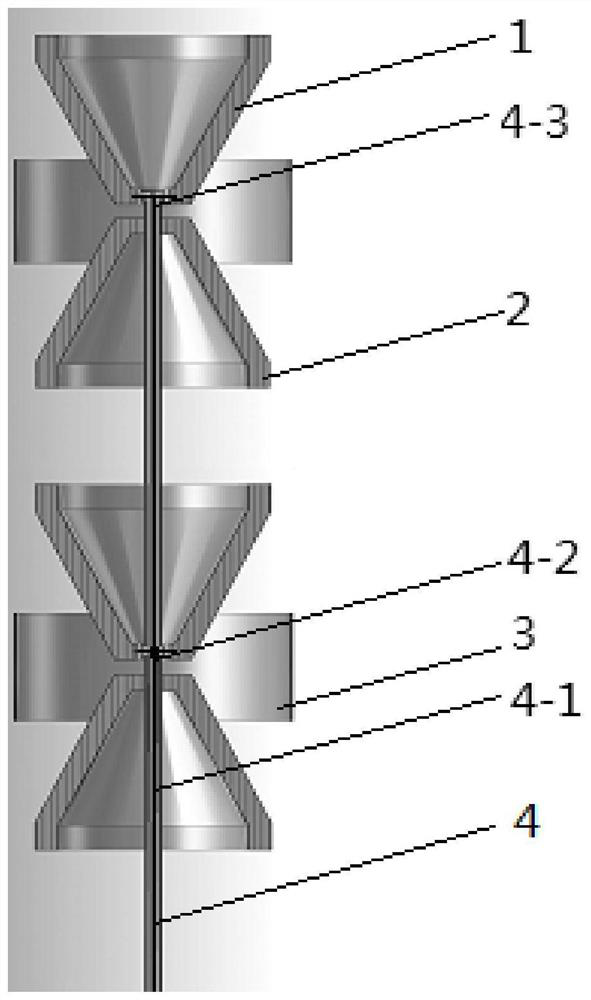
Figure 2 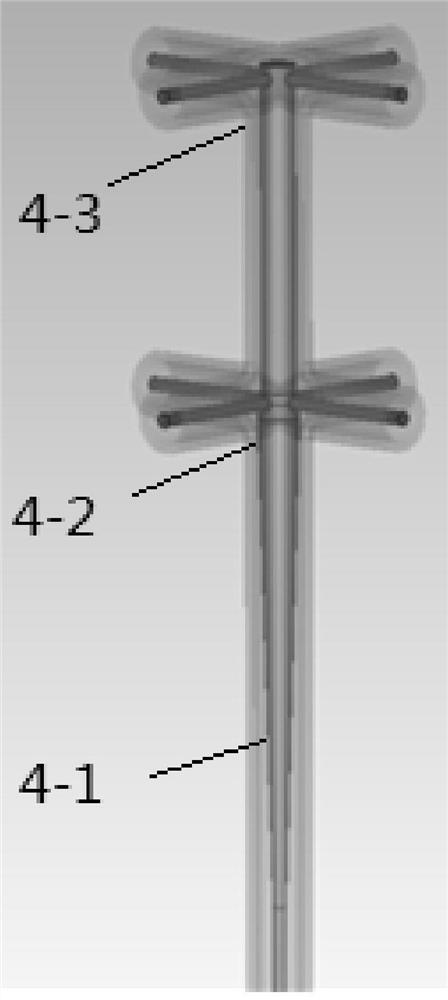
Figure 3
Abstract
Description
technical field
[0001] The invention belongs to the antenna microwave technology direction in the field of communication and radar technology. Background technique
[0002] Omnidirectional antennas are widely used in mobile communications, passive reconnaissance, electronic countermeasures and other fields due to their 360° coverage in the horizontal plane. Different application fields have different requirements for the working bandwidth, gain, polarization mode, and structural form of the omnidirectional antenna. At present, conventional omnidirectional antennas are mainly divided into two categories: one is through the improvement of monopole antennas, such as biconical antennas, disc cone antennas and other single antennas, and the polarization form is mostly vertical polarization; the other is based on dipole antennas. The sub-antenna units form an array to realize horizontal or dual polarization. There are generally two implementation forms for omnidirectional antenn...
Examples
Embodiment 1
[0027] refer to Figure 4 , the biconical dipole antenna unit, using the gradient structure of the radiator to achieve a better match between the feed port and the free space impedance transformation, the upper and lower radii of the biconical dipole are a, b, and the height h2; The coaxial metal sleeve outside the body further widens the bandwidth of the antenna, and the radius d and height h3 of the sleeve. When the total height is constant, the matching and radiation performance of the antenna are mainly determined by the ratio of the total height of the sleeve antenna to the height h3 of the sleeve. This ratio has an optimal value. Under this optimal ratio, the bandwidth of the antenna is the most width. There is also an optimal ratio between the radius b of the sleeve and the radius a of the inner conductor, and adjusting the value of b can effectively change the impedance bandwidth of the antenna when other parameters are given.
[0028] refer to Figure 5 , the branc...