
Automatic gain control method for radio communication mobile station
Patent Information
- Authority / Receiving Office
- US · United States
- Current Assignee / Owner
- Publication Date
- 2005-03-10
- Estimated Expiration
- Not applicable · inactive patent
Smart Images
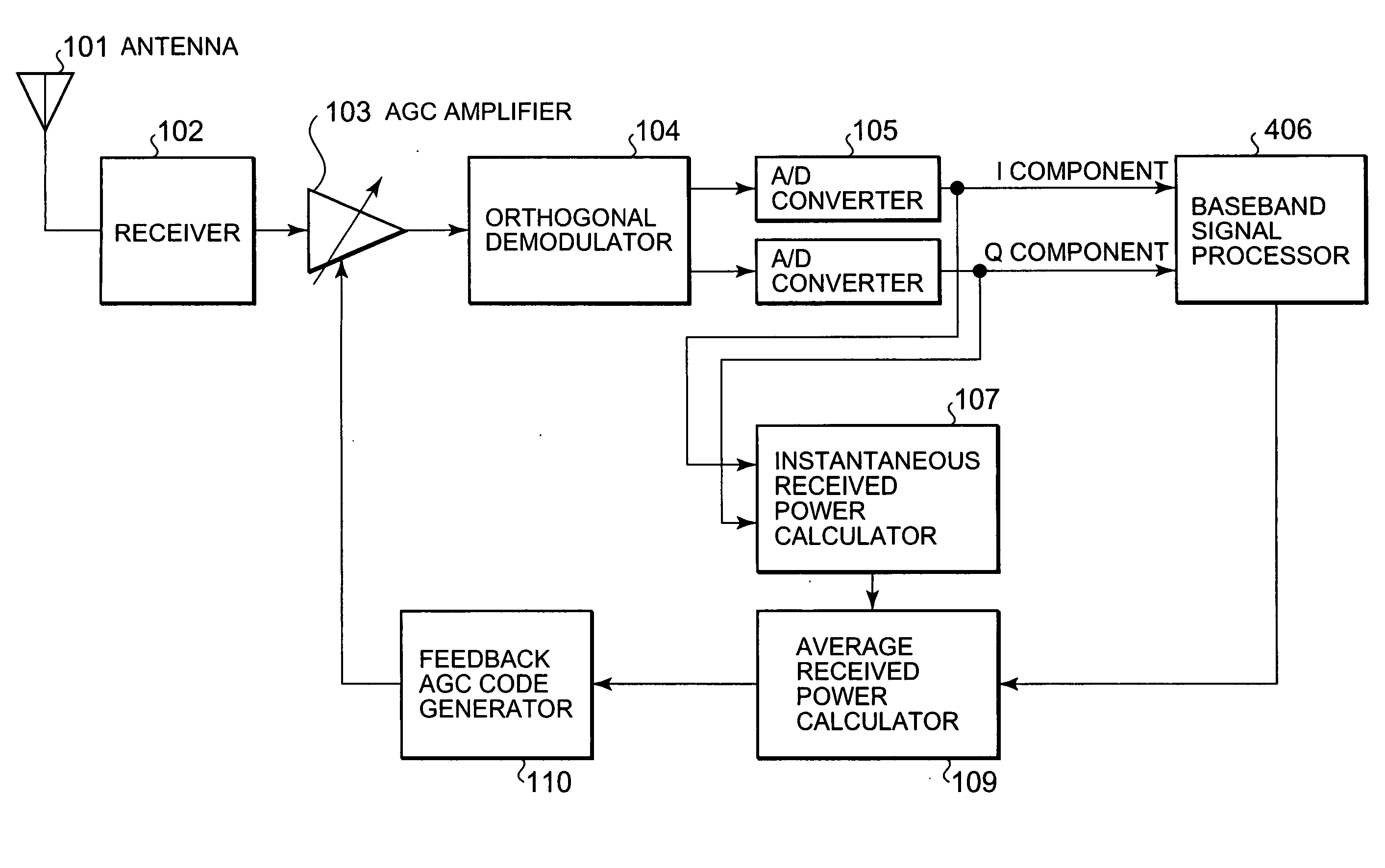
Figure 1 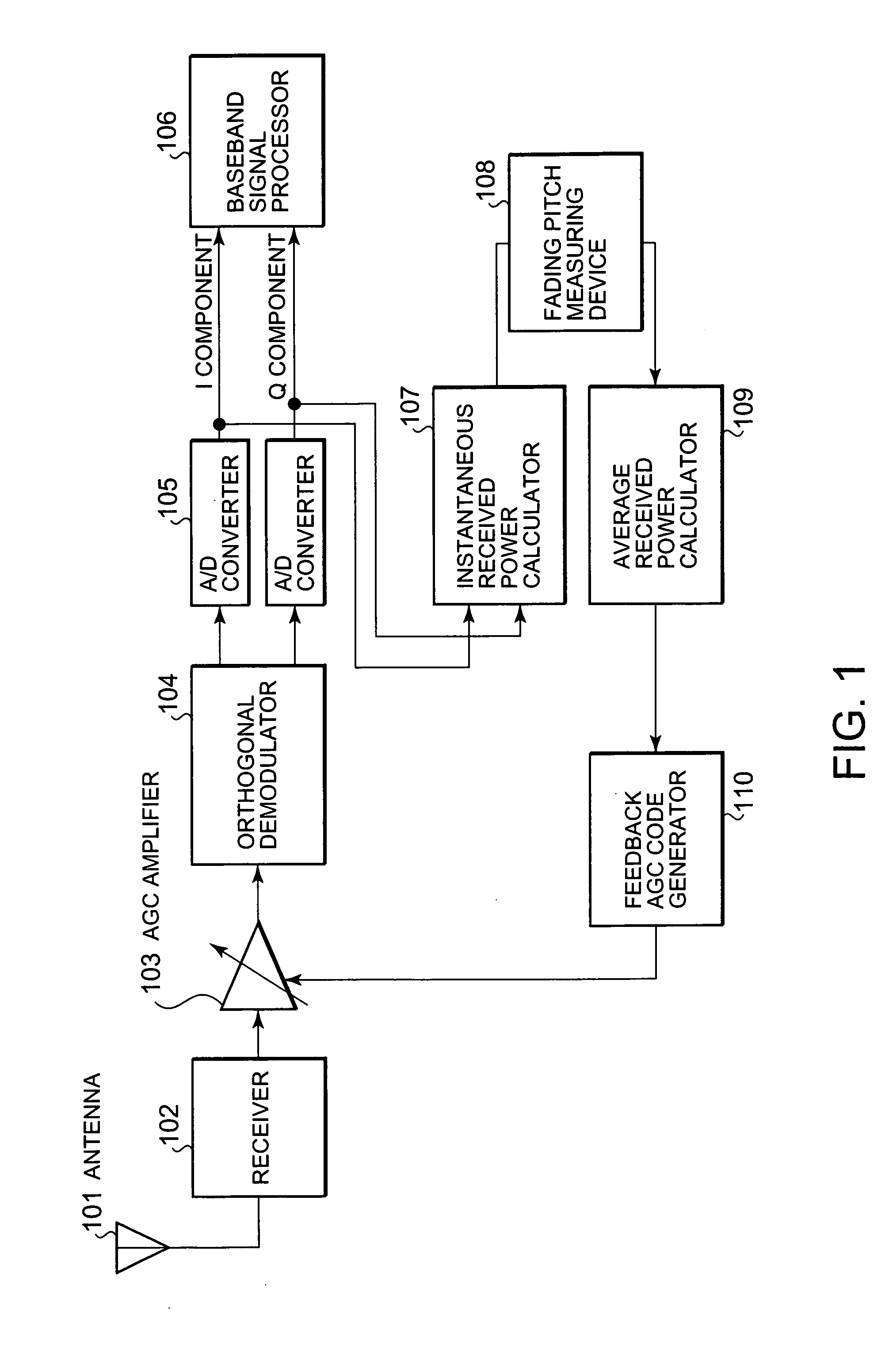
Figure 2 
Figure 3
Abstract
Description
BACKGROUND OF THE INVENTION
[0001] 1. Field of the Invention
[0002] The present invention relates to automatic gain control used in radio communication mobile stations and, more particularly, to an automatic gain control method for realizing stable reception characteristics against a change in fading period.
[0003] 2. Description of the Related Art
[0004] Generally, automatic gain control (AGC) used in radio communication mobile stations is performed so as to keep constant the amplitude of an in-phase (I) component signal and that of a quadrature (Q) component signal supplied from a radio unit to a baseband signal processing unit in a radio communication mobile station. FIG. 5 is a block diagram of an example of the arrangement of components for AGC in a conventional radio communication mobile station.
[0005] Referring to FIG. 5, the radio communication mobile station includes an antenna 501 for receiving a signal transmitted from a base station, a receiver 502 for radio signal proc...
Examples
first embodiment
[0037]FIG. 1 is a block diagram of a radio communication mobile station according to the present invention.
[0038] The radio communication mobile station according to the present embodiment includes an antenna 101 for receiving a radio signal transmitted from a base station (not shown), a receiver 102 for performing radio signal processing, e.g., frequency-converting the received signal having a radio frequency bandwidth into a radio signal having an intermediate frequency bandwidth, an AGC amplifier 103 of which gain is controllable depending on the power of the received signal, an orthogonal demodulator 104 for performing orthogonal demodulation and frequency conversion to the intermediate frequency signal to produce I-component and Q-component baseband signals, analog-to-digital (AD) converters 105 for converting the I-component and Q-component baseband signals, that are analog, into digital signals, respectively, a baseband signal processor 106 for performing digital signal proce...
second embodiment
[0056]FIG. 4 is a block diagram of a radio communication mobile station according to the present invention. Referring to FIG. 4, the same components as those in FIG. 1 are designated by the same reference numerals.
[0057] According to the foregoing first embodiment, radio waves from the base station are received and the fading pitch thereof is then measured. Averaging time required to calculate the average received power used in controlling the AGC amplifier is changed depending on the measured fading pitch. According to the present embodiment, a base station transmits fading pitch information. A radio communication mobile station receives the fading pitch information and changes averaging time according to the received fading pitch information. The averaging time is required to calculate average received power used in controlling the gain of an AGC amplifier.
[0058] Generally, a fading pitch is high in a specific location such as an expressway or a high-rise community. In such an ar...