
Optical RZ-duobinary transmission system with narrow bandwidth optical filter
a transmission system and optical filter technology, applied in electromagnetic transmission, electrical equipment, transmission, etc., can solve the problems of reducing system performance, affecting the performance of rz-duobinary against chromatic dispersion, so as to reduce the filter bandwidth, increase the chromatic dispersion tolerance of signals, and balance the sensitivity of the receiver against chromatic dispersion. tolerance
Patent Information
- Authority / Receiving Office
- US · United States
- Patent Type
- Applications(United States)
- Current Assignee / Owner
- Publication Date
- 2005-09-15
- Estimated Expiration
- Not applicable · inactive patent
Smart Images
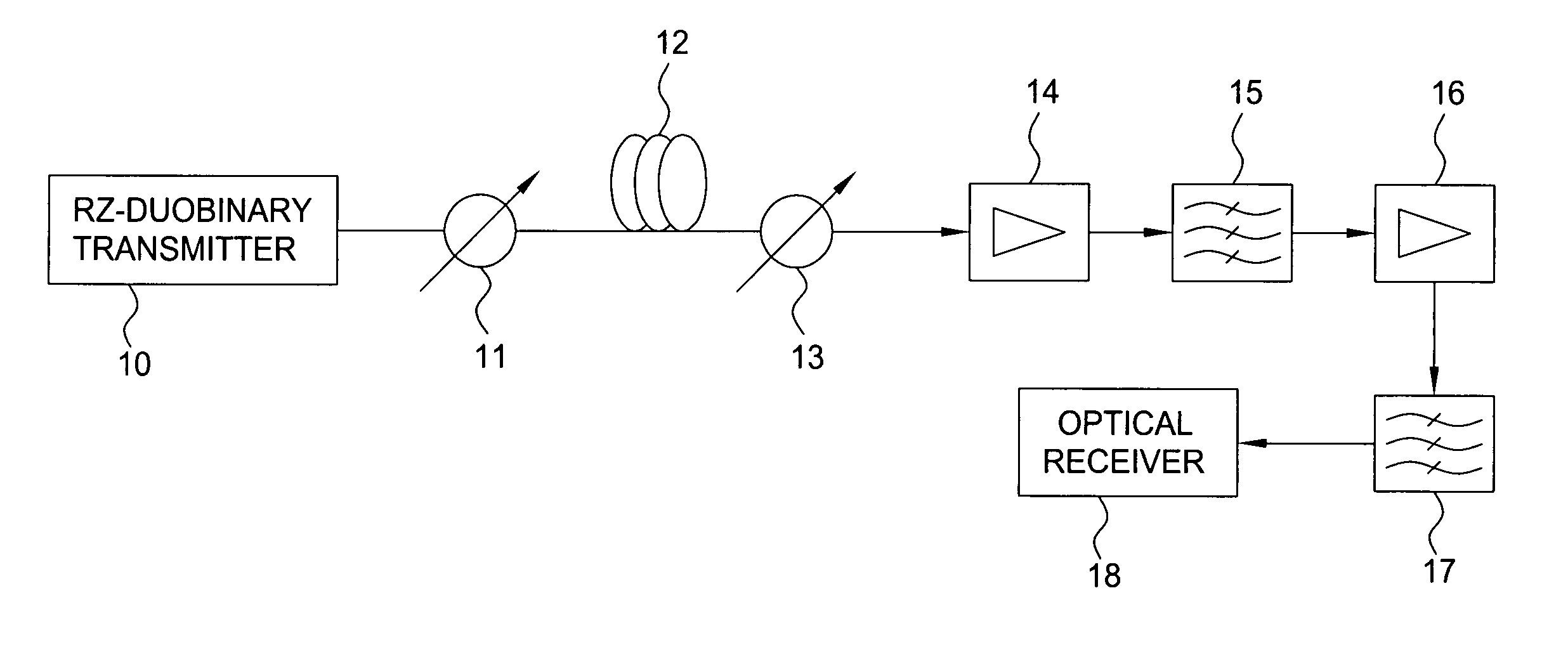
Figure 1 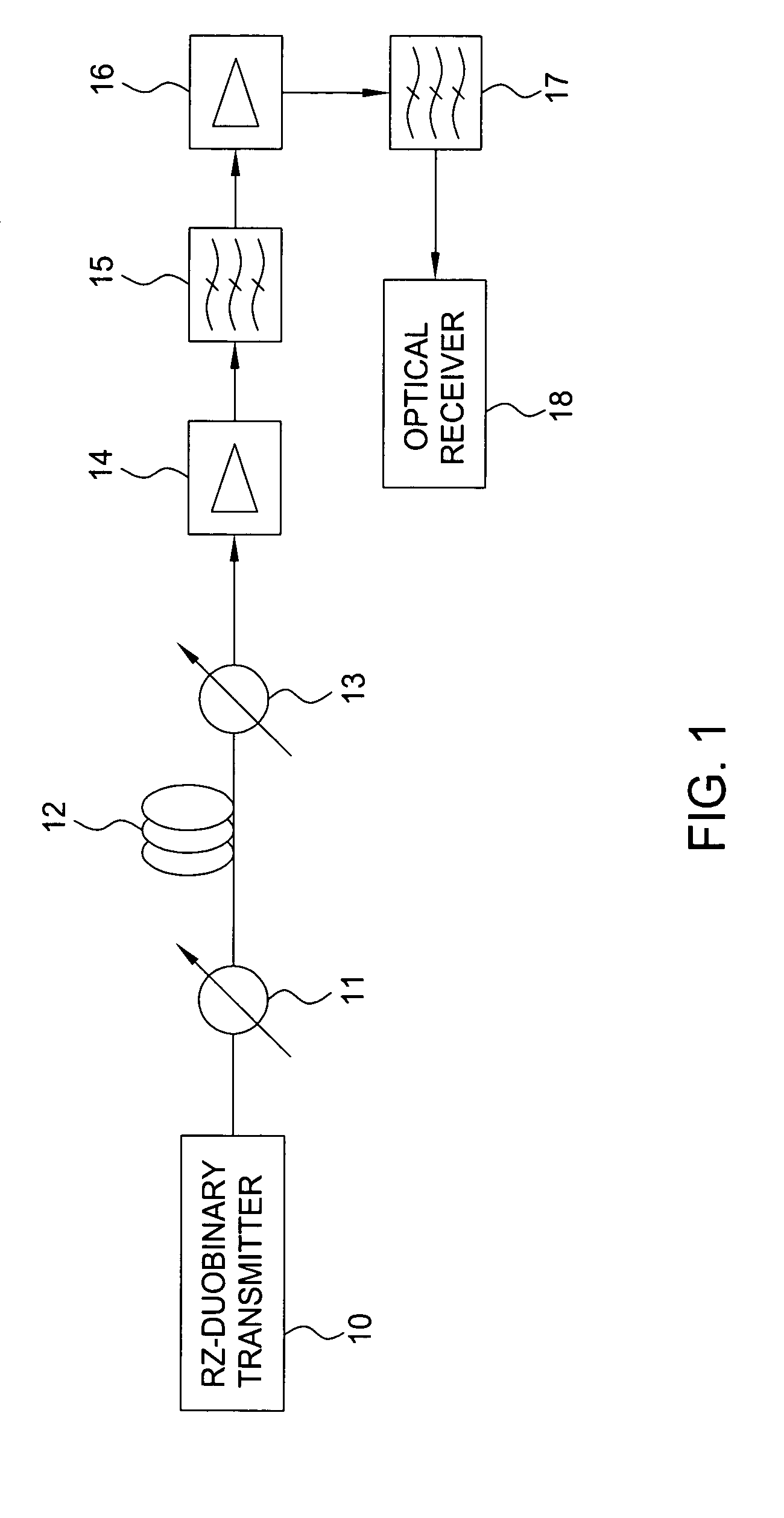
Figure 2 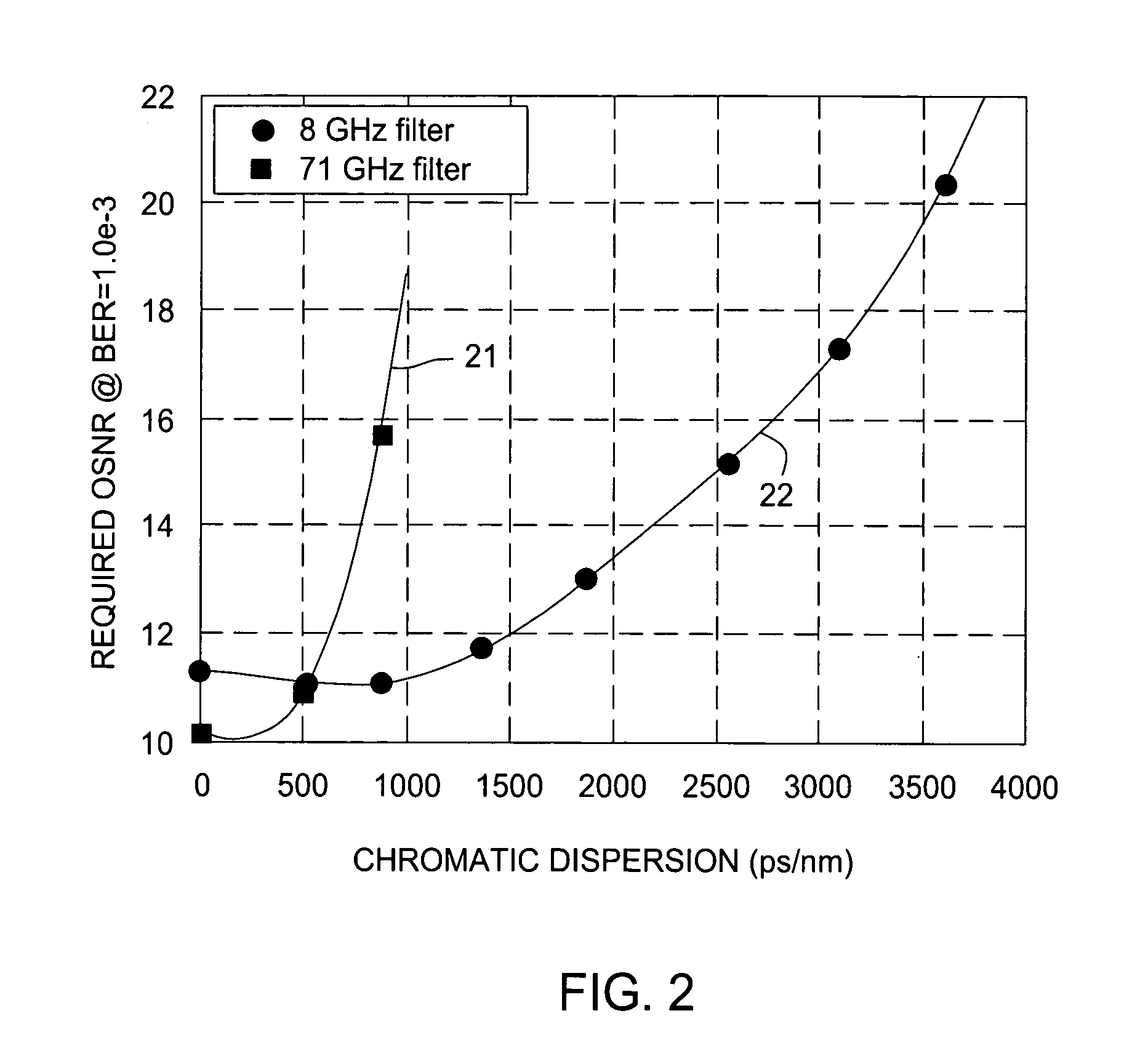
Figure 3
Abstract
Description
FIELD OF THE INVENTION
[0001] This invention relates to the field of optical RZ-duobinary transmission systems and, more specifically, to an optical receiver for RZ-duobinary signals incorporating a narrow bandwidth optical filter. BACKGROUND OF THE INVENTION
[0002] Advanced modulation formats are considered to be of great importance for the development of the next generation of optical transmission networks. Among the various modulation formats, optical duobinary modulation has attracted much attention due to its compact spectrum and good transmission performance. Choice of a format depends, in part, on the ability to tolerate system nonlinearities and chromatic dispersion without impairing the receiver sensitivity.
[0003] A non-return-to-zero duobinary (NRZ-duobinary) modulation format can tolerate about three times more chromatic dispersion than the ordinary NRZ format. Chromatic dispersion tolerance makes NRZ-duobinary a potential candidate for metro-optical networks because, th...
Examples
Embodiment Construction
[0014] Duobinary signaling offers a compact spectrum and good transmission performance in optical transmission systems. The NRZ and RZ-duobinary formats offer complementary results. NRZ-duobinary signaling tolerates chromatic dispersion well while being less tolerant to system nonlinearities; RZ-duobinary signaling, on the other hand, tolerates system nonlinearities well while being less tolerant to chromatic dispersion. System nonlinearities include, but are not limited to, inter-channel and intra-channel impairments such as four-wave mixing and cross-phase modulation.
[0015] Since NRZ-duobinary signaling exhibits complementary traits to RZ-duobinary signaling, efforts to optimize system and receiver performance tend to be successful in one regime and not in the other. For example, optical filters are placed in or near the optical receiver in order to reject amplified spontaneous emission (ASE) noise and, thereby, reduce signal-independent ASE-ASE beat noise. If a too narrow filter...