

Hyperplaty clays and their use in paper coating and filling, methods for making same, and paper products having improved brightness
a technology of clay and paper coating, applied in clayware, soil conditioning compositions, other domestic articles, etc., can solve the problems of significantly higher manufacturing costs of calcined and chemically aggregated kaolins than those of hydrous kaolins
Patent Information
- Authority / Receiving Office
- US · United States
- Patent Type
- Applications(United States)
- Current Assignee / Owner
- Publication Date
- 2006-01-12
- Estimated Expiration
- Not applicable · inactive patent
Smart Images
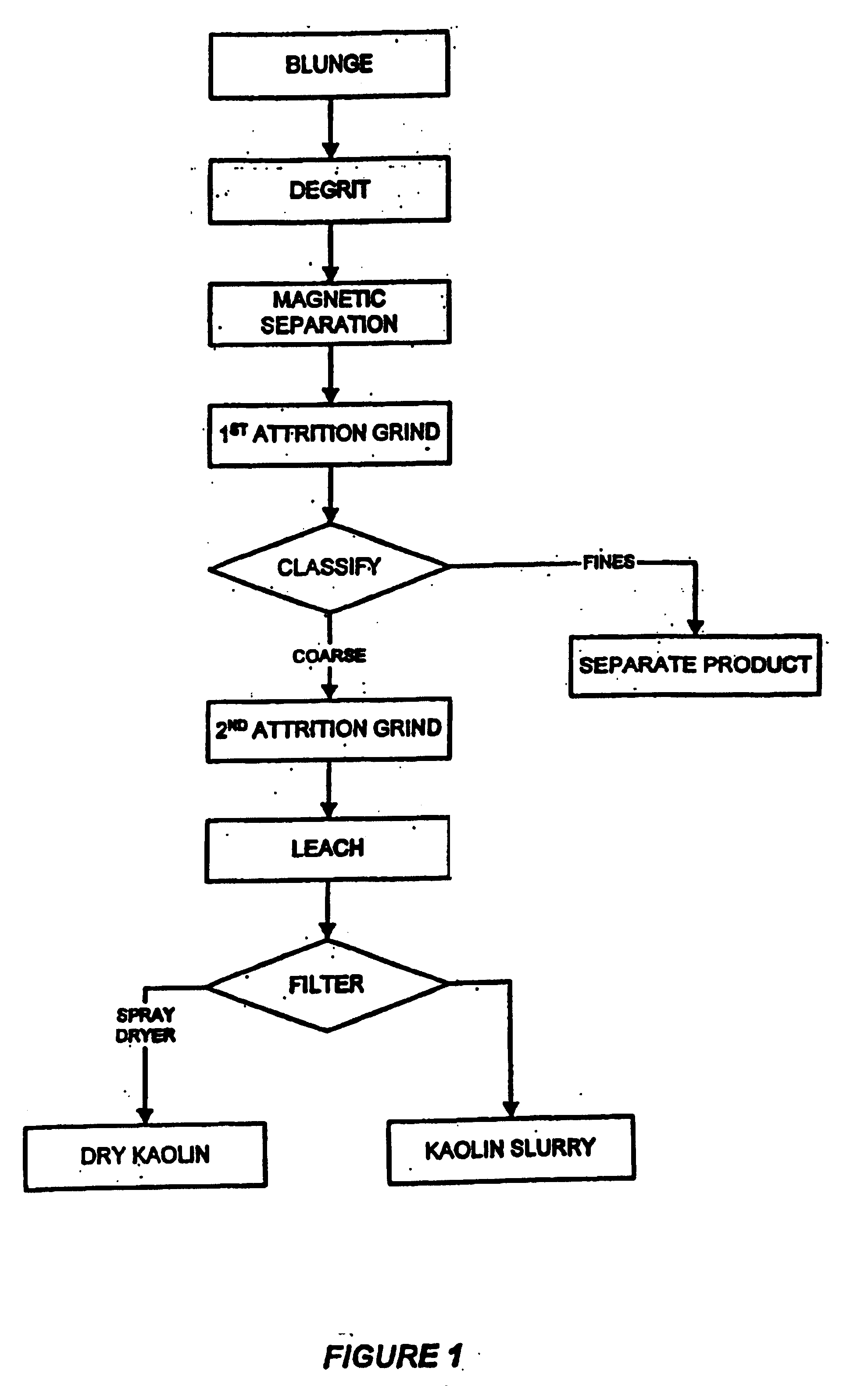
Figure 1 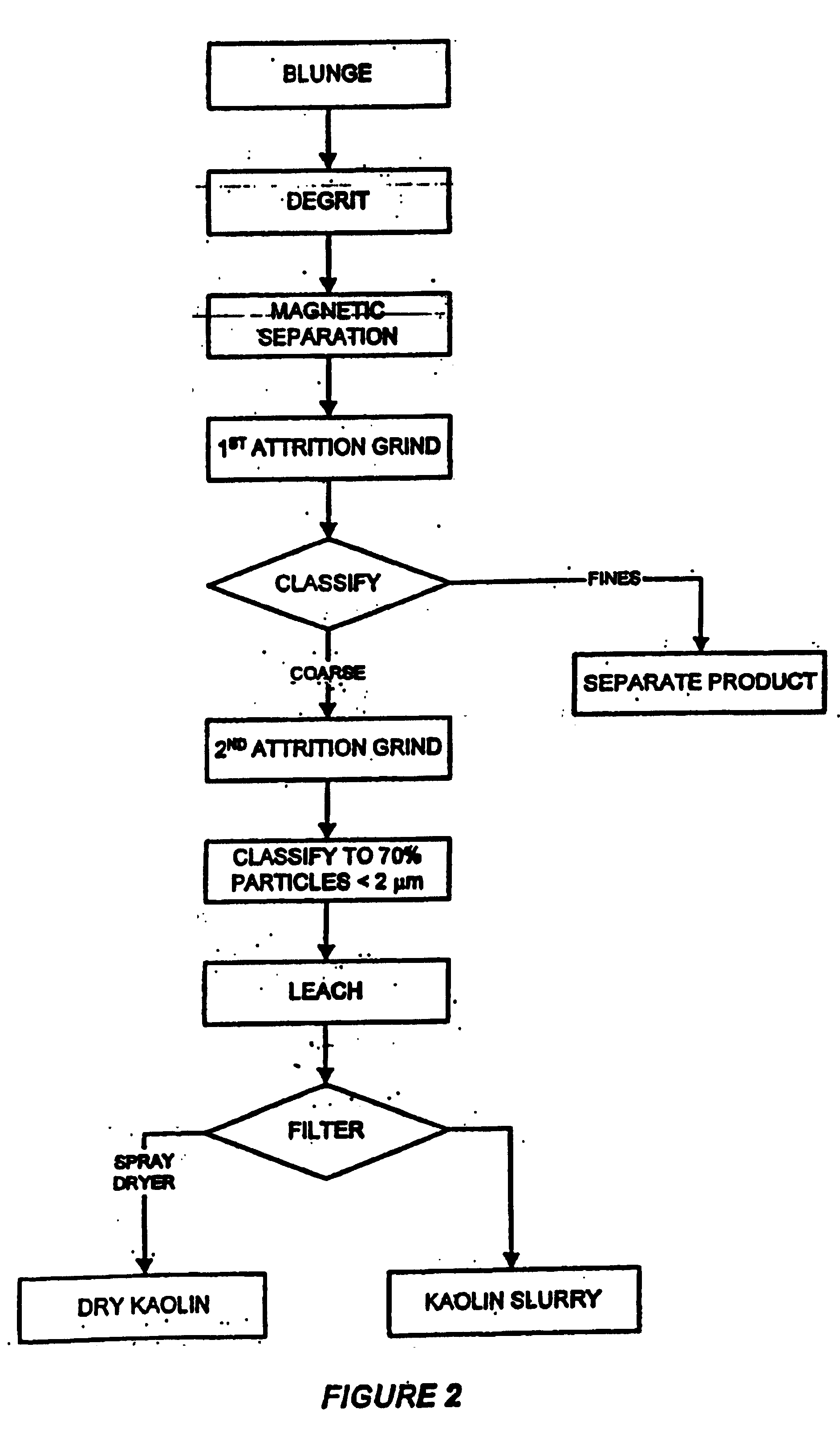
Figure 2 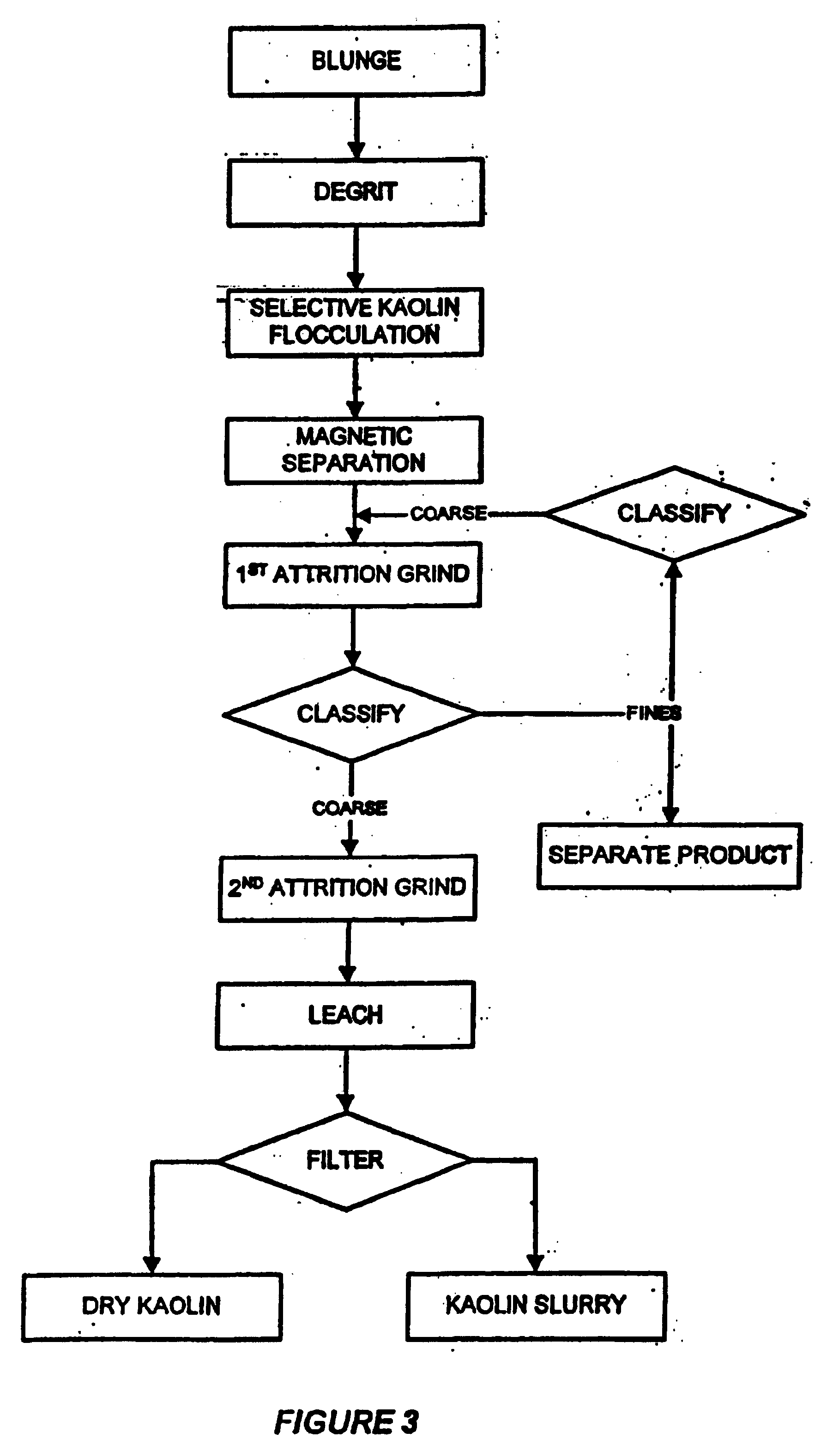
Figure 3
Abstract
Description
RELATED APPLICATION
[0001] This nonprovisional application claims the benefit of priority under 35 U.S.C. § 119(e) to U.S. Provisional Application No. 60 / 318,207, filed Sep. 7, 2001, entitled “THE USE OF HYPERPLATY CLAYS IN PAPER COATINGS AND FILLING, AND PAPER PRODUCTS HAVING IMPROVED BRIGHTNESS,” the disclosure of which is incorporated by reference herein in its entirety.FIELD OF THE INVENTION
[0002] The present invention relates to a hydrous kaolin, which provides improved optical properties when used as a filler or coating. Also, the present invention relates to a paper coating and a coated paper product that exhibits improved properties, such as improved brightness. Further, the present invention relates to methods for preparing hydrous kaolin products. BACKGROUND OF THE INVENTION
[0003] Particulate kaolin products find a variety of uses, including as pigments, fillers, and extenders for use in paint, plastics, polymers, papermaking and paper coating. Kaolin clay, also referred...
Examples
example 1
[0137] This example illustrates a method of refining kaolin to produce a high shape factor kaolin, i.e., greater than or equal to 70, either as a dry kaolin or a kaolin slurry that is stabilized by adding additional water and carboxymethyl cellulose (a thickener). A “stabilized slurry” refers to a slurry where the kaolin does not appreciably settle out of solution over time. It would be expected that adding additional water would have provided a less stabilized slurry. By including a CMC (carboxymethylcellulose) thickener, a stabilized slurry is formed while decreasing the slurry solids. The stabilization process is performed as follows:
[0138] 1. The product is reblunged with a small amount of dispersant, such as 35 / 65 Mill Chem, which is a mixture of soda ash and polyacrylate.
[0139] 2. Add approximately 8 lbs / ton CMC to thicken and stabilize.
[0140] 3. Add biocide to prevent bacterial interaction with the CMC.
[0141]FIG. 1 is a flowchart outlining the process of providing a high ...
example 2
[0142]FIG. 2 is a flowchart outlining a process for the preparation of a high shape factor kaolin. A Georgia crude kaolin is subjected to blunging and degritting steps, followed by magnetic separation and a first attrition grinding step. The product is then classified where the coarse fraction is subjected to a second attrition grinding step, followed by another classification to obtain a product where 70% of the particles have an esd less than 2 μm. This product is then leached and filtered, followed by the formation of either a dry kaolin product or a slurry.
COARSECOARSEFRACTIONFRACTIONFROM 2NDFROM 1STATTRITIONAFTERAFTERPROCESSATTRITIONGRINDING &LEACH-SPRAYPRODUCTGRINDINGCLASSIFYINGING**DRY% solids 33.6%25.5%52.1% 1.2%s.g.1.2621.184Tons8.93.58Brightness87.287.44L95.17a−0.18b2.77TiO20.613Fe2O30.419Brookfield*160Hercules*480Panacea74.797.487.4PSD 39.369.769.1 23.148.0 12.928.46.815.0Recovery100.0%57.3%98.0%99.0%
*(60% solids)
example 3
[0143] This Example provides another process where a Georgia crude kaolin is reblunged and degritted, as illustrated in the flowchart of FIG. 3. After selective flocculation, the kaolin is subjected to magnetic separation. A coarse fraction from a size classification centrifuge is then added to the kaolin prior to a first attrition grinding step. After a size classification, the coarse fraction is subjected to a second attrition grinding step, followed by leaching and filtering to produce a high shape factor product.
PROCESSGrinderGrinderCoarseAFTERBirdPRODUCTFeedProductFractionLEACHING**Spray DryRejects% solids32.732.129.643.996.254.1Brightness84.5685.8385.9887.6787.2182.36L94.695.0295.0895.595.2592.64a−0.2−0.18−0.13−0.22−0.19−0.27b4.193.833.83.113.113.11TiO20.6130.6350.6520.6390.630.666Fe2O30.3940.4060.430.3850.3750.382Brookfield*1360Hercules*50 rpmPanacea51.687.187.185.887.157.8PSD 4866.370.969.369.735.8 27.244.249.246.947.420.4 13.624.328.326.32610.14.87.810.61011.62.7Recover...