
Avirulent, immunogenic flavivirus chimeras
a technology of immunogenic flavivirus and chimera, which is applied in the field of immunology and virology, can solve the problems of not being able to develop an effective vaccine against any dengue virus strain, and achieve the effect of preventing any pathogenic effect of the virus
Patent Information
- Authority / Receiving Office
- US · United States
- Patent Type
- Applications(United States)
- Current Assignee / Owner
- Publication Date
- 2006-03-23
- Estimated Expiration
- Not applicable · inactive patent
Smart Images
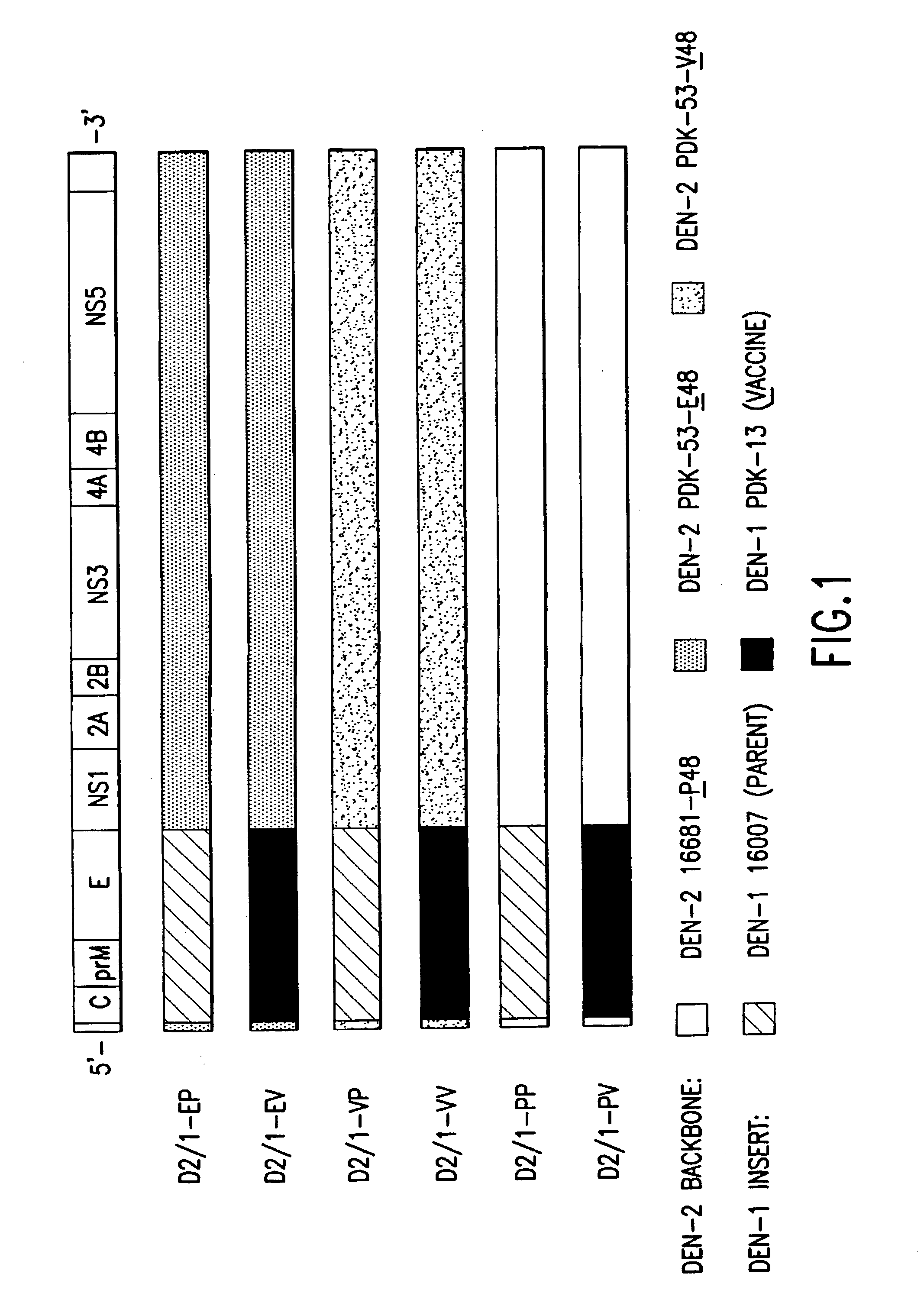
Figure 1 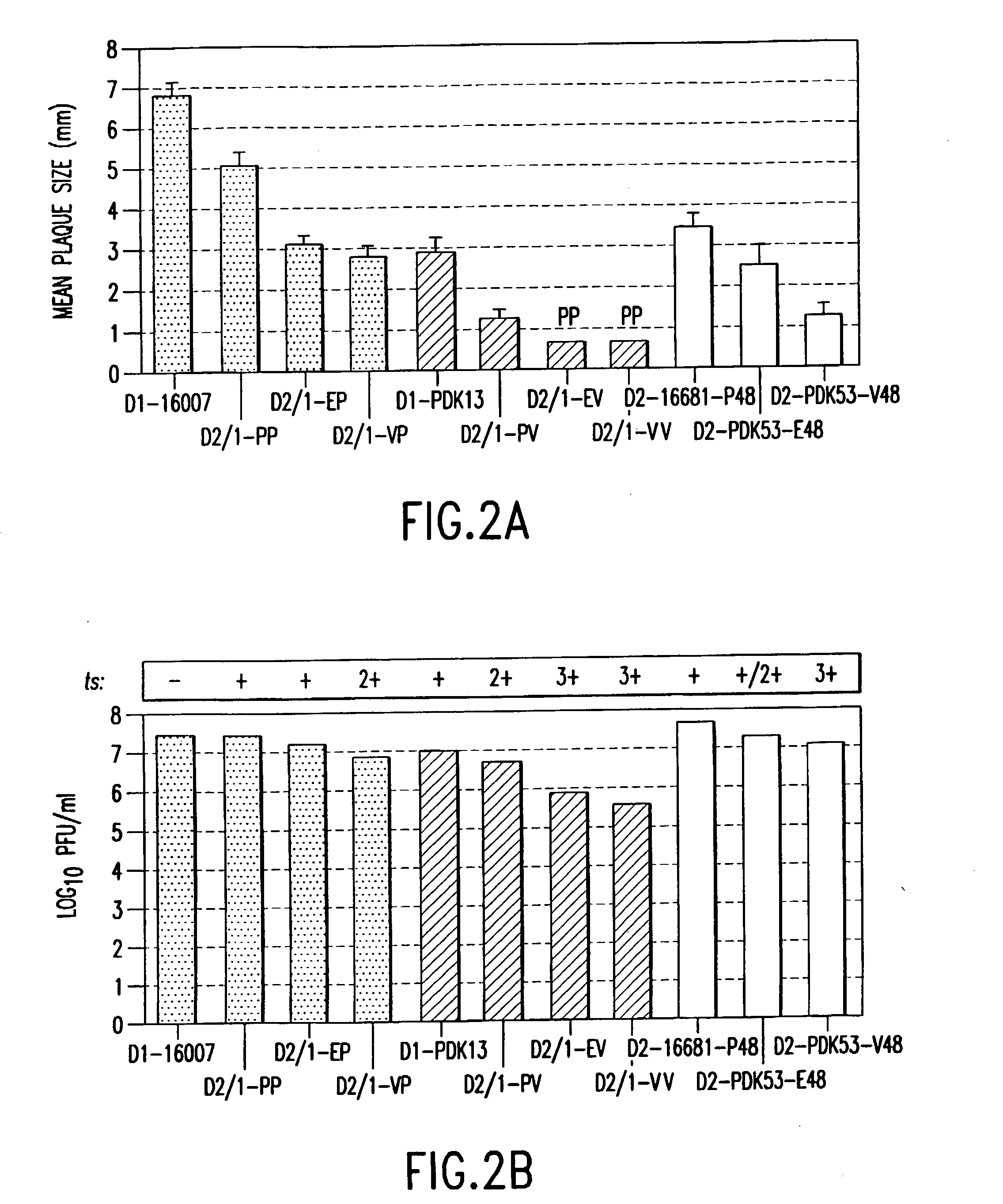
Figure 2 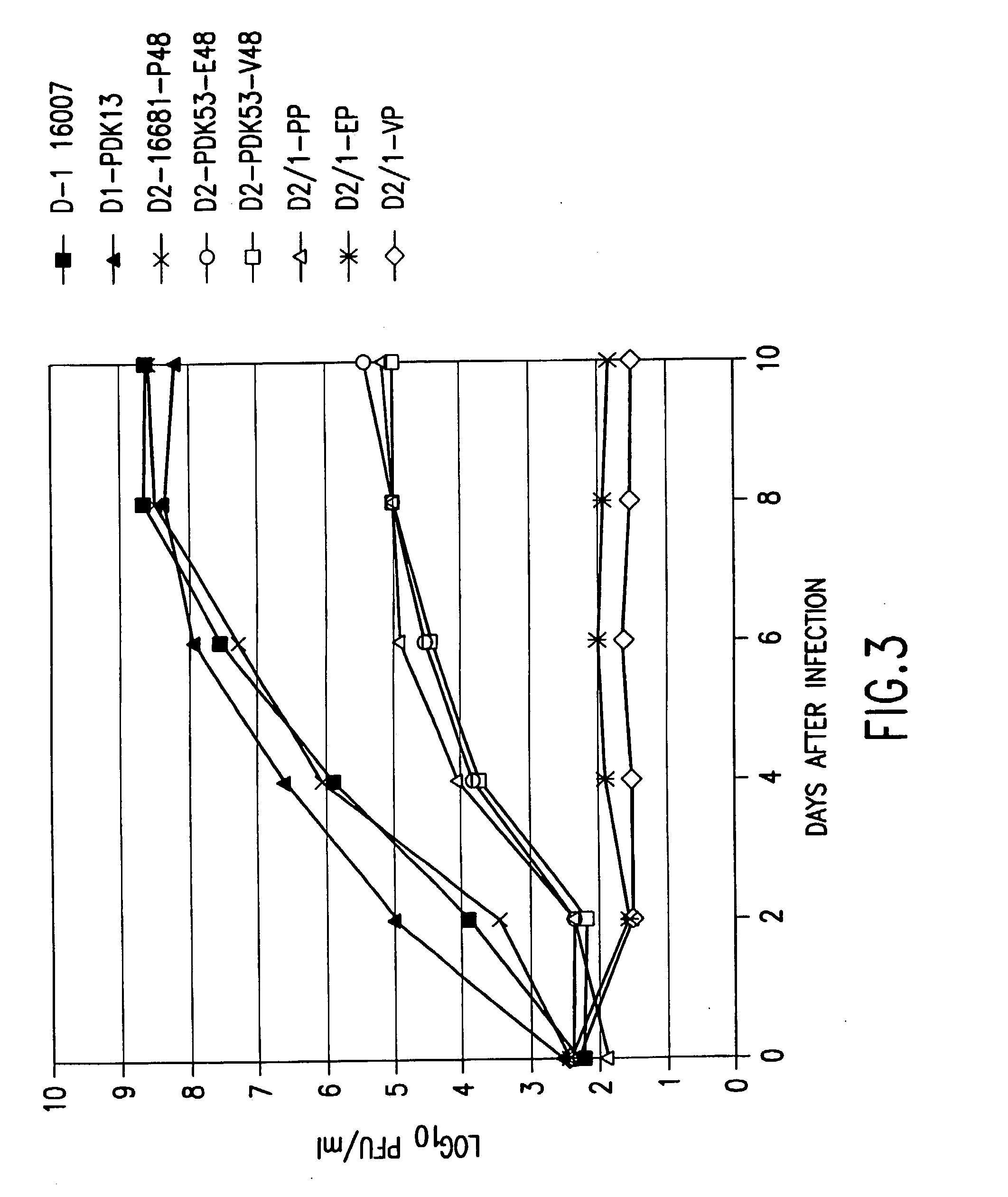
Figure 3
Abstract
Description
[0001] This application claims priority to provisional application Ser. No. 60 / 182,829, filed Feb. 16, 2000, which is herein incorporated in its entirety.
[0002] This invention was made by the Centers for Disease Control and Prevention, an agency of the United States Government. Therefore, the United States Government has certain rights in this invention.FIELD OF THE INVENTION
[0003] The present invention relates to the fields of immunology and virology and more particularly to avirulent, immunogenic flavivivirus chimeras for the production of immunogenic, live, attenuated flavivirus vaccines. BACKGROUND OF THE INVENTION
[0004] Dengue viruses are mosquito-borne pathogens of the genus Flavivirus (family Flaviviridae). Four serotypes of dengue virus (often abbreviated “DEN”) have been identified, including dengue-1, dengue-2, dengue-3 and dengue-4 (DEN-1 to DEN-4). The flavivirus genome is a single-stranded, positive-sense RNA approximately 11 kb in length, containing a 5′-noncoding re...
Examples
example 1
Preparation of a Chimeric Dengue-1 Vaccine: PDK-53 / Dengue-1
Viruses and Cell Cultures
[0112] Wild-type DEN-1 16007 and DEN-2 16681 viruses were available in the virus collection at the Centers for Disease Control and Prevention (Atlanta, Ga.). DEN-1 16007 virus was recovered from the serum of a patient with DHF / DSS in 1964 in Thailand. The virus was isolated following three passages in grivet monkey kidney BS-C-1 cells and one passage in LLC-MK2 cells, passaged twice in Toxorhynchites amboinensis mosquitoes, and then passaged in primary dog kidney (PDK) cells at the Center for Vaccine Development, Mahidol University, Thailand, to derive the candidate DEN-1 PDK-13 vaccine virus (Yoksan et al., “Dengue virus vaccine development: study on biological markers of uncloned dengue 1-4 viruses serially passaged in primary kidney cells,” pp. 35-38, In Arbovirus research in Australia, Proceedings of the Fourth Symposium, CSIRO / QIMR, Brisbane, Australia (1986); Bhamarapravati & Sutee, Vaccine ...
example 2
Construction of Chimeric DEN-2 / 3 Infectious Clones
[0138] An in vitro ligation strategy was used for the full genome-length DEN-2 / 3 infectious clones.
(i) 5′-end DEN-2 / 3 Intermediate Clones: pD2I / D3-P1-Asc and pD2I / D3-E1-Asc
[0139] Intermediate DEN-2 clones, pD2I-P and pD2I-E were used to subclone the DEN-3 16562 virus-specific cDNA fragment. The cDNA fragment containing the prM-E genes of wild-type DEN-3 16562 virus was amplified by reverse transcriptase—polymerase chain reaction (RT-PCR) from DEN-3 viral RNA with primers D3-435.Mlu:
(5′-TGCTGGCCACTTAACTACGCGTGATGGAGAGCCGCGCA-3′ (SEQ ID NO:33); underlined MluI site followed by DEN-3 virus sequence near the 5′ end of the prM gene) and cD3-2394.Ngo:
[0140] (5′-TGTAATGATGCCGGCCGCGATGCATGAAAATGA-3′ (SEQ ID NO:34); underlined NgoMIV site followed by complementary sequence near the 3′ end of the E gene of DEN-3 virus). The MluI site contained a silent mutation for DEN-2 virus at amino acid prM-5-Thr. This position is Ser in DEN-3 virus...
example 3
Construction of Chimeric DEN-2 / 4 Infectious Clones
pD2-16681-P48, pD2-PDK53-E48, pD2-PDK53-V48 Vectors
[0144] The three DEN-2 backbone vectors used for construction of the chimeric DEN-2 / 4 clones were modified as described above. The DEN-2 infectious clones have been previously reported in Kinney et al., 1997. Clone pD2-16681-P48 was modified from pD2 / IC-30P-A to contain cloning sites MluI and NgoMIV at nucleotide positions 451 and 2380, respectively. The same cloning sites were introduced into both DEN-2 PDK-53 virus-specific clones, pD2 / IC-130Vx-4 and -130Vc-K, and the modified clones were designated as pD2-PDK53-E48 and pD2-PDK53-V48, respectively. Two cloning errors were found in the original pD2 / IC-130Vx-4 and -130Vc-K at nt-6665 and nt-8840. These defects were corrected in pD2-PDK53-E48 and -V48. The introduced NgoMIV cloning site resulted in two nucleotide mutations (nt 2381 and 2382; TG to CC), which encoded a Val-to-Ala substitution at E-482 of DEN-2 virus. The nucleotide ...