
Method and control unit for medication administering devices
a technology for medication administration and control units, applied in the direction of drugs and medications, instruments, packaging, etc., to achieve the effects of reducing user programming errors, reducing user operations, and simplifying user operations
Patent Information
- Authority / Receiving Office
- US · United States
- Current Assignee / Owner
- Publication Date
- 2007-04-26
- Estimated Expiration
- Not applicable · inactive patent
Smart Images
Figure 1 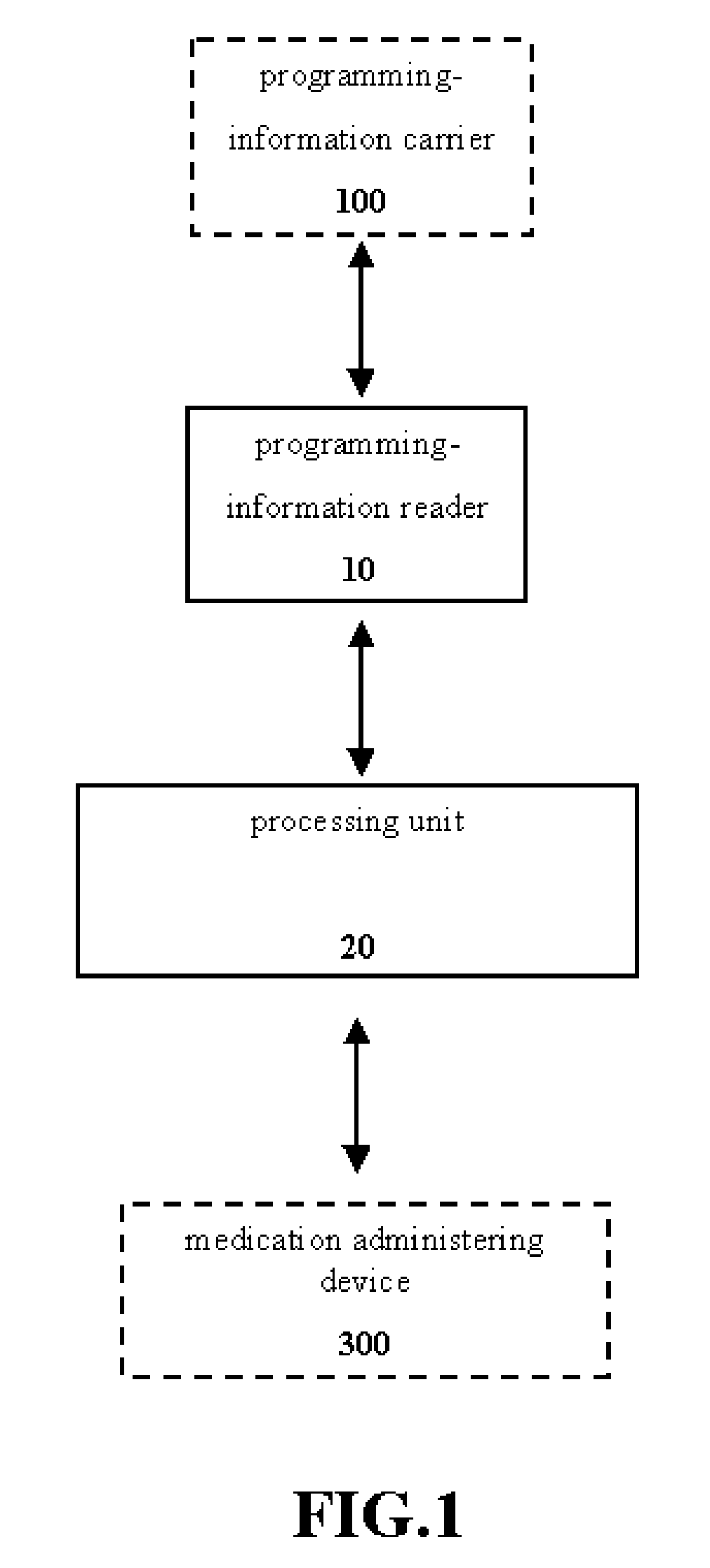
Figure 2 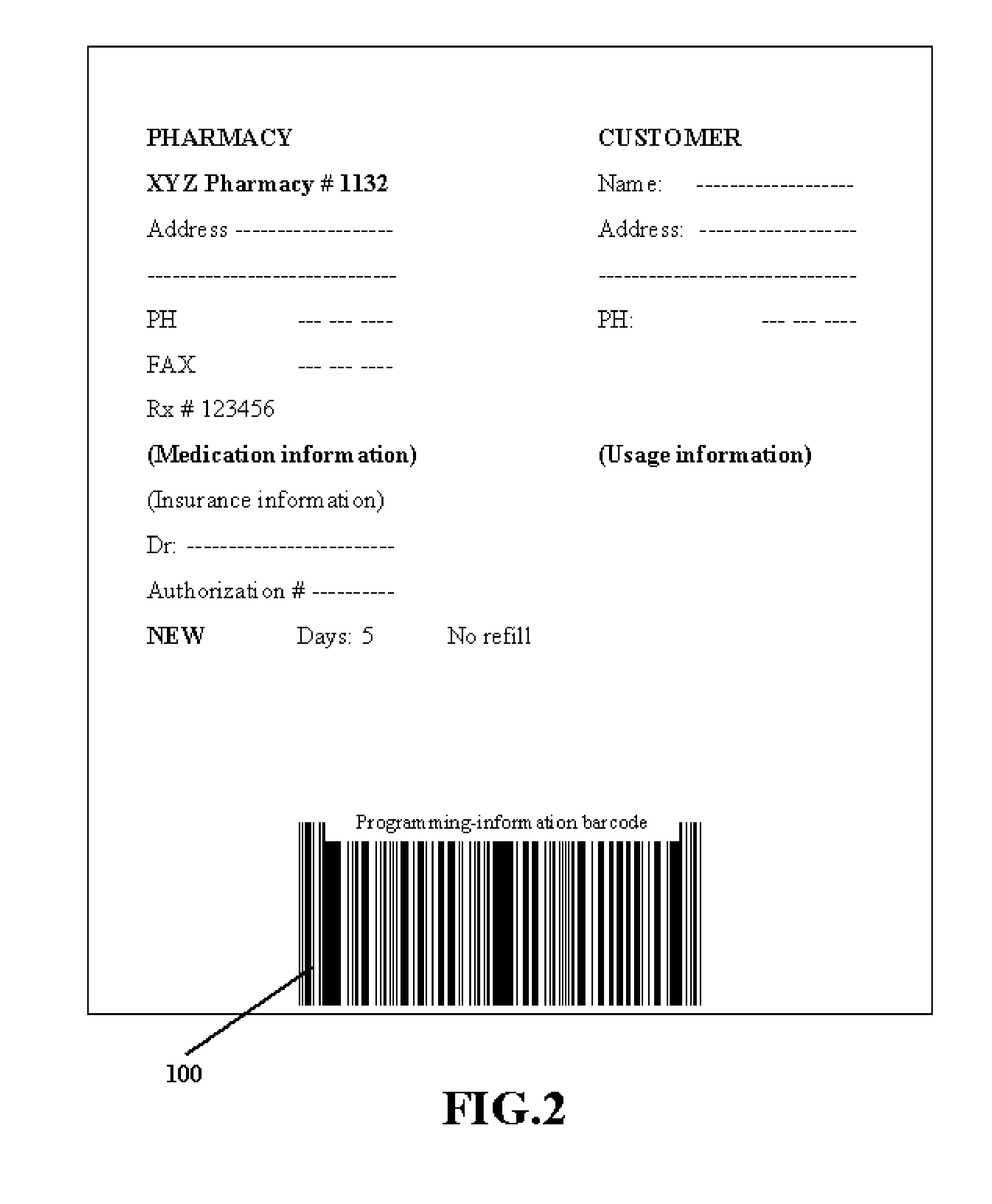
Figure 3
Abstract
Description
BACKGROUND OF THE INVENTION
[0001] 1. Field of Invention
[0002] This invention relates to managing and administering medications, especially to automated system for managing and administering medications.
[0003] 2. Description of Prior Art
[0004] Presently, a doctor prescribes medication for a patient by writing on a standard prescription form, calling a prescription-filling facility, or entering into a specialized computer system (such as Computerized Physician Order Entry, or CPOE) with the prescription information, which normally includes the doctor's information, the patient's information, the medication identifier (name), and the usage information. The usage information usually includes schedule (e.g., one unit dose every morning, one unit dose every four hours, etc.), unit dosage (e.g., three tablets, 10 ml, etc.), and total daily dosage (e.g., 9 tablets, 40 ml., three unit doses, etc.).
[0005] For an inpatient, the prescription is usually filled by an in-hospital medication a...
Examples
embodiment
Preferred Embodiment
[0136] Refer to FIG. 1 for the major components of the control unit of the present invention. The control unit comprises two major components, a programming-information reader 10 and a processing unit 20. The programming-information reader 10 is capable of reading programming information encoded in machine-readable format according to an encoding protocol. The programming information is stored in a programming-information carrier 100. The present invention uses various types of programming information in various suitable situations. Typical ones include medication identifier, usage information, user identifier, and user requests, which can be selectively combined and stored in a single programming-information carrier or stored separately. For clarity and simplicity, the preferred embodiment section mainly concerns two types of programming information unless otherwise stated. The first one contains both medication identifier and usage information of a medication, ...