
MRI compatible, radiopaque alloys for use in medical devices
a radiopaque alloy and compatible technology, applied in the field of medical devices, can solve the problems of not being able to achieve fluoroscopy fluoroscopy and compromising clinical functionality, and achieve the effects of reducing strain, improving clinical function, and excellent mri compatibility and biocompatibility
Patent Information
- Authority / Receiving Office
- US · United States
- Patent Type
- Applications(United States)
- Current Assignee / Owner
- Publication Date
- 2008-08-14
- Estimated Expiration
- Not applicable · inactive patent
Smart Images
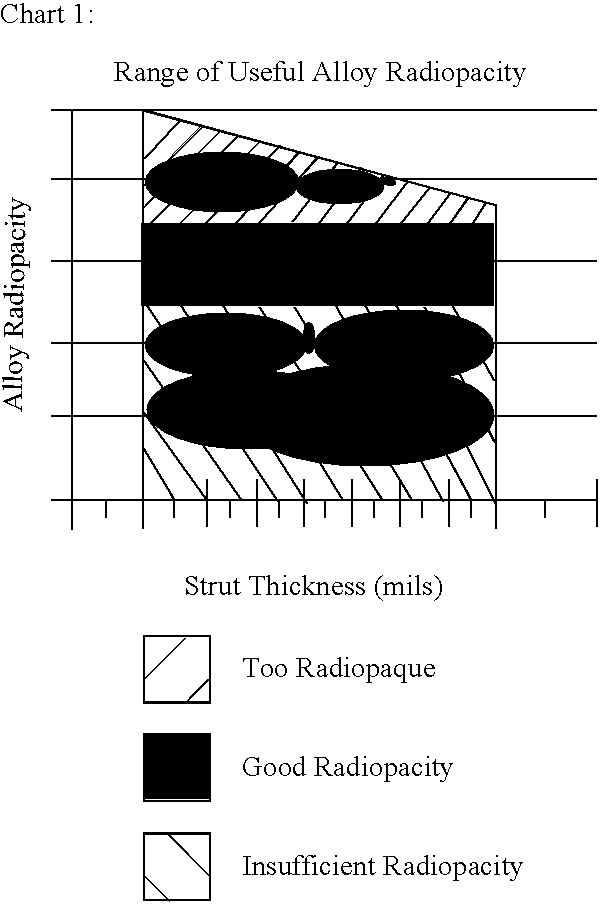
Figure 1
Abstract
Description
CROSS-REFERENCE TO RELATED APPLICATIONS
[0001] This application claims priority from U.S. Provisional Application No. 60 / 901,568, filed on Feb. 13, 2007, the contents of which are hereby incorporated by reference in their entirety.BACKGROUND OF THE INVENTION
[0002] This invention relates to medical devices for use in a human body. In particular, the invention relates to, but is not limited to, medical devices for treating or repairing the body including anastomosis devices such as clips, abdominal aortic aneurysm (AAA) grafts, and metal stents that can be viewed effectively by fluoroscopy (x-ray), computer tomography (x-ray based), and magnetic resonance imaging (MRI).
[0003] Currently, x-ray (fluoroscopy, computer tomography (CT) and electron beam tomography (EBT)) is the preferred imaging modality for cardiovascular interventional procedures, such as delivering and implanting stents. Stent placement requires real time visualization so that the interventionalist can track the delivery de...
Examples
Embodiment Construction
[0017]The present invention relates to a metallic alloy that provides a sufficient degree of radiopacity and MRI compatibility to be visible using both fluoroscopy and MRI imaging technology. The metallic alloy is particularly suitable for medical devices including, but not limited to, intravascular stents, anastomosis clips, and AAA grafts. As an example by comparison, the medical device formed of 316L stainless steel will have some radiopacity under fluoroscopy, however, the same device will generate a “black hole” imaging artifact around the metal device when viewed under MRI imagery. The alloy of the present invention solves the prior art problems by providing a medical device formed of the alloy of the present invention that is compatible with both fluoroscopy and MRI imaging.
[0018]Metallic alloy families that provide sufficient radiopacity under both fluoroscopy and MRI imaging include aluminum (Al), titanium (Ti), zirconium (Zr), niobium (Nb), molybdenum (Mo), silver (Ag), in...