
Ionic complexes
a technology of complexes and complexes, applied in the field of ionic complexes, can solve the problems of disease remains tooth restoration surfaces can be susceptible to further dental caries, and dental caries is still a major public health problem, so as to reduce the solubility of tooth enamel, prolong the effect of marked effect, and increase the prophylactic
Patent Information
- Authority / Receiving Office
- US · United States
- Patent Type
- Applications(United States)
- Current Assignee / Owner
- Publication Date
- 2010-08-26
Smart Images
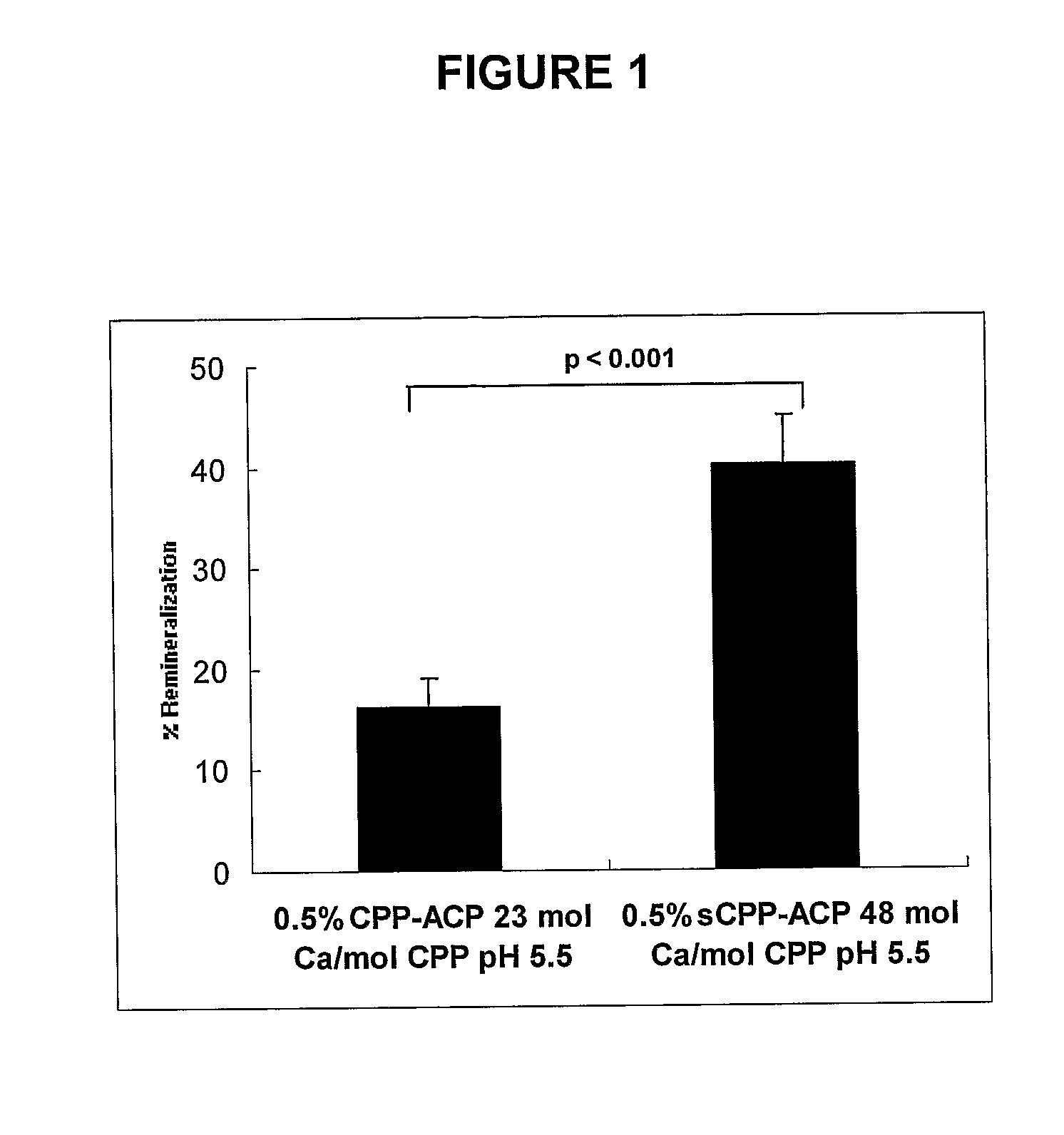
Figure 1 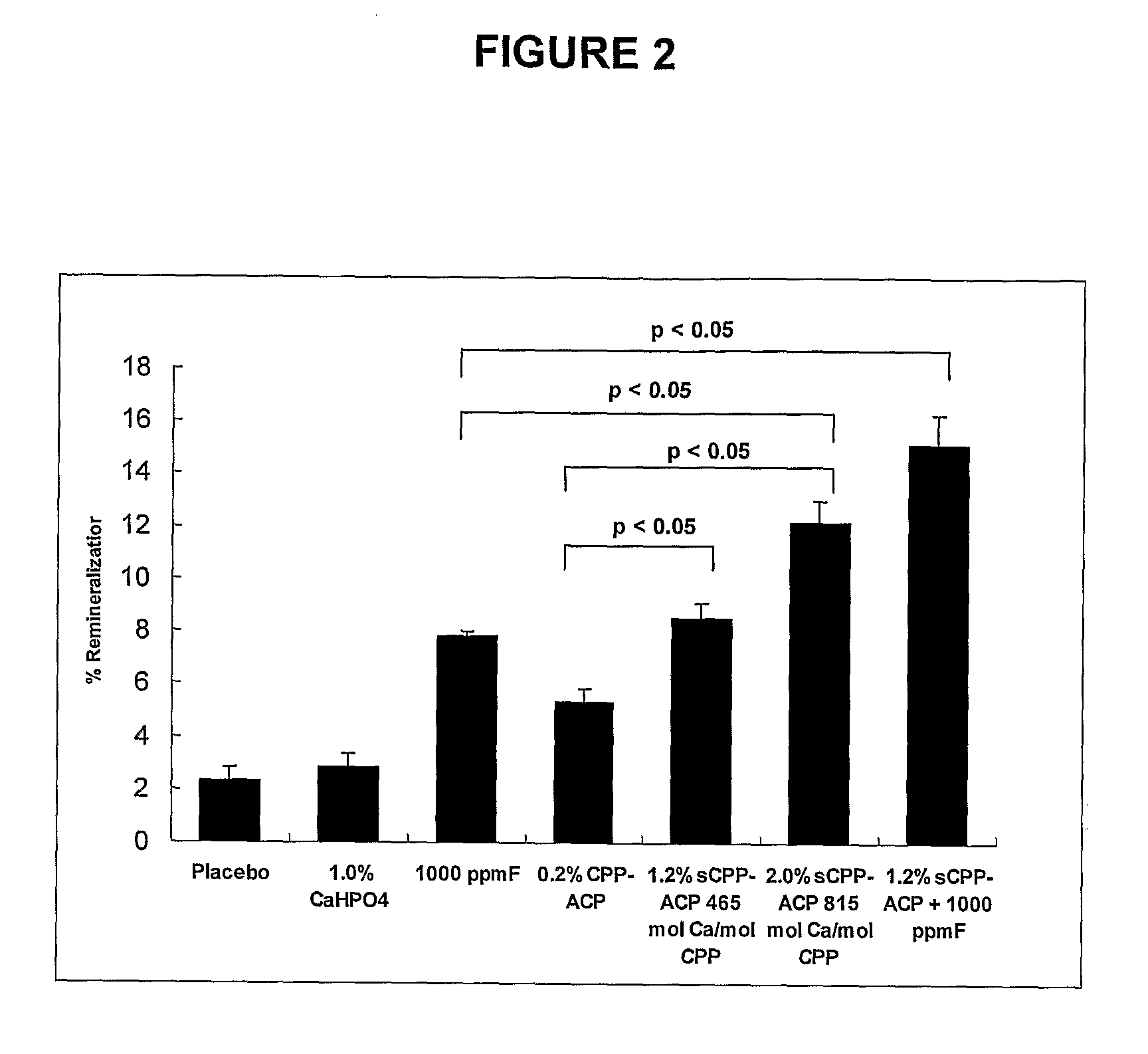
Figure 2
Abstract
Description
[0001] The present invention relates to superloaded complexes of amorphous calcium phosphate and / or amorphous calcium fluoride phosphate stabilised by phosphopeptides / phosphoproteins. These superloaded complexes have anticariogenic properties useful to protect tooth and bone structures as they remineralize (repair) early stages of dental caries as well as other dental / medical applications (including anti-calculus, anti-erosion / corrosion and anti-dentinal hypersensitivity). Methods of making the superloaded complexes of the invention and of treatment or prevention of dental caries, dental calculus, dental erosion / corrosion and dental hypersensitivity are also provided.BACKGROUND
[0002] Dental caries is initiated by the demineralization of hard tissue of the teeth usually by organic acids produced from fermentation of dietary sugar by dental plaque odontopathogenic bacteria. Dental caries is still a major public health problem. Further, restored tooth surfaces can be susceptible to furth...
Examples
example 2
[0087]In another example Recaldent™ (CPP-ACP) powder was dry blended with CaHPO4 powder in the ratio CPP-ACP:CaHPO4 equals 1:10 on a weight basis. This powder was then added to sugar-free gum and toothpaste formulations at 1-5% w / w.
example 3
Comparison of Remineralization of Enamel Subsurface Lesions In Vitro by Normal CPP-ACP and Superloaded CPP-ACP (sCPP-ACP)
[0088]The polished enamel surface of extracted human third molars were sawn as a slab (8×4 mm2) and covered with acid resistant nail varnish to form an occlusal-half and a gingival-half mesiodistal window (1×7 mm2) separated by 1 mm [Reynolds E. C. (1997) J. Dent. Res. 76, 1587-1595]. Subsurface enamel lesions were created in these windows using the Carbopol method of White [White D. J. (1987) Caries Res 21, 228-242] as modified by Reynolds [Reynolds E. C. (1997) J. Dent. Res. 76, 1587-1595]. The enamel slabs were sawn in half to 4×4 mm2 blocks. The gingival-half lesion on one block and the occlusal-half lesion on the other block were sealed with varnish to create the demineralized controls as described by Reynolds [Reynolds E. C. (1997) J. Dent. Res. 76, 1587-1595].
[0089]The enamel half-lesions were exposed to the two different remineralization solutions for 10 d...
example 4
[0094]The ability of toothpaste formulations containing superloaded CPP-ACP (sCPP-ACP) to remineralize enamel sub-surface lesions was investigated in a randomized, cross-over, double-blind in situ clinical study using the protocol of Reynolds et al. [Reynolds E. C. et al., (2003) J Dent Res. 82, 206-211]. Ten subjects wore removable palatal appliances with six, human enamel, half-slabs containing sub-surface demineralized lesions prepared as described in Example 3. The other half of each enamel slab was stored in a humidified container and was used as the control demineralized lesion. There were seven treatments in the study, toothpaste B containing 0.2% w / w normal CPP-ACP, toothpaste C containing 0.2% CPP-ACP / 1.0% CaHPO4 (referred to in FIG. 2 and Example 5 as “1.2% sCPP-ACP”), toothpaste E containing 1.0% CaHPO4, toothpaste F containing 1000 ppm F, toothpaste G containing 1.2% sCPP-ACP plus 1000 ppmF, toothpaste D containing 0.2% CPP-ACP / 1.8% CaHPO4 (referred to in FIG. 2 and Exam...