
Power-measured pulses for thermal trimming
a technology of resistors and pulses, applied in the direction of resistor details, resistor mounting/supporting, instruments, etc., can solve the problems of inability to ensure that the temperature induced by subsequent pulses will have a specific relationship, and the instability of resistors can become unstable during trimming signals, etc., to achieve constant power dissipation and unpredictable instability of resistors
Patent Information
- Authority / Receiving Office
- US · United States
- Patent Type
- Applications(United States)
- Current Assignee / Owner
- Publication Date
- 2012-01-26
- Estimated Expiration
- Not applicable · inactive patent
Smart Images
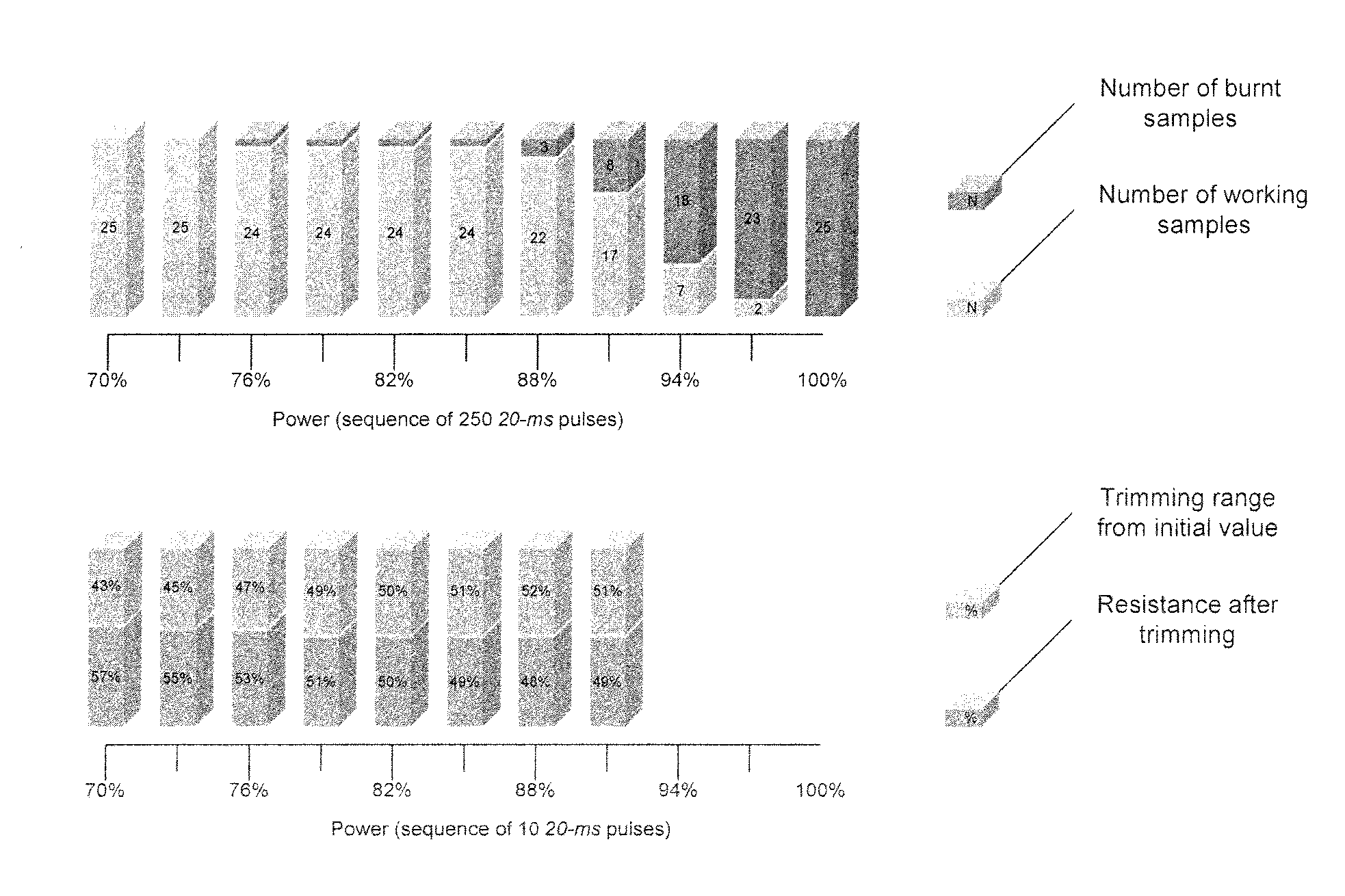
Figure 1 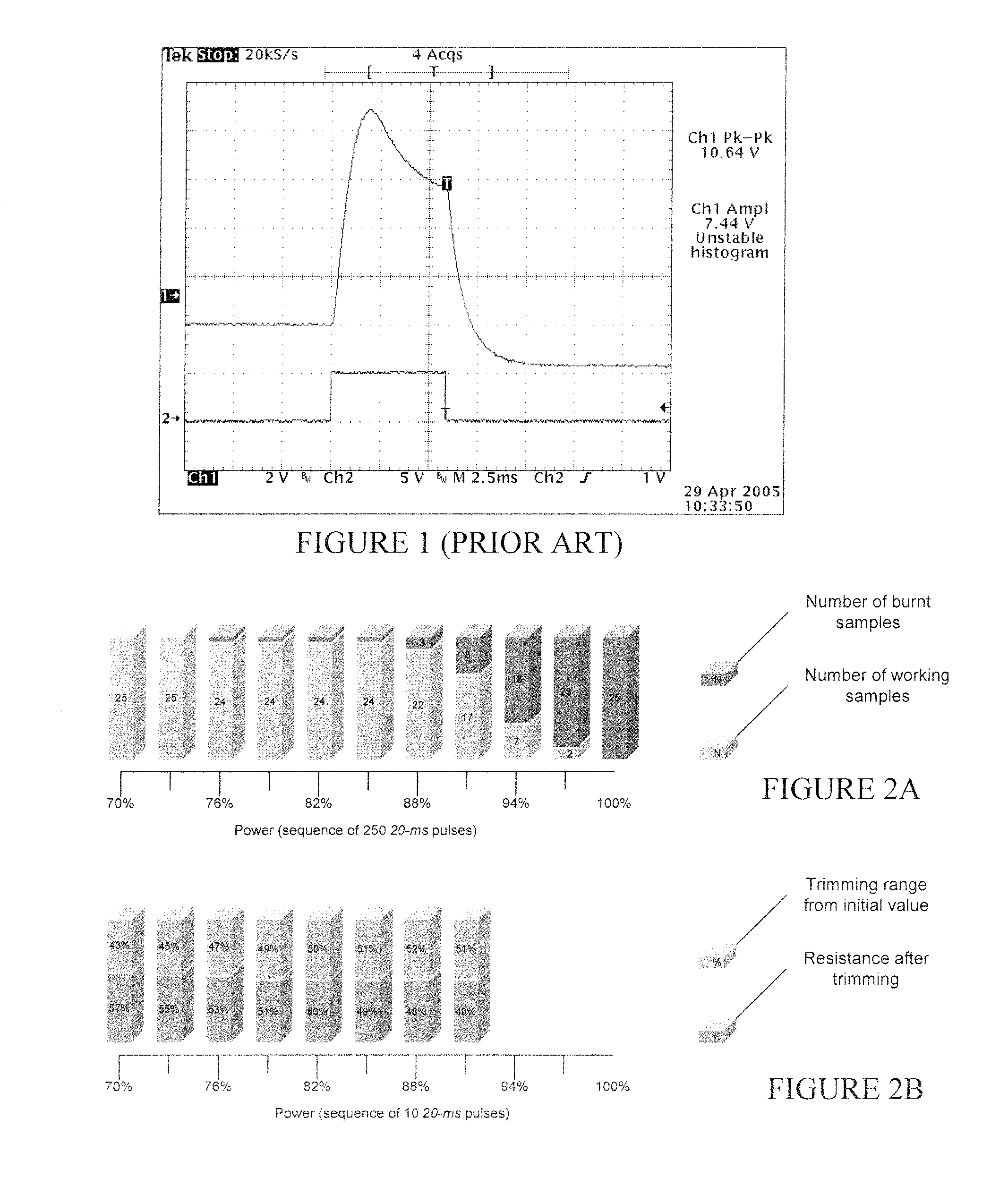
Figure 2 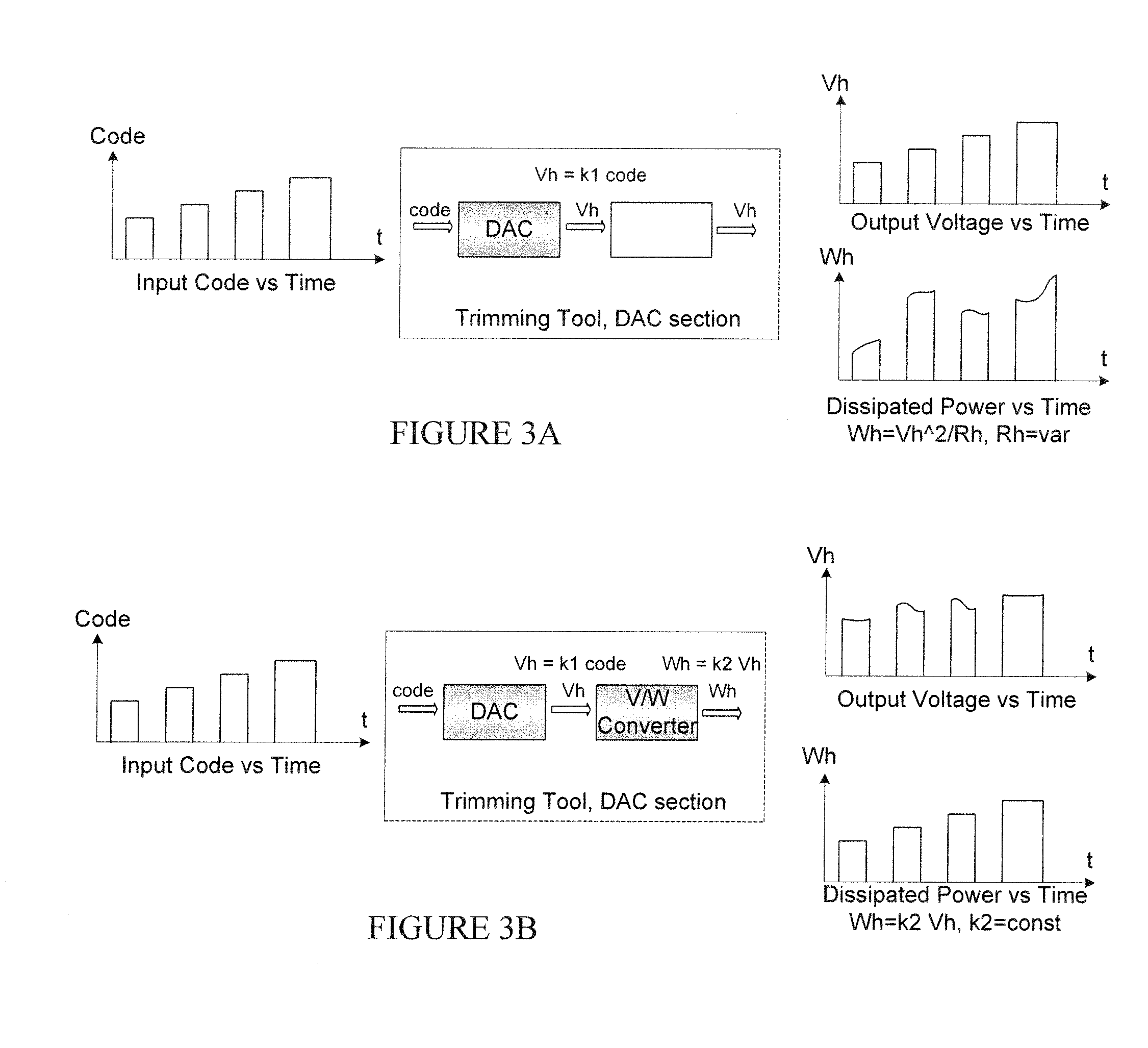
Figure 3
Abstract
Description
CROSS-REFERENCE TO RELATED APPLICATIONS
[0001] The present application is a divisional application of U.S. patent application Ser. No. 11 / 793,385, which is a national stage of PCT Patent Application No. PCT / CA2007 / 000139 filed on Jan. 30, 2007, which claims priority of U.S. Provisional Patent Application No. 60 / 762,884, filed on Jan. 30, 2006.TECHNICAL FIELD
[0002] The invention relates to resistors and resistor networks which are electro-thermally trimmable, and more specifically, to thermal trimming of these resistors to adjust parameters such as resistance, temperature coefficient of resistance and relative temperature coefficient of resistance.BACKGROUND OF THE INVENTION
[0003] Prior art on thermal trimming of resistors has disclosed and addressed several configurations and variations. Thermal trimming of a thermally-mutable resistor is possible whether or not it is residing on or in a thermally-isolated microstructure. Also, there may or may not be a separate auxiliary heater used to...
Examples
Embodiment Construction
[0027]This invention proposes a method to mitigate the above-described problem of heater-resistor stability. Thermal trimming is fundamentally controlled by temperature, and typically there is no reliable temperature sensor in the trimming zone (because typically the heater-resistor and functional-resistor may be both unstable at trimming temperatures, and because design of another explicit temperature sensor would raise further inconvenience). Therefore, the resistors, microstructure, and system to apply heating pulses, are co-designed, taking account of the temperature-coefficients (magnitude and sign) of resistance of the heater, heating-pulse-voltage, pulse-current and pulse-power, speed of resistance changes in the heater-resistor during thermal trimming, relative temperature ranges of thermal trimmability of the heater-resistor and functional resistor, as well as thermal inertia and thermal isolation of the microstructure(s).
[0028]Pulses of constant electric power are used for...