
Curable-on-demand composition comprising dual reactive silane functionality
a technology of reactive silane and composition, which is applied in the direction of group 5/15 element organic compounds, film/foil adhesives, transportation and packaging, etc., can solve the problems of difficult to obtain the good balance between these properties, slow or incomplete cure, and difficult to process materials without risking premature gelation, etc., to achieve stable solution, fast cure upon drying, and efficient processing
Patent Information
- Authority / Receiving Office
- US · United States
- Patent Type
- Applications(United States)
- Current Assignee / Owner
- Publication Date
- 2013-07-11
- Estimated Expiration
- Not applicable · inactive patent
Smart Images
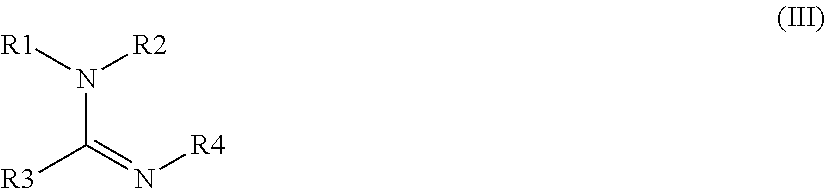
Figure 1 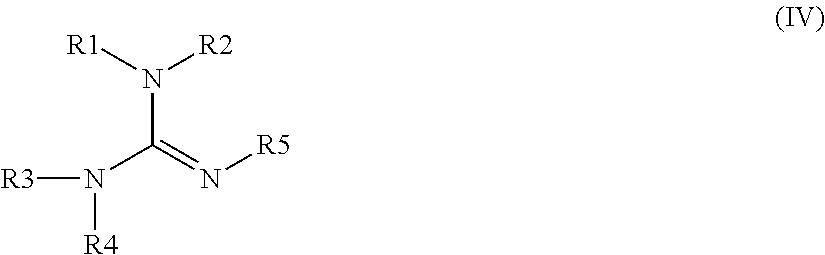
Figure 2 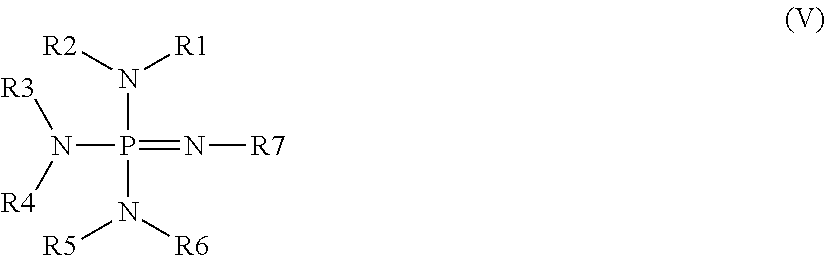
Figure 3
Abstract
Description
STATEMENT OF PRIORITY
[0001] This application claims the priorities of U.S. Provisional Applications Nos. 61 / 360,007, filed Jun. 30, 2010; and 61 / 360,068, also filed Jun. 30, 2010; the contents of which are hereby incorporated by reference.FIELD
[0002] This invention relates to curable compositions comprising reactive silane functionality and, in other aspects, to articles comprising the compositions and to processes for curing the compositions.BACKGROUND
[0003] Moisture-curable compositions cure in the presence of moisture to form crosslinked materials such as adhesives, sealants, and coatings that are useful in many industries. The moisture for curing is typically obtained from the atmosphere or from a substrate to which the composition has been applied, although it can also be added to the composition (for example, to enable curing in depth or in confinement).
[0004] Moisture-curable compositions usually comprise polymers having groups (for example, alkoxysilyl or acyloxysilyl moieties) ...
Examples
example 1
[0128]A mixture of 34.0 g (0.2 mol) 1,8-diazabicylo[5.4.0]undecene and 200 mL toluene was mixed with 34.2 g (0.2 mol) benzyl bromide. An insoluble oil formed and then changed to a white solid as the temperature rose to 57° C. over 10 minutes. After 4 hours, the solid was filtered and dried to provide 62.5 g of 8-benzyl-1,8-diazabicyclo[5.4.0]undecane (the 8-benzyl salt of DBU, which was soluble in water). NaBH4 solution (1.58 g, 5.1 mmol, 4.4M NaBH4 in 14M NaOH solution, obtained from Alfa Aesar, Ward Hill, Mass.) was diluted with 10 mL water. Then, 15 mL t-butyl methyl ether (t-BuOMe) was added to the diluted solution, and the resulting mixture was magnetically stirred and cooled to 3° C. To the cooled mixture was added 3.23 g of the 8-benzyl salt of DBU prepared as described above. After 2 hours, the resulting cold mixture was phase split, the resulting aqueous layer was extracted with t-BuOMe, and the resulting t-BuOMe solutions were combined, dried, and stripped to yield 0.86 g ...