
Socks and other footwear with selective friction reducing features
Patent Information
- Authority / Receiving Office
- US · United States
- Current Assignee / Owner
- Publication Date
- 2013-10-10
- Estimated Expiration
- Not applicable · inactive patent
Smart Images
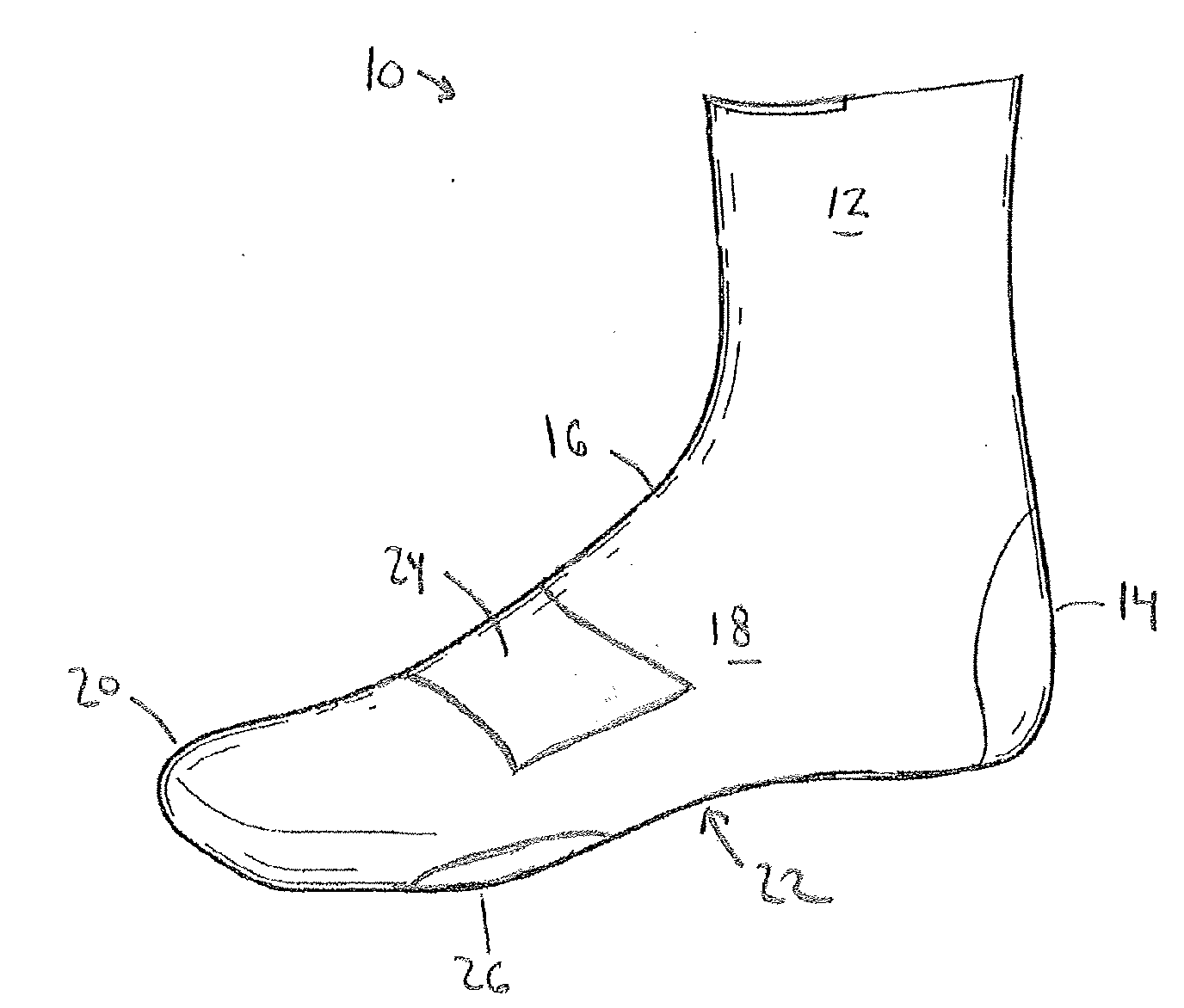
Figure 1 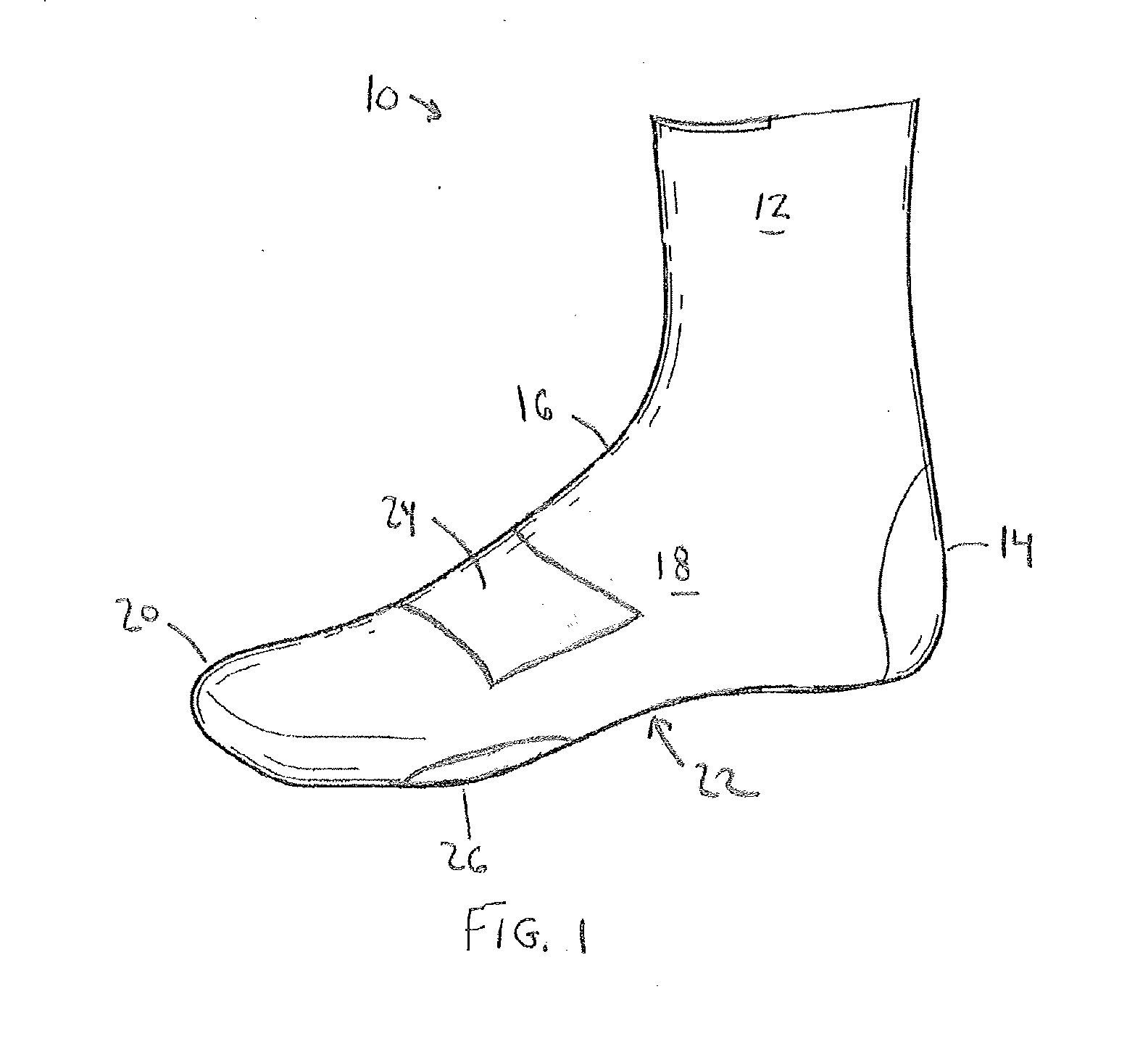
Figure 2 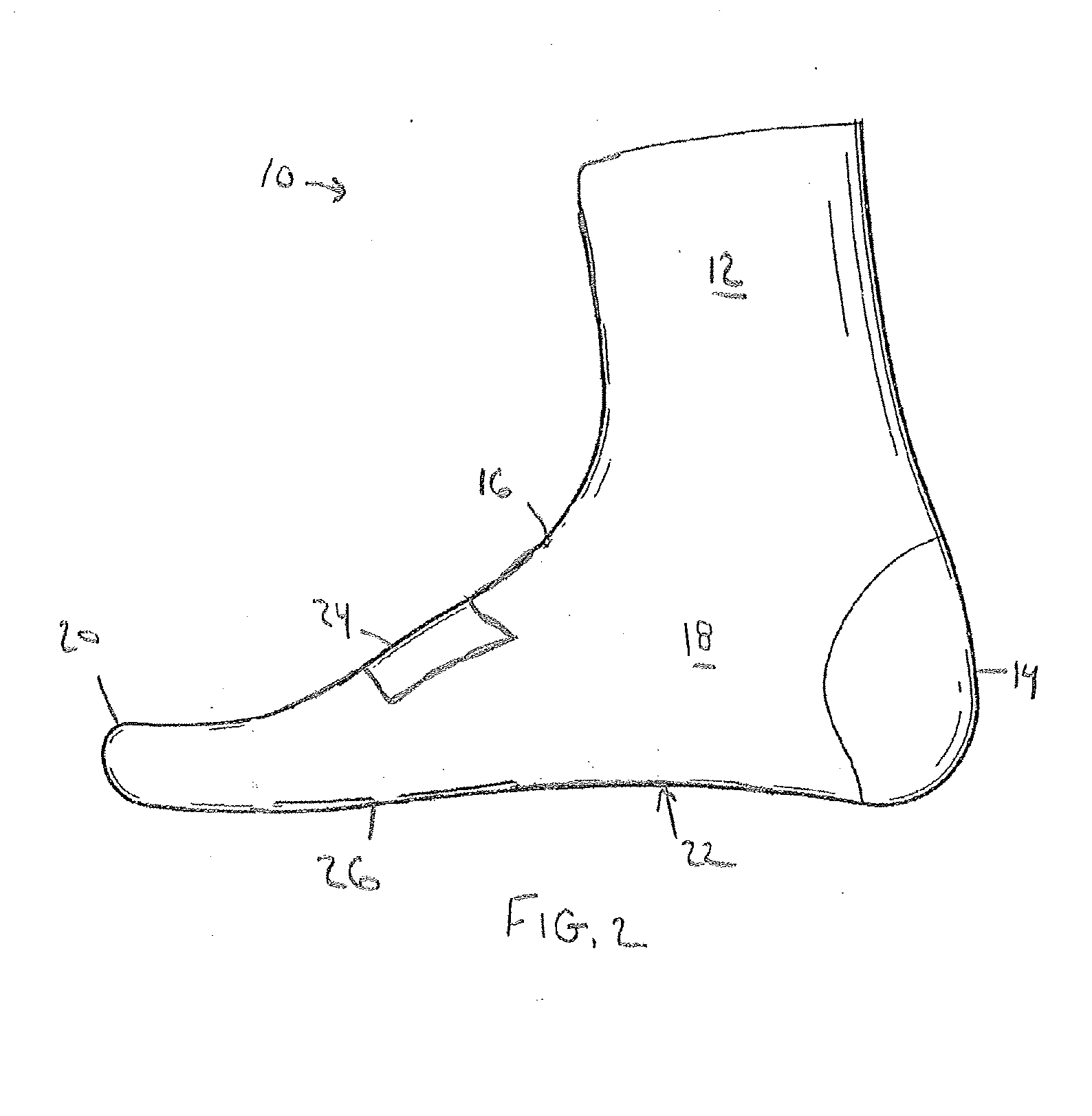
Figure 3
Abstract
Description
CROSS REFERENCE TO RELATED APPLICATION
[0001] This application is a nonprovisional, and claims the priority benefit, of U.S. provisional patent application Ser. No. 61 / 620,077 filed Apr. 4, 2012, of the same title and by the same inventor. The content of that application is incorporated herein by reference.BACKGROUND OF THE INVENTION
[0002] 1. Field of the Invention
[0003] The present invention relates to footwear. More particularly, the present invention relates to inner footwear, such as socks and stockings, as well as outer footwear, such as, for example, dress shoes, casual shoes, athletic boots, protective boots, sneakers, orthopedic shoes and the like. Still more particularly, the present invention relates to footwear with selective friction reducing features to reduce the difficulty of inserting a foot into outer footwear such as a boot.
[0004] 2. Description of the Prior Art
[0005] People wear outer footwear of different types for a wide range of reasons. Outer footwear includes shoes...
Examples
first embodiment
[0030]In the sock 10, at least one of the heel portion 14, the arch portion 24 and the ball portion 26 is fabricated with a low-friction material applied to a portion or substantially all of the outer surface of such one or more portions. The low-friction material may be a viscoelastic material or a nonviscoelastic material having a low coefficient of friction. For example, the material may be silicone. Alternatively, the low-friction material may be a spray-on material adhered to the surface of the sock 10 at one or more of the heel portion 14, the arch portion 24 and the ball portion 26. The spray-on material may be a Teflon® spray material but not limited thereto. The low-friction material applied to the sock 10 at one or more of the indicated portions may also be a metallic or a nonmetallic material selected for a coefficient of friction that is less than the remainder of the material used to make the sock 10.
second embodiment
[0031]In the sock 10, at least one of the heel portion 14, the arch portion 24 and the ball portion 26 is fabricated with one or more fibers coated with a low-friction material applied to a portion or substantially all of the outer surface of such fibers. The low-friction material may be a viscoelastic material or a nonviscoelastic material having a low coefficient of friction. For example, the material may be silicone. The fibers that are coated may be any manmade or natural fibers. The fibers may be selected from, but are not limited to, cotton and wool. The coated fibers may be integrated, that is, interspersed, with the other fibers or weaves of the conventional material(s) used to make the other portions of the sock 10 in one or more of the portions 14, 24 and 26, such as cotton, or they may be used as replacements for the materials in those areas. In that embodiment, the coated fibers would be joined with adjacent conventional fibers, such as by weaving, rather than by intersp...
third embodiment
[0032]In the sock 10, at least one of the heel portion 14, the arch portion 24 and the ball portion 26 is fabricated with one or more low-friction fibers. The one or more low-friction fibers may be any manmade or natural fibers having a coefficient of friction less than the coefficient of friction of the remainder of the material used to make the sock 10. The low-friction fibers may be selected from, but are not limited to, nylon, polyethylene and polypropylene fibers. Other viscoelastic and non-viscoelastic materials may be selected for that purpose. The fibers may be integrated, that is, interspersed, with the other fibers or weaves of the conventional material(s) used to make the other portions of the sock 10 in one or more of the portions 14, 24 and 26, such as cotton, or they may be used as replacements for the materials in those areas. In that embodiment, the low-friction fibers would be joined with adjacent conventional fibers, such as by weaving, rather than by interspersing...