
Dielectric ceramic and laminated ceramic capacitor
a technology of laminated ceramic and dielectric ceramic, which is applied in the direction of fixed capacitor details, inorganic insulators, fixed capacitors, etc., can solve the problems of significant decrease in high-temperature load life, and achieve the effects of reducing high-temperature load life, and improving high-temperature load li
Patent Information
- Authority / Receiving Office
- US · United States
- Current Assignee / Owner
- Publication Date
- 2014-01-09
Smart Images
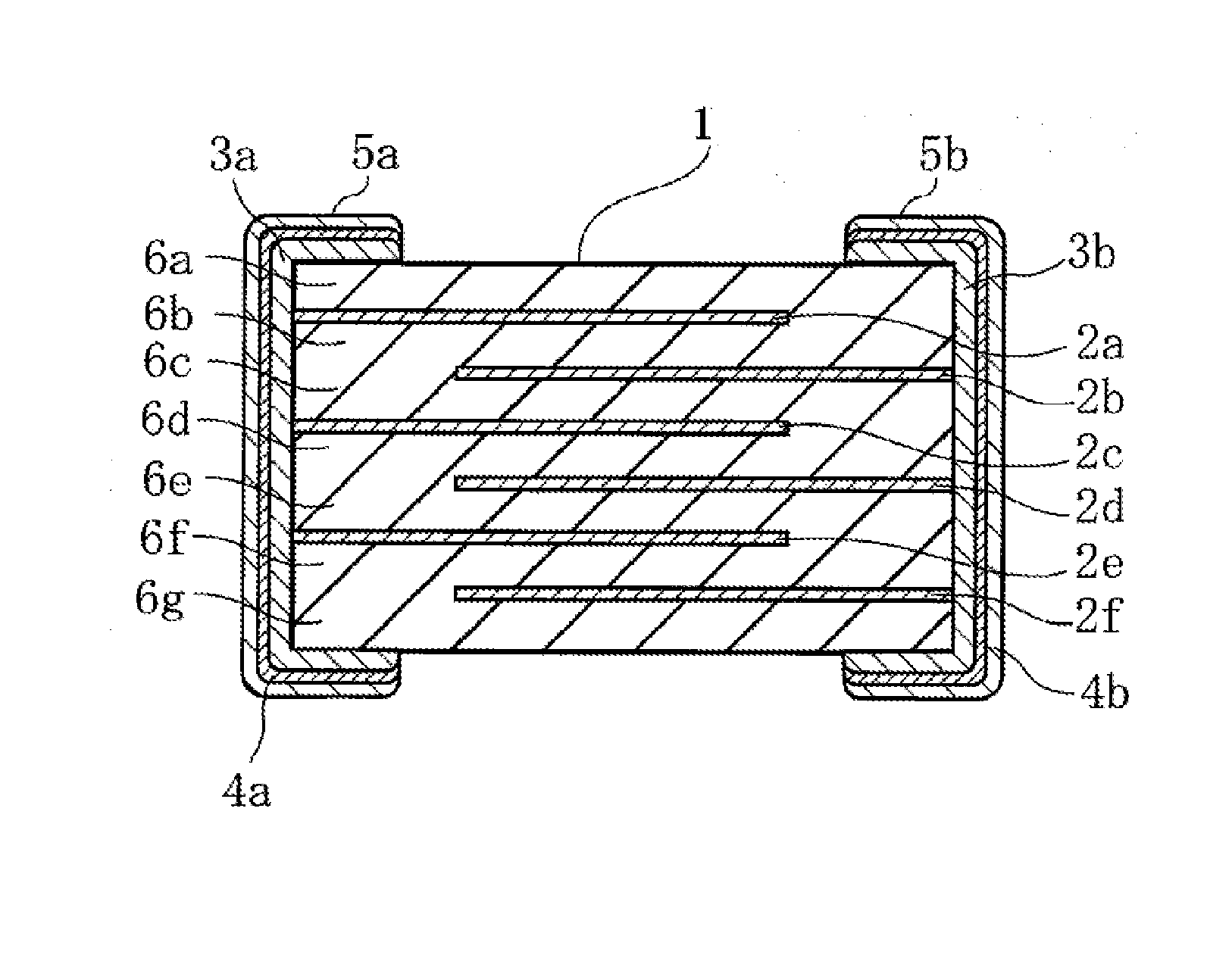
Figure 1 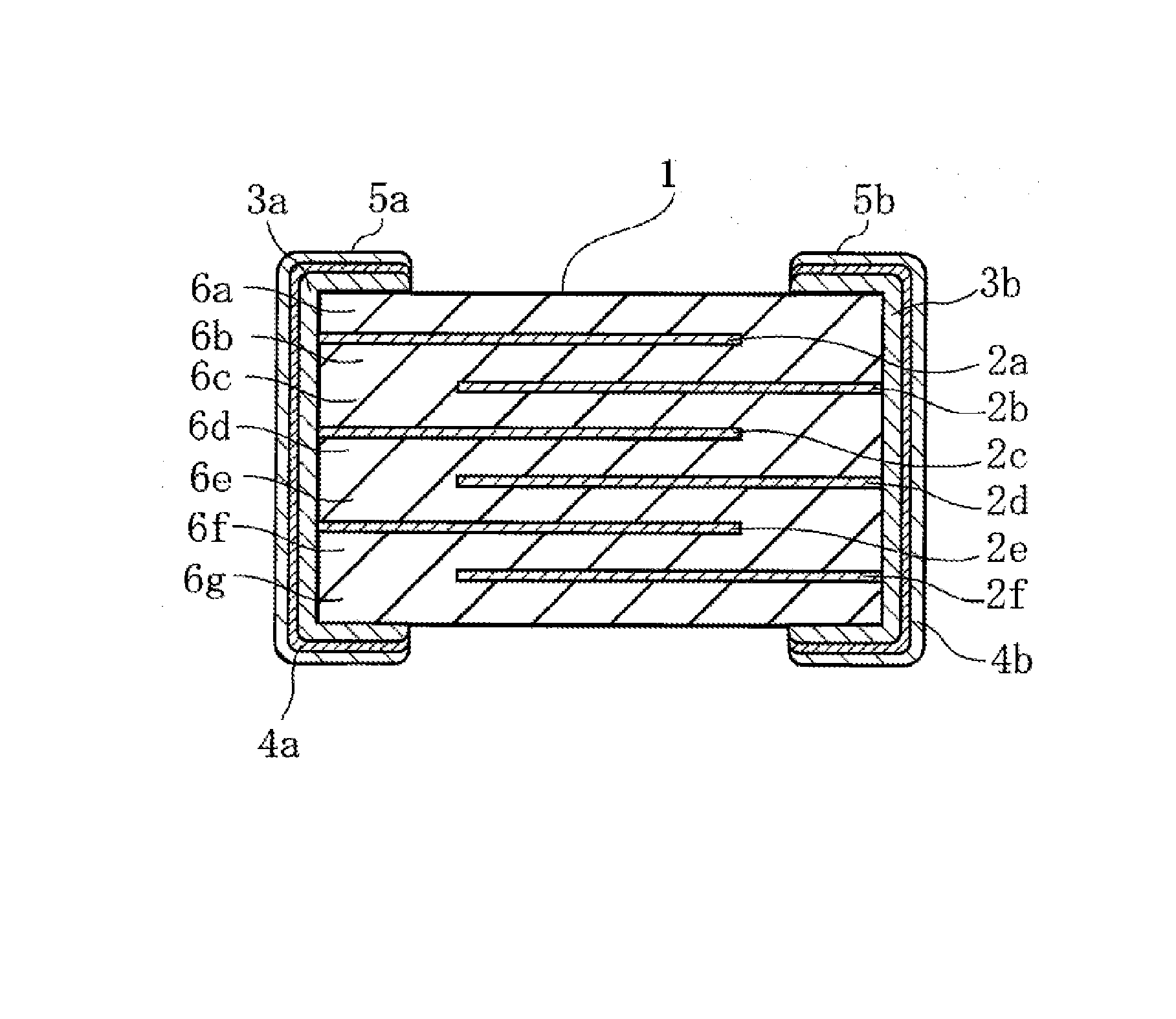
Figure 2
Abstract
Description
CROSS REFERENCE TO RELATED APPLICATIONS
[0001] The present application is a continuation of International application No. PCT / JP2012 / 056576, filed Mar. 14, 2012, which claims priority to Japanese Patent Application No. 2011-057415, filed Mar. 16, 2011, the entire contents of each of which are incorporated herein by reference.FIELD OF THE INVENTION
[0002] The present invention relates to a dielectric ceramic and a laminated ceramic capacitor, and more particularly, to a dielectric ceramic suitable for a dielectric material for a small-sized and high-capacitance laminated ceramic capacitor, and a laminated ceramic capacitor manufactured with the use of the dielectric ceramic.BACKGROUND OF THE INVENTION
[0003] With the development of electronics technology in recent years, the reduction in size and the increase in capacitance have been rapidly advanced on laminated ceramic capacitors. Further, with the reduction in size and increase in capacitance for laminated ceramic capacitors, dielectric...
Examples
example 1
[0074][Preparation of Samples]
[0075](Sample Numbers 1 to 6)
[0076]High-purity BaCO3, CaCO3, and TiO2 were prepared as ceramic raw materials, and these ceramic raw materials were weighed for the molar substitution x and compounding molar ratio m of Ca as shown in Table 1. Then, these weighed materials were put along with PSZ balls and pure water into a ball mill, subjected to sufficient mixing and grinding in a wet way, and to drying, and then subjected to calcination at a temperature of 1050° C. for about 2 hours, thereby preparing main constituent powders with an average grain size of 0.20 μm (synthesis of main-phase grains).
[0077]Next, Y2O3, SiO2, MgO, MnCO3, and V2O5 were prepared as accessory constituent powders. Then, these accessory constituent powders were weighed for the contents of Y, Si, Mg, Mn, and V in terms of parts by mol as shown in Table 1 with respect to 100 parts by mol of the Ti contained in the main constituent powder, and subjected to wet mixing in a ball mill, a...
example 2
[0120]High-purity BaCO3, CaCO3, and TiO2 were prepared as ceramic raw materials, and these ceramic raw materials were weighed for the molar substitution x and compounding molar ratio m of Ca as shown in Table 3. Then, these weighed materials were put along with PSZ balls and pure water into a ball mill, subjected to sufficient mixing and grinding in a wet way, and to drying, and then subjected to calcination at a temperature of 1000 to 1200° C. for about 2 hours, thereby preparing main constituent powders with an average grain size of 0.20 μm (synthesis of main-phase grains).
[0121]Next, Y2O3, SiO2, MgO, MnCO3, and V2O5 were prepared as accessory constituent powders. Then, these accessory constituent powders were weighed for the contents of Y, Si, Mg, Mn, and V in terms of parts by mol as shown in Table 3 with respect to 100 parts by mol of the Ti contained in the main-phase grains, and subjected to wet mixing in a ball mill, and to a drying treatment to obtain ceramic raw material p...
example 3
[0139]High-purity BaCO3, CaCO3, and TiO2 were prepared as ceramic raw materials, and these ceramic raw materials were weighed for the molar substitution x and compounding molar ratio m of Ca as shown in Table 4. Then, these weighed materials were put along with PSZ balls and pure water into a ball mill, subjected to sufficient mixing and grinding in a wet way, and to drying, and then subjected to calcination at a temperature of 1000 to 1200° C. for about 2 hours, thereby preparing main constituent powders with an average grain size of 0.20 μm.
[0140]Next, a rare-earth oxide Re2O2 (Re: Gd, Tb, Dy, Ho, Er, Tm, and Yb) was prepared, and SiO2, MgO, MnCO3, and V2O5 were further prepared. Then, these materials were weighed for the contents of the rare-earth element Re, Si, Mg, Mn, and V in terms of parts by mol as shown in Table 4 with respect to 100 parts by mol of the Ti in the main constituent powder, and subjected to wet mixing in a ball mill, and to a drying treatment to obtain cerami...