
Polyimide film production method, polyimide film production apparatus, and polyimide film
Patent Information
- Authority / Receiving Office
- US · United States
- Current Assignee / Owner
- Publication Date
- 2014-02-27
Smart Images
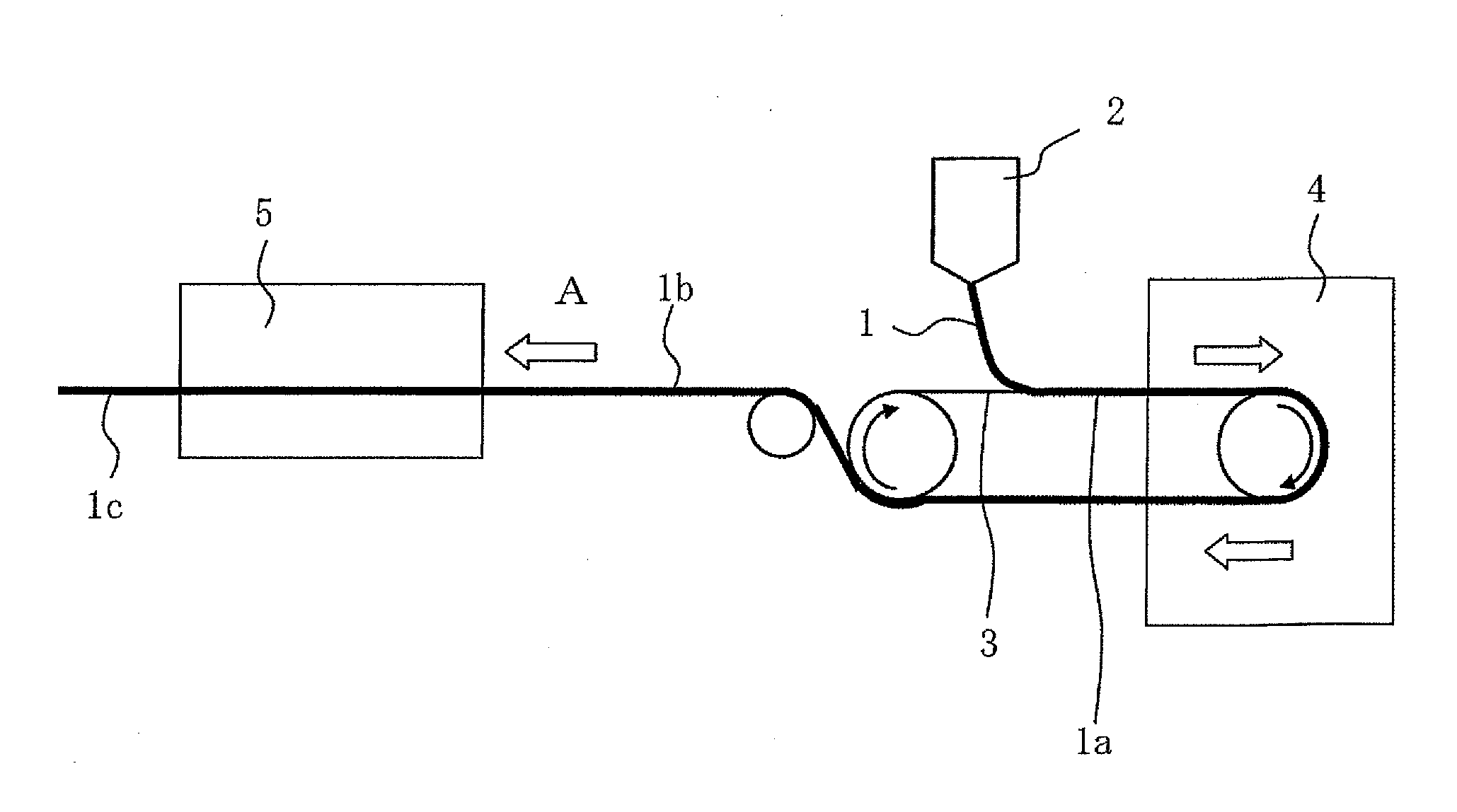
Figure 1 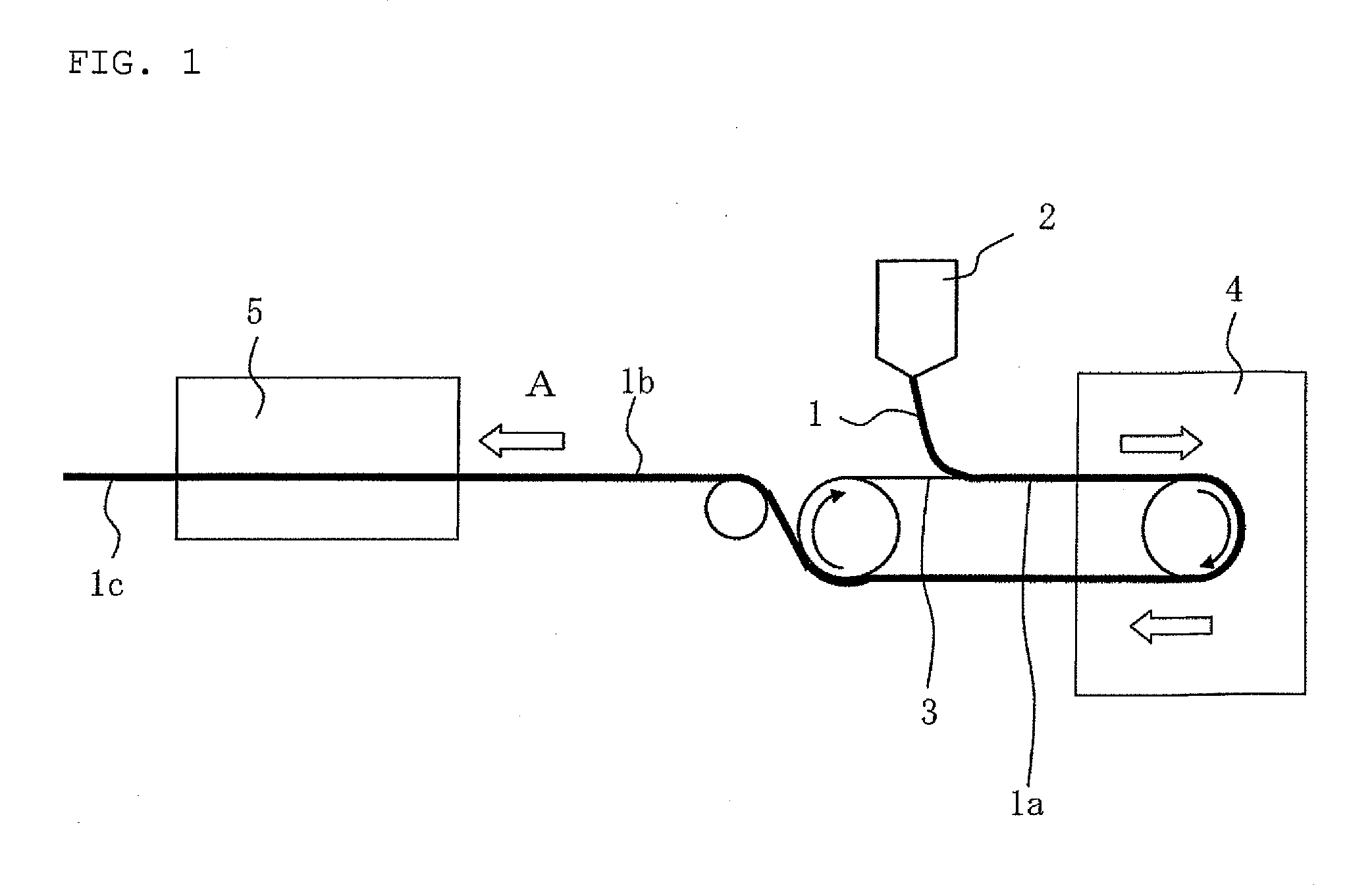
Figure 2 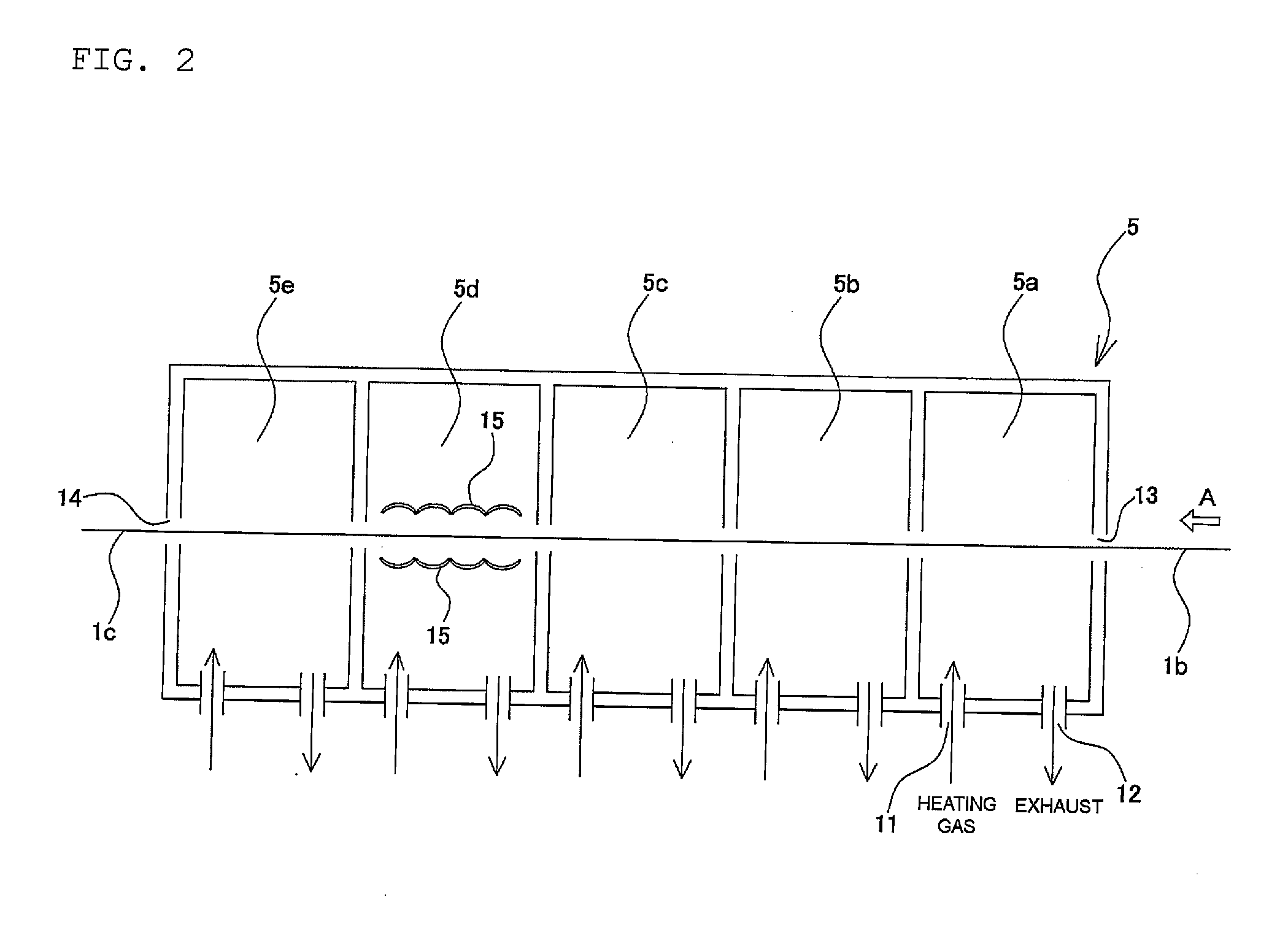
Figure 3
Abstract
Description
TECHNICAL FIELD
[0001] The present invention relates to a method for manufacturing a polyimide film, a device for manufacturing a polyimide film, and a polyimide film that can be suitably used in a solar cell substrate or the like for which high-temperature treatment is necessary.BACKGROUND ART
[0002] Polyimide films have high heat resistance and high electrical insulation properties, and even a polyimide film of thin make provides rigidity, heat resistance or electrical insulation properties necessary for handling. Polyimide films are therefore widely used in the industrial fields of electrical insulation films, heat shielding films, base films for flexible circuit boards, and the like. Polyimide films have also recently come to be used in solar cell substrates and the like.
[0003] A polyimide film is manufactured by a process including a casting step for flow-casting and applying a film-shaped coating of a polyimide precursor solution such as polyamic acid, for example, on a support, he...
Examples
Example
[0055]The examples 1) through 3) below are cited as examples of the combination of the tetracarboxylic acid component and the diamine component from the perspectives of mechanical characteristics and heat resistance.
[0056]1) A combination of 3,3′,4,4′-biphenyl tetracarboxylic acid dianhydride; and p-phenylene diamine, or p-phenylene diamine and 4,4-diaminodiphenyl ether (e.g., with a PPD / DADE mole ratio preferably of 100 / 0 to 85 / 15).
[0057]2) A combination of 3,3′,4,4′-biphenyl tetracarboxylic acid dianhydride and pyromellitic dianhydride (e.g., the s-BPDA / PMDA mole ratio is preferably 0 / 100 to 90 / 10); and p-phenylene diamine, or p-phenylene diamine and 4,4-diaminodiphenyl ether (e.g., with a PPD / DADE mole ratio preferably of 90 / 10 to 10 / 90).
[0058]3) A combination of pyromellitic dianhydride; and p-phenylene diamine and 4,4-diaminodiphenyl ether (e.g., with a PPD / DADE mole ratio preferably of 90 / 10 to 10 / 90).
[0059]A publicly known solvent can be used as the abovementioned organic sol...
Example
EXAMPLE
[0097](Method for Measuring Volatile Content)
[0098]The volatile content is calculated using the equation below, where A is the weight of the polyimide film after being heated for 10 minutes at 150° C., and B is the weight of the polyimide film after being heated for 20 minutes at 450° C.
Volatile content=[(A−B) / A]×100
EXAMPLE
[0099]A polyimide precursor solution was prepared by mixing substantially equal mole amounts of 3,3′,4,4′-biphenyl tetracarboxylic acid dianhydride and paraphenylenediamine in N,N-dimethylacetamide to give a monomer content of 18 mass %. The polyimide precursor solution thus obtained was continuously flow-cast from a slit of a T-die mold onto an endless-belt-shaped stainless steel support in a drying furnace, and a thin film was formed on the support. The thin film was dried at 120 to 140° C. while adjusting the temperature and heating time, and a long self-supporting film having a heating loss (solvent content) of 38% and an imidization rate of 13% was m...
Example
Comparative Example 1
[0101]A polyimide film having a width of 300 mm was obtained in the same manner as in the example described above, except that infrared heaters were not used. The volatile content of this polyimide film was 0.14 mass %.