
1,3 substituted azetidine pde10 inhibitors
a technology of azetidine and pde10, which is applied in the field of compounds, can solve the problems of high noncomplicance or discontinuation rate of medication, lack of efficacy, and dissatisfaction with therapy
Patent Information
- Authority / Receiving Office
- US · United States
- Patent Type
- Applications(United States)
- Current Assignee / Owner
- Publication Date
- 2014-09-11
Smart Images
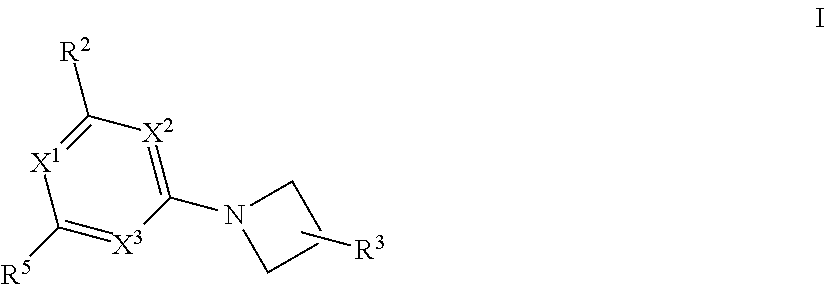
Figure 1 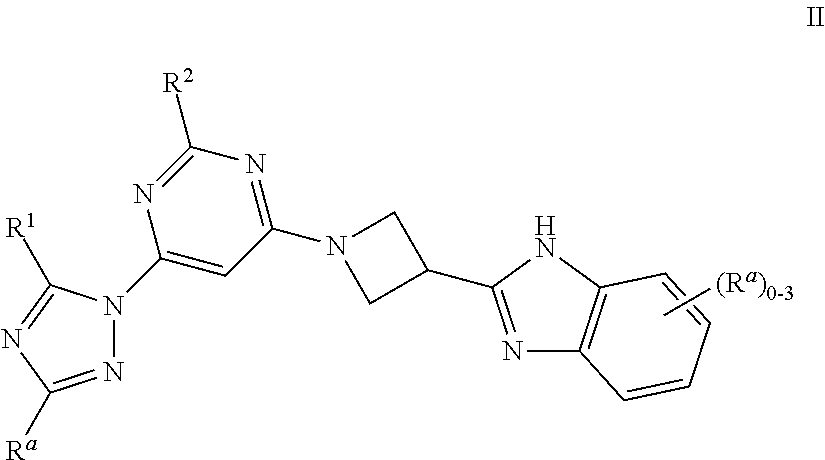
Figure 2 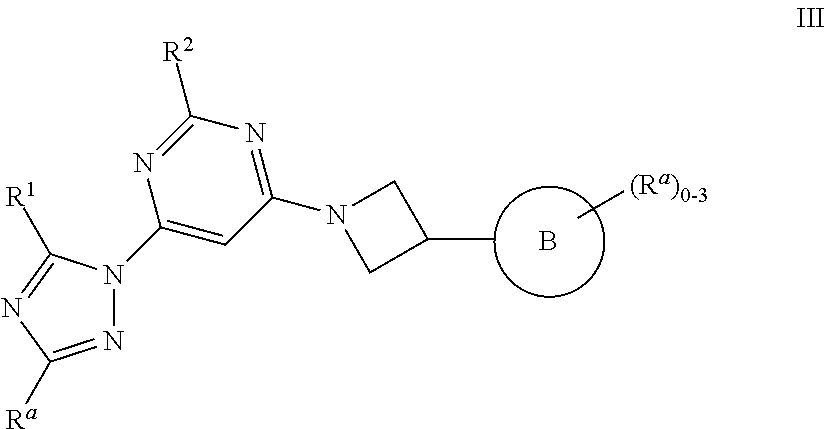
Figure 3
Abstract
Description
FIELD OF THE INVENTION
[0001] The invention relates generally to compounds which act as inhibitors of the phosphodiesterase (PDE) 10 enzyme, compositions and therapeutic uses thereof.BACKGROUND OF THE INVENTION
[0002] Schizophrenia is debilitating disorder affecting the psychic and motor functions of the brain. It is typically diagnosed in individuals in their early to mid-twenties and symptoms include hallucinations and delusions or at the other extreme, anhedonia or social withdrawal. Across the spectrum, the symptoms are indicative of cognitive impairment and functional disabilities. Notwithstanding improvements in antipsychotic treatments, current therapies, including typical (haloperidol) and atypical (clozapine or olanzapine) antipsychotics, have been less than acceptable and result in an extremely high rate of noncomplicance or discontinuation of medication. Dissatisfaction with therapy is attributed to lack of efficacy or intolerable and unacceptable side affects. The side effec...
Examples
example 1
[0268]
2-(1-(6-(3,5-dimethyl-1H-1,2,4-triazol-1-yl)-2-methylpyrimidin-4-yl)azetidin-3-yl)-1-methyl-1H-benzo[d]imidazole (Example 1)
[0269]Intermediate 2 (0.15 g, 0.67 mmol), Intermediate 1 (0.13 g, 0.67 mmol), and Cs2CO3 (0.66 g, 2.01 mmol) were suspended in DMF (6.7 mL) in a microwave vial. The vial was then capped and heated in the microwave at 100° C. for 30 min. After cooling to room temperature, the reaction was filtered and the filtrate was purified by reverse phase chromatography (acetonitrile / water / 0.1% TFA). The fractions containing the product were partitioned between EtOAc and saturated NaHCO3. The organic layer was washed with brine, dried over Na2SO4 and concentrated to provide Example 1 (0.17 g, 78%) as a white solid. 1H NMR: (500 MHz, CD3OD) δ 7.63 (d, J=8 Hz, 1H), 7.5 (d, J=8 Hz, 1H), 7.28 (m, 2H), 6.66 (s, 1H), 4.66 (m, 2H), 4.53 (m, 3H), 3.83 (s, 3H), 2.84 (s, 3H), 2.51 (s, 3H), 2.36 (s, 3H). MS: m / z=375.4 (M+H).
example 2
[0270]
1-methyl-2-(1-(2-methyl-6-(4-methyl-1H-pyrazol-1-yl)pyrimidin-4-yl)azetidin-3-yl)-1H-benzo[d]imidazole (Example 2)
[0271]To a solution of 4-methylpyrazole (10.5 mg, 0.13 mmol) in DMA (0.65 mL) in a microwave vial was added Cs2CO3 (83 mg, 0.26 mmol) and the mixture was stirred at rt. After 15 min, Intermediate 3 (40 mg, 0.13 mmol) was added and the tube was capped, sealed, and heated at 150° C. for 3 h. The reaction was cooled to rt, filtered through a syringe filter and purified by reverse-phase preparative chromatography (5-50% acetonitrile / water+0.1% TFA) to give Example 2. 1H NMR: (500 MHz, CD3OD) δ 8.31 (m, 1H), 7.76 (m, 1H), 7.54 (m, 1H), 7.33 (m, 3H), 6.62 (s, 1H), 4.64 (m, 4H), 4.31 (m, 1H), 3.73 (s, 3H), 2.51 (s, 3H), 2.14 (s, 3H) ppm. MS: m / z=360.5 (M+H).
[0272]The foregoing procedure for nucleophilic aromatic substitution, or modifications thereof (i.e. NaH base with DMSO solvent) known by those skilled in the art, was used for the following Examples, substituting the ...
example 35
[0273]
N-[1-(dimethylamino)ethylidene]propanamide (A)
[0274]A solution of propionamide (60 mg, 0.82 mmol) in DMA-DMA (0.36 mL) was heated at 50° C. for 16 h. The reaction was concentrated to provide crude A that was used without further purification.
2-(1-(6-(5-ethyl-3-methyl-1H-1,2,4-triazol-1-yl)-2-methylpyrimidin-4-yl)azetidin-3-yl)-1-methyl-1H-benzo[d]imidazole (Example 35)
[0275]A solution of Intermediate 11 (50 mg, 0.16 mmol) and A (46 mg, 0.32 mmol) in acetic acid (1.6 mL) was heated at 100° C. for 30 min. The solvent was removed in vacuo and the residue was purified by reverse phase chromatography (MeCN / H2O / 0.1% TFA). The fractions containing the product were partitioned between EtOAc and saturated NaHCO3. The organic layer was washed with 50% saturated brine solution, dried over Na2SO4 and concentrated to provide Example 35 as an off-white solid. 1H NMR: (500 MHz, DMSO-d6) δ 7.60 (d, J=8 Hz, 1H), 7.53 (d, J=8 Hz, 1H), 7.21 (m, 2H), 6.52 (s, 1H), 4.58 (m, 2H), 4.45 (m, 3H), 3.74...