
2h-chromene derivatives as analgesic agents
Patent Information
- Authority / Receiving Office
- US · United States
- Current Assignee / Owner
- Publication Date
- 2017-06-08
Smart Images
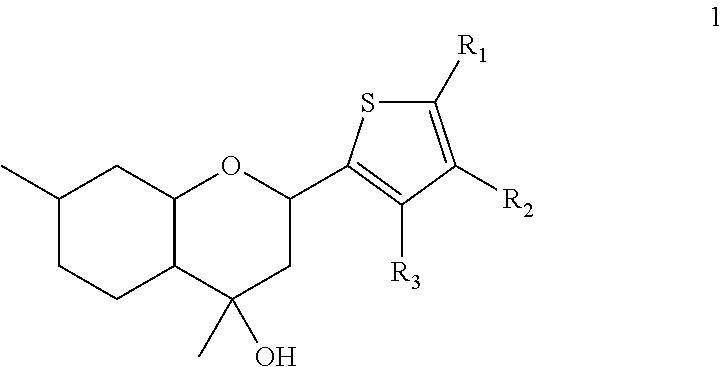
Figure 1 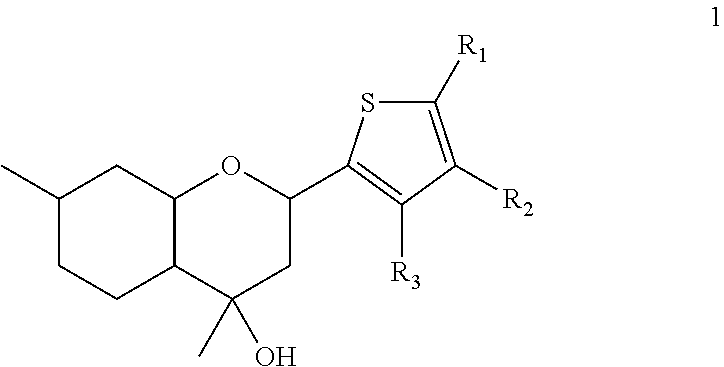
Figure 2 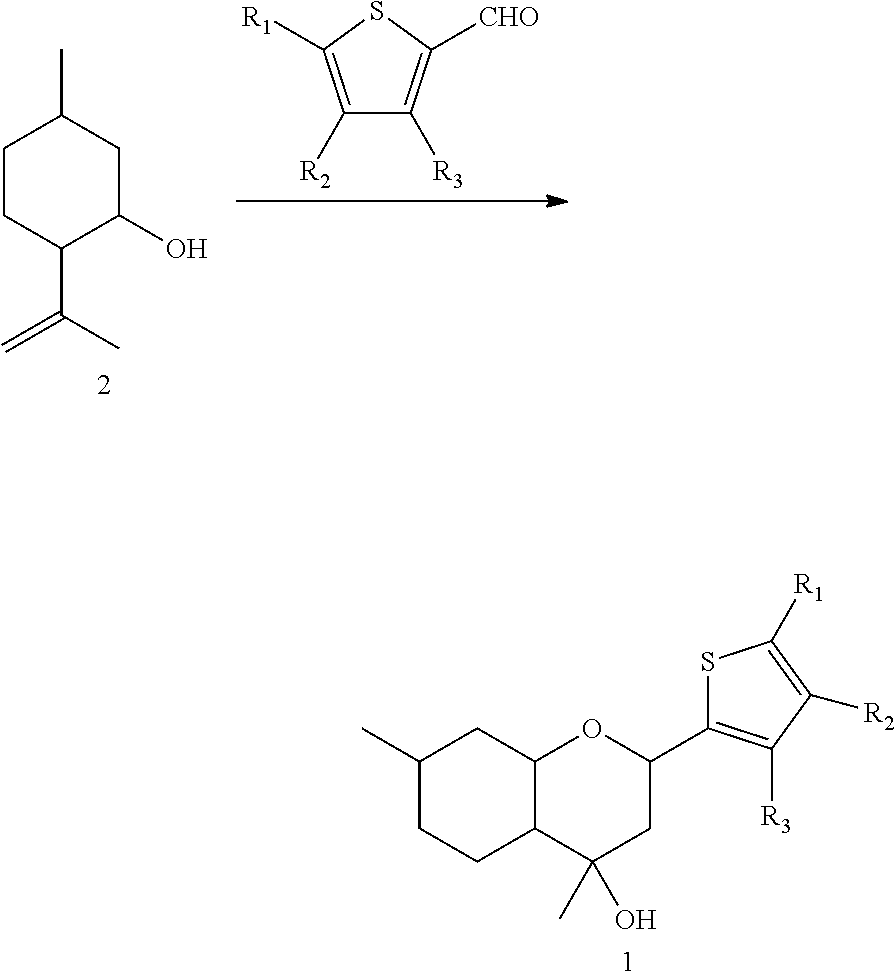
Figure 3
Abstract
Description
FIELD OF THE INVENTION
[0001] The invention relates to the field of medicine, specifically, to drugs having analgesic effect.BACKGROUND OF THE INVENTION
[0002] Analgesic drugs are known, that are nonnarcotic analgesics by their mechanism of action, such as acetylsalicylic acid, metamizole and others [1]. Data on activity in acetic acid induced writhing test (ED50) and acute toxicity (LD50) of the known drugs are presented in [2] and in Table 1.TABLE 1Toxicity and analgesic action of the known drugs [2].DrugED50, mg / kgLD50, mg / kgAcetylsalicylic acid1551600Metamizole553300Sodium diclofenac5370
[0003] The disadvantage of acetylsalicylic acid is low activity and gastrointestinal toxicity; metamizole may induce hematopoiesis disorders, up to agranulocytosis.
[0004] Diclofenac sodium [3] was chosen as a prototype.
[0005] The disadvantages of sodium diclofenac are adverse gastrointestinal effects (gastrointestinal toxicity).DESCRIPTION OF THE INVENTION
[0006] The goal of the invention is the developme...
Examples
example 1
of 4,7-dimethyl-2-(thiophene-2-yl)octahydro-2H-chromene-4-ol 1a
[0024]
[0025]A solution of 0.29 g thiophene-2-carbaldehyde in 3 ml CH2Cl2 was added to a suspension of 1.3 g of K10 clay in 5 ml CH2Cl2, then a solution of 0.400 g isopulegol 2 in 3 ml CH2Cl2 was added. The solvent was evaporated and the reaction mixture was kept at room temperature during 60 min. Then 10 ml of EtOAc was added, the catalyst was filtered and the solvent was evaporated. The resulting mixture was separated at a column with 13 g silica gel (eluent: solution of 0 to 100% ethyl acetate in hexane). 0.543 g (yield 78%) of compound 1a was obtained. NMR 1H spectrum of compound 1a corresponds to the spectrum, published in the literature [4].
example 2
of 4,7-dimethyl-2-(3-methylthiophene-2-yl)octahydro-2H-chromene-4-ol 1b
[0026]
[0027]Similar to Example 1, interaction of 0.300 g isopulegol 2 with 0.25 g 3-methylthiophene-2-carbaldehyde in the presence of 1.1 g K10 clay during 120 min resulted in 0.381 g (yield 70%) of compound 1b.
[0028]Spectrum NMR 1H (CDCl3): 0.88-0.97 (m, 1H, Ha-8); 0.92 (d, J (16, 9a)=6.6 Hz, 3H, H-16); 1.03 (dddd, J (7a, 7e)=J (7a, 8a)=12.8 Hz, J (7a, 6a)=12.1 Hz, J (7a, 8e)=3.3 Hz, 1H, Ha-7); 1.11 (ddd, J (10a, 10e)=J (10a, 9a)=12.2 Hz, J (10a, 1a)=10.8 Hz, 1H, Ha-10); 1.28 (d, J (15, 4a)=0.7 Hz, 3H, H-15); 1.31 (ddd, J (6a, 7a)=12.1 Hz, J (6a, 1a)=10.2 Hz, J (6a, 7e)=3.3 Hz, 1H, Ha-6); 1.40-1.53 (m, 2H, Ha-9, OH); 1.72 (ddddd, J (8e, 8a)=12.9 Hz, J (8e, 7a)=J (8e, 9a)=J (8e, 7e)=3.3 Hz, J (8e, 10e)=2.0 Hz, 1H, He-8); 1.85 (ddq, J (4a, 4e)=12.7 Hz, J (4a, 3a)=11.7 Hz, J (4a, 15)=0.7 Hz, 1H, Ha-4); 1.91-1.97 (m, 1H, He-7); 1.95 (dd, J (4e, 4a)=12.7 Hz, J (4e, 3a)=2.4 Hz, 1H, He-4); 1.99 (dm, J (10e, 10a)=12.2 H...
example 3
of 4,7-dimethyl-2-(5-methylthiophene-2-yl)octahydro-2H-chromene-4-ol 1c
[0029]
[0030]Similar to Example 1, interaction of 0.300 g isopulegol 2 with 0.25 g 5-methylthiophene-2-carbaldehyde in the presence of 1.1 g K10 clay during 120 min resulted in 0.386 g (yield 71%) of compound 1c.
[0031]Spectrum NMR 1H (CDCl3): 0.87-0.96 (m, 1H, Ha-8); 0.92 (d, J (16, 9a)=6.6 Hz, 3H, H-16); 1.02 (dddd, J (7a, 7e)=J (7a, 8a)=12.8 Hz, J (7a, 6a)=12.2 Hz, J (7a, 8e)=3.3 Hz, 1H, Ha-7); 1.09 (ddd, J (10a, 10e)=J (10a, 9a)=12.3 Hz, J (10a, 1a)=10.8 Hz, 1H, Ha-10); 1.25 (d, J (15, 4a)=0.8 Hz, 3H, H-15); 1.28 (ddd, J (6a, 7a)=12.2 Hz, J (6a, 1a)=10.2 Hz, J (6a, 7e)=3.3 Hz, 1H, Ha-6); 1.39-1.52 (m, 2H, Ha-9, OH); 1.72 (ddddd, J (8e, 8a)=12.8 Hz, J (8e, 7a)=J (8e, 9a)=J (8e, 7e)=3.3 Hz, J (8e, 10e)=2.0 Hz, 1H, He-8); 1.86 (ddq, J (4a, 4e)=12.7 Hz, J (4a, 3a)=11.7 Hz, J (4a, 15)=0.8 Hz, 1H, Ha-4); 1.93 (dddd, J (7e, 7a)=12.8 Hz, J (7e, 6a)=J (7e, 8a)=J (7e, 8e)=3.3 Hz, 1H, He-7); 1.99 (dm, J (10e, 10a)=12.3 Hz...