
Method for manufacturing an orthopaedic insole and product thus obtained
Patent Information
- Authority / Receiving Office
- US · United States
- Current Assignee / Owner
- Publication Date
- 2020-01-30
- Estimated Expiration
- Not applicable · inactive patent
Smart Images
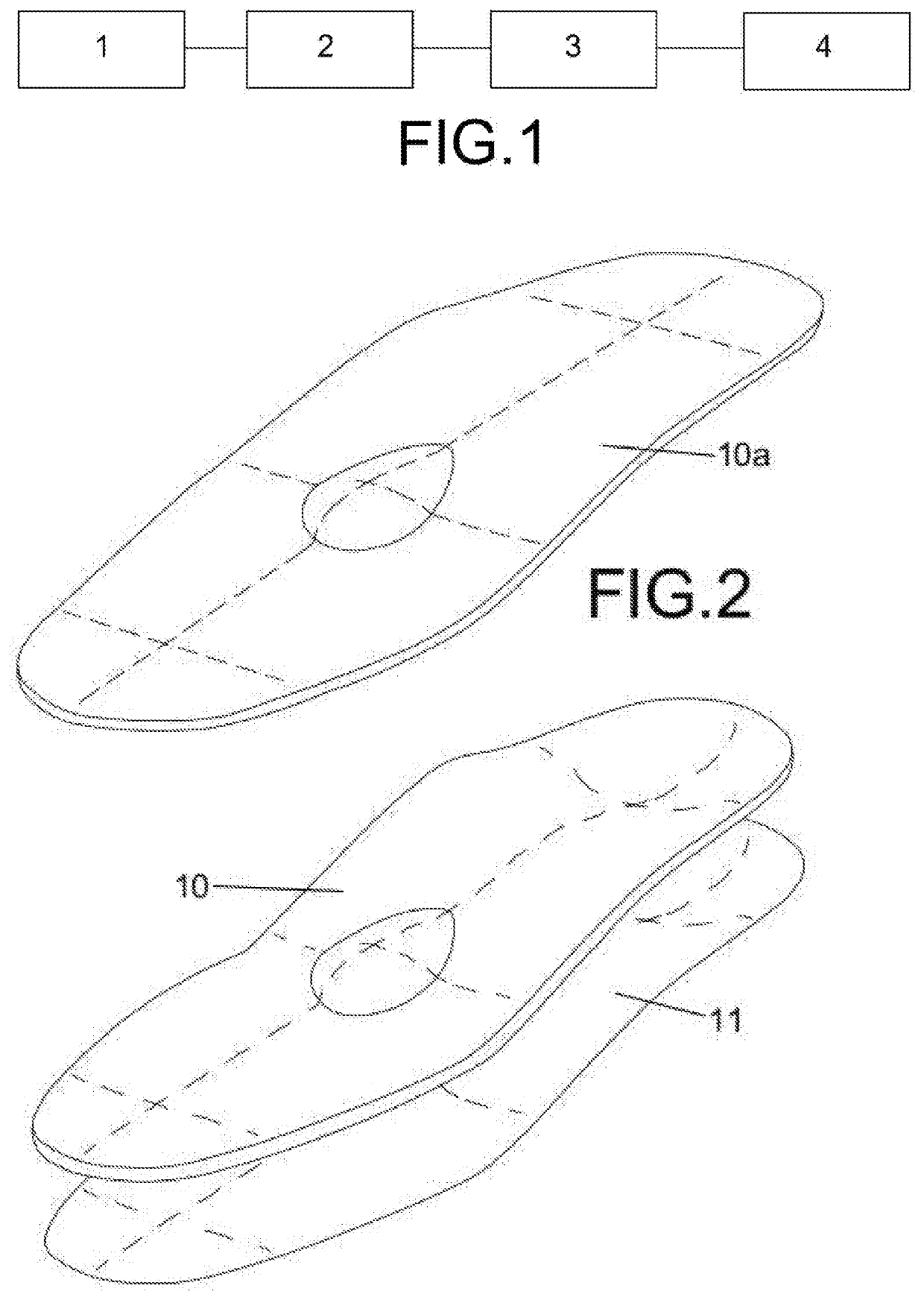
Figure 1 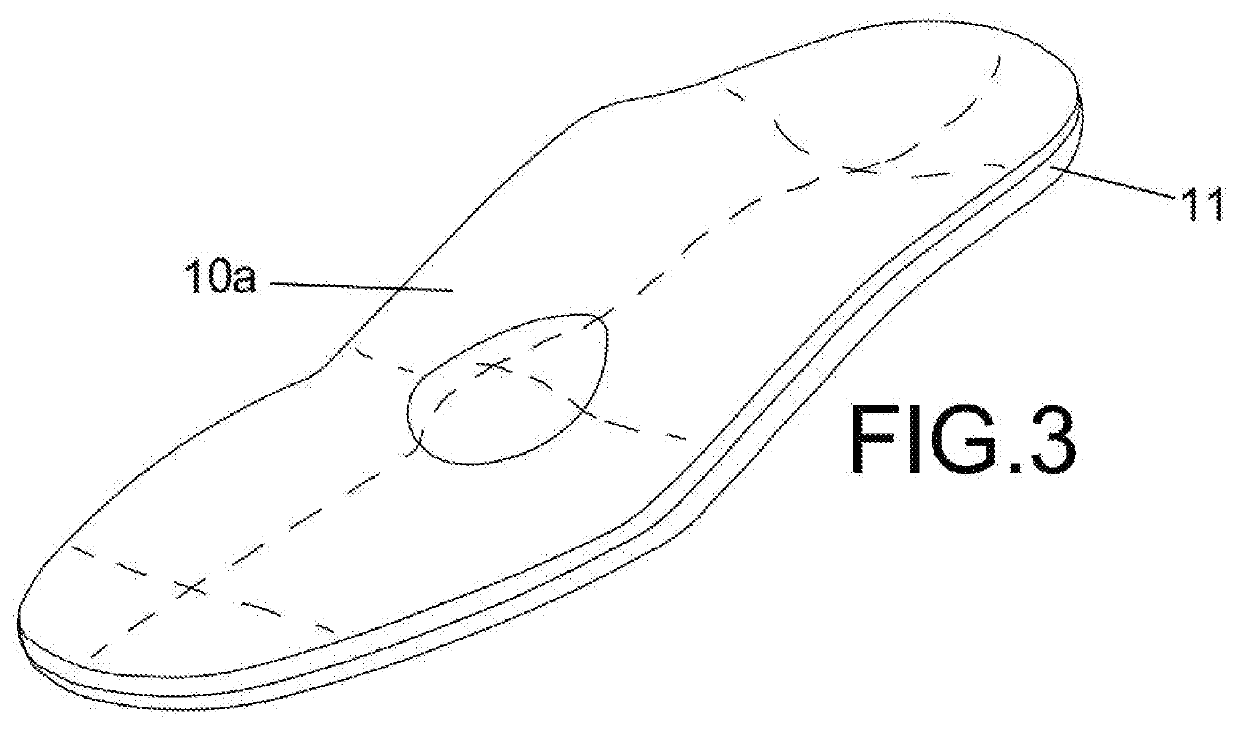
Figure 2
Abstract
Description
OBJECT OF THE INVENTION
[0001] The object of the present specification is a method for manufacturing an orthopaedic insole and the product thus obtained, whereby the upper part of said insole is geometrically transformed for the purpose of allowing its production by means of milling or additive manufacturing techniques.BACKGROUND OF THE INVENTION
[0002] At present, an orthosis, according to the definition of the International Organisation for Standardisation (ISO), is a support or another external device (apparatus) applied to the body for modifying functional or structural aspects of the neuromuscular and skeletal system.
[0003] The term is used to refer to apparatuses or devices, splints, technical aids and supports used in orthopaedics, physiotherapy, and occupational therapy which correct or facilitate the performance of an action, activity, or movement, seeking to save energy and increase safety. They are used to hold, align, or correct deformities and to improve the function of the ...
Examples
Embodiment Construction
[0045]The attached drawings show a preferred embodiment of the invention. More specifically, the method for manufacturing an orthopaedic insole, object of the present specification, comprises a first step 1 of 3D modelling a future insole with a specific geometry and which will ideally be formed by a soft surface 10 and a rigid surface 11.
[0046]A second step 2 of software treatment for the “flattening” or modelling of the original soft upper part 10, transforming same into an obtained soft surface or element 10a with its lower surface being completely flat and the relative thicknesses still being maintained, is then performed.
[0047]To that end, the software uses mathematical models based on finite element and graph theories, where the structure of the flat upper flat is modelled, modelling a soft object the lower part of which is flat.
[0048]This is achieved by means of performing calculation using iterative methods based on the resolution of non-linear systems with multiple unknowns...