
Feedstock for 3D printing, preparation method and application thereof
a 3d printing and 3d printing technology, applied in the field of metal material preparation, can solve the problems of inability to meet customers' requirements, inability to widely apply fdm at present, low strength of plastic products produced in this way, etc., to achieve the effect of improving product quality, avoiding waste of raw materials, and controlling the accuracy of product surfa
Patent Information
- Authority / Receiving Office
- US · United States
- Patent Type
- Applications(United States)
- Current Assignee / Owner
- Publication Date
- 2021-07-08
- Estimated Expiration
- Not applicable · inactive patent
Smart Images
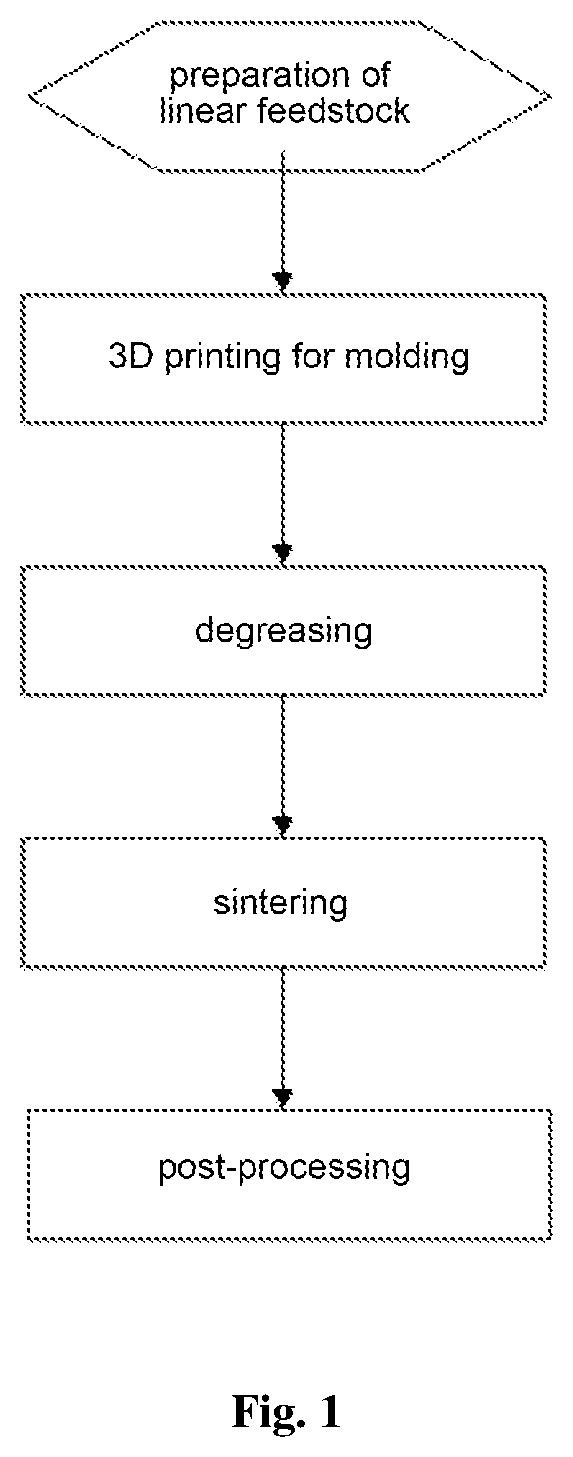
Figure 1
Abstract
Description
TECHNICAL FIELD
[0001] The present invention relates to the field of preparation of metal materials, specifically to a feedstock for 3D printing, a preparation method and an application thereof.BACKGROUND
[0002] 3D printing technology, which is also known as three-dimension printing technology, is a technology to build objects in a manner of layer-by-layer printing by using adhesive materials such as powdery metals or plastics on the basis of digital model files. It can generate parts with any shape directly from computer graphic data without mechanical processing or any mold, thereby greatly shortening the product development cycles, increasing productivity and reducing production costs. Products such as lampshades, body organs, jewelry, tailored football shoes based on player's foot types, racing parts, solid-state batteries, and personalized mobile phones, violins, etc. can be manufactured by using this technology.
[0003] The 3D printing technology is actually a general designation of ...
Examples
example 1
[0050]A preparation method of a feedstock for 3D printing is as follows:
[0051](1) 60 vol % of titanium metal powder was mixed with 40 vol % of polymer binder, the polymer binder including: 85 wt % of polyoxymethylene, 14 wt % of polypropylene, and 1 wt % of stearic acid; the raw materials were added into an internal mixer and mixed at 170° C. for 1 h;
[0052](2) The material obtained after mixing in the step (1) was extruded into a linear material with a diameter of 2 mm by using an extruder, cooled to obtain a feedstock for 3D printing, and the linear feedstock was wound into a disk shape for use.
[0053]The application of the feedstock for 3D printing obtained in this example includes the following steps:
[0054](1) The linear feedstock was used as a raw material to print a green body with a preset shape via a 3D printer;
[0055](2) The green body obtained in step (1) was degreased at 110° C. for 4 h using nitric acid as a medium, 10% of polymer binder was removed to obtain a brown body;
[...
example 2
[0057]A preparation method of a feedstock for 3D printing is as follows:
[0058](1) 50 vol % of titanium alloy powder was mixed with 50 vol % of polymer binder, the polymer binder including: 80 wt % of paraffin wax, 19.5 wt % of polyethylene and 0.5 wt % of stearic acid; the raw materials were added into an internal mixer and mixed at 200° C. for 0.5 h;
[0059](2) The material obtained after mixing in the step (1) was extruded into a linear material with a diameter of 3 mm by using an extruder, cooled to obtain a feedstock for 3D printing, and the linear feedstock was wound into a disk shape for use.
[0060]The application of the feedstock for 3D printing obtained in this example includes the following steps:
[0061](1) The linear feedstock was used as a raw material to print a green body with a preset shape via a 3D printer;
[0062](2) The green body obtained in step (1) was soaked at 80° C. for 6 h using heptane as a medium, 12% of polymer binder was removed to obtain a brown body;
[0063](3)...
example 3
[0065]A preparation method of a feedstock for 3D printing is as follows:
[0066](1) 70 vol % of copper powder was mixed with 30 vol % of polymer binder, the polymer binder including: 84 wt % of paraffin wax, 14 wt % of polypropylene and 2 wt % of stearic acid; the raw materials were added into an internal mixer and mixed at 165° C. for 2 h;
[0067](2) The material obtained after mixing in the step (1) was extruded into a linear material with a diameter of 5 mm by using an extruder, cooled to obtain a feedstock for 3D printing, and the linear feedstock was wound into a disk shape for use.
[0068]The application of the feedstock for 3D printing obtained in this example includes the following steps:
[0069](1) The linear feedstock was used as a raw material to print a green body with a preset shape via a 3D printer;
[0070](2) The green body obtained in step (1) was soaked at 60° C. for 8 h using heptane as a medium, 11% of polymer binder was removed to obtain a brown body;
[0071](3) The brown bo...