
Toothbrush
a technology of toothbrushes and brushes, applied in the field of toothbrushes, can solve the problems that the toothbrushes have not met with significant commercial success, and achieve the effect of equal bending moments
Patent Information
- Authority / Receiving Office
- US · United States
- Patent Type
- Patents(United States)
- Current Assignee / Owner
- Publication Date
- 2005-05-03
- Estimated Expiration
- Not applicable · inactive patent
Smart Images
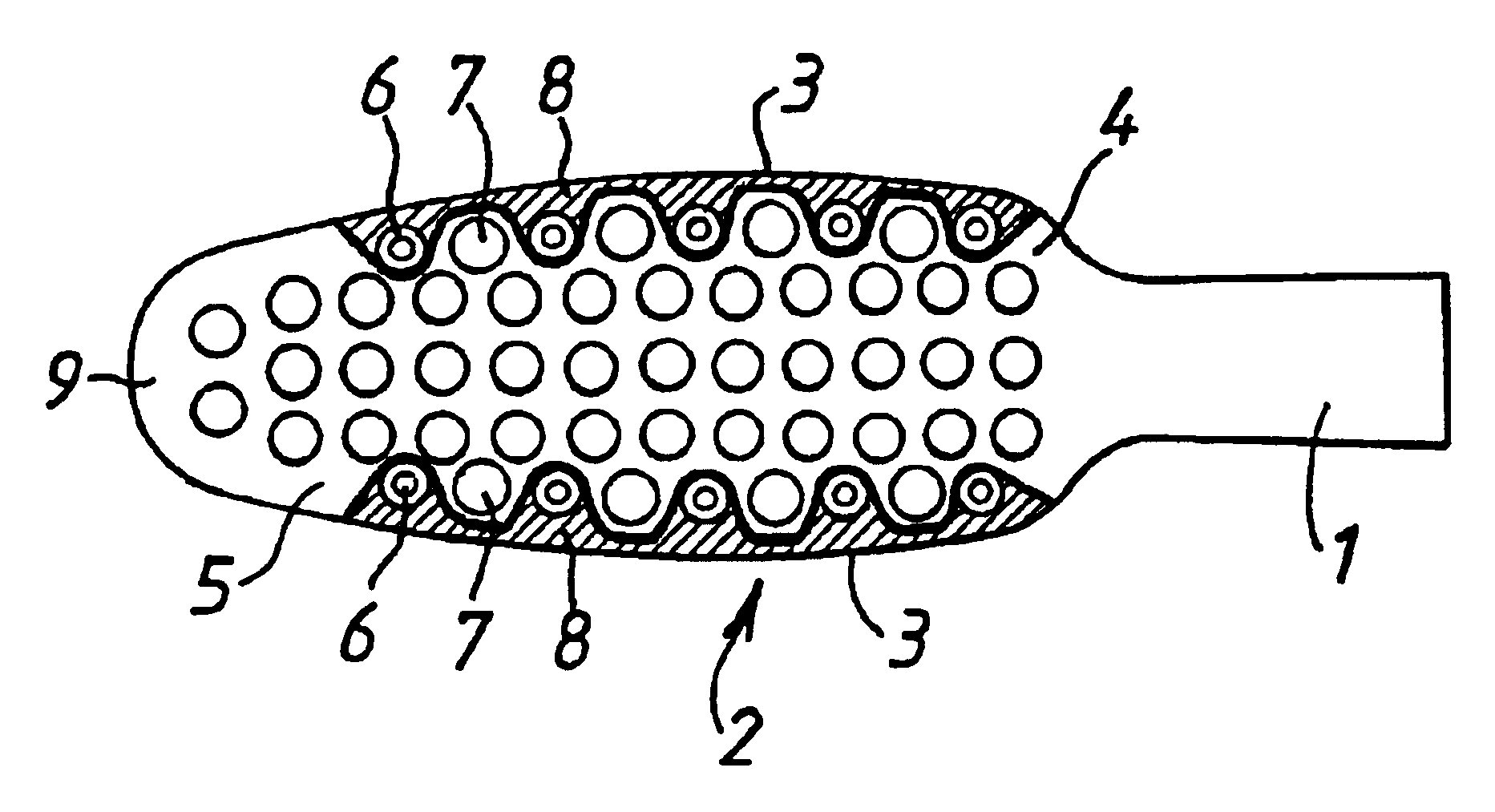
Figure 1 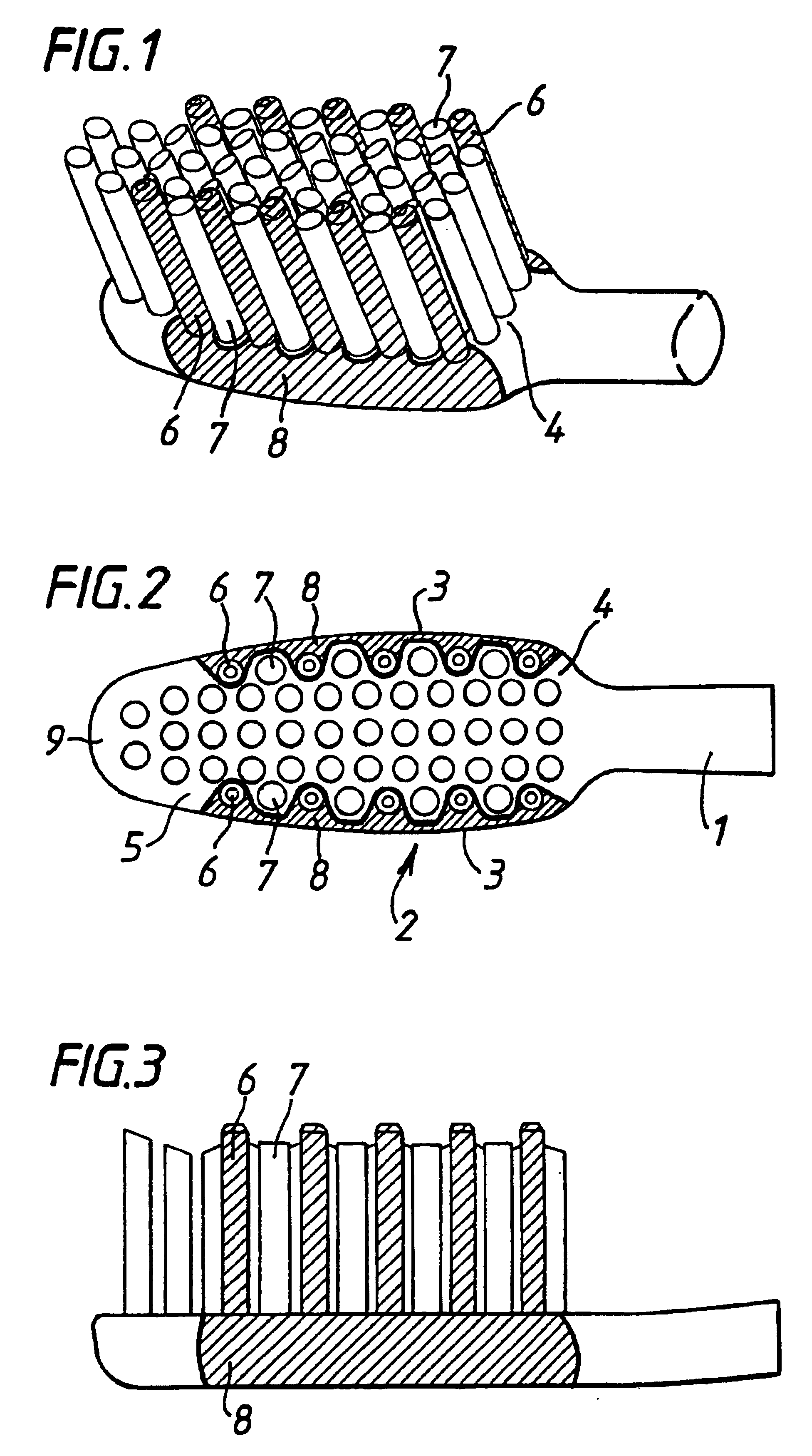
Figure 2
Abstract
Description
FIELD OF THE INVENTION
[0001] The present invention relates to toothbrushes and more particularly to toothbrushes with both bristles and gum massaging elements attached to the brush head.BACKGROUND OF THE INVENTION
[0002] Toothbrushes generally comprise bristles, usually arranged in tufts of about 40 to 50, for the purpose of cleaning teeth by removing accumulated plaque and other debris. It has further been recognised gum health can be improved by gentle stimulation of the gums with massaging elements. There has therefore been a desire to have a toothbrush which provides for the cleaning ability of bristles, along with a massaging elements also located on the toothbrush head to stimulate the gums.
[0003] U.S. Pat. No. 4,277,862 discloses a toothbrush comprising an elongate massaging element along each side of the brush head. The toothbrush of U.S. Pat. No. 4,288,883 has a wider than conventional head with a central bristle portion flanked by arrays of massaging elements. U.S. Pat. No. 5,...
Examples
Embodiment Construction
[0012]The toothbrush of the invention has an overall conventional construction, by which is meant that it comprises a generally elongated handle with a brush head attached to one end of the handle. The head can be detachably connected to the handle, for example to permit replacement of the head when bristles become worn. Herein the end of the handle to which the head is attached shall be referred to as the proximal end and the opposite end the distal end. The construction of the handle is not critical to the present invention. The handle should of course be comfortable to grip and allow easy manipulation of the brush so that the head can be moved around the various areas of the mouth. Preferably it will include elastomeric grip portions moulded to the rigid portion of the handle, as is now almost customary with toothbrush design. The handle can comprise a neck region at its proximal end, the neck being a portion of the handle which is generally of smaller cross-section than the rest...