
Ink stock solution, ink composition and method for producing them
a technology which is applied in the field of ink composition and solution, can solve the problems of difficulty in obtaining a coloring agent satisfying all requirements in a high level, difficulty in allowing conventionally well-known dyes, and difficulty in obtaining coloring agents that meet all requirements at present, so as to achieve stable qualities, low viscosity, and low cost
Patent Information
- Authority / Receiving Office
- US · United States
- Patent Type
- Patents(United States)
- Current Assignee / Owner
- Publication Date
- 2008-07-22
- Estimated Expiration
- Not applicable · inactive patent
Smart Images
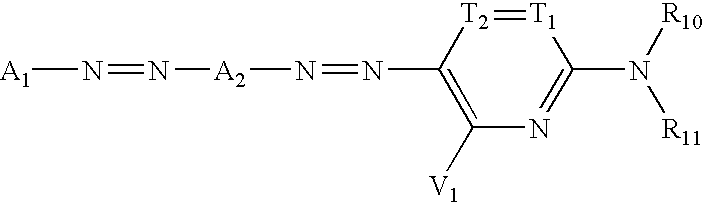
Figure 1 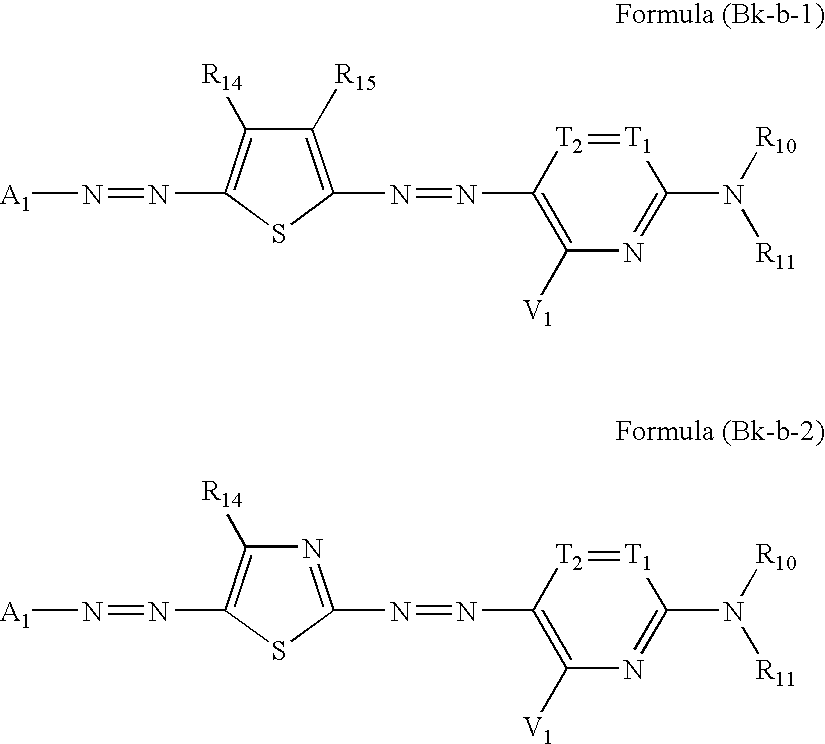
Figure 2 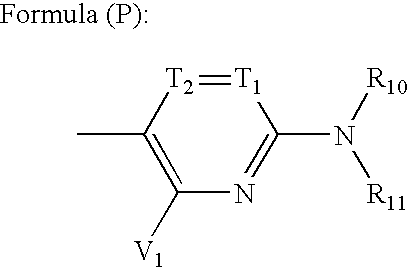
Figure 3
Abstract
Description
FIELD OF THE INVENTION
[0001] The present invention relates to an ink stock solution, an ink composition and method for producing them.BACKGROUND OF THE INVENTION
[0002] With the recent popularization of computers, inkjet printers have been widely used for printing letters on paper, film, cloth or the like not only at offices but also at homes.
[0003] The inkjet recording method includes a system of ejecting a liquid droplet by applying a pressure using a piezoelectric element, a system of ejecting a liquid droplet by generating a bubble in an ink by heat, a system of using an ultrasonic wave, and a system of ejecting a liquid droplet by drawing with electrostatic force. As these inks for inkjet recording, there are used an aqueous ink, an oily ink and a solid (fusion-type) ink. Of these inks, the aqueous ink becomes mainstream in terms of production, handleability, odor, safety and the like.
[0004] A coloring agent used in such an ink for inkjet recording is required to have high solubilit...
Examples
example 1
(Preparation of Ink Stock Solution)
[0361]To 150 g of a black dye of compound A having the following structure (oxidation potential: 1.31 V (vs SCE)), 800 g of ultrapure water (18 MΩ or more) was added, followed by stirring for 1 hour with heating at 60 to 65° C. After the dye had been completely dissolved, the solution was cooled to room temperature, and 1.0 g of a preservative, PROXEL XL2 (Avecia Corp.), was added thereto. After stirring for 10 minutes, sodium bicarbonate was added to adjust the pH to 8.0. Then, 50 g of triethylene glycol was added as a viscosity reducing agent, followed by stirring for 10 minutes. Thereafter, filtration under reduced pressure was performed through a microfilter having an average pore size of 0.2 μm to prepare ink stock solution A for inkjet recording.
[0362]
examples 2 to 6
[0363]Ink stock solutions B to F for inkjet recording were prepared in the same manner as with Example 1 with the exception that respective water-soluble organic solvents shown in Table 1 were used as a viscosity reducing agent in place of triethylene glycol.
example 7
[0364]Ink stock solution C for inkjet recording was prepared in the same manner as with Example 1 with the exception that the amount of ultrapure water was changed from 800 g to 825 g, and that the amount of triethylene glycol added was changed from 50 g to 25 g.