
Metal sintered body and production method
a technology production methods, applied in the direction of coatings, etc., can solve the problems of complex component configuration, inability to maintain the reliability of components for a long time, complex logistical administration of components, etc., and achieve the effect of reducing the vacancy ratio, high density and high degree of hardness of metal sintered parts
Patent Information
- Authority / Receiving Office
- US · United States
- Current Assignee / Owner
- Publication Date
- 2002-08-06
- Estimated Expiration
- Not applicable · inactive patent
Smart Images
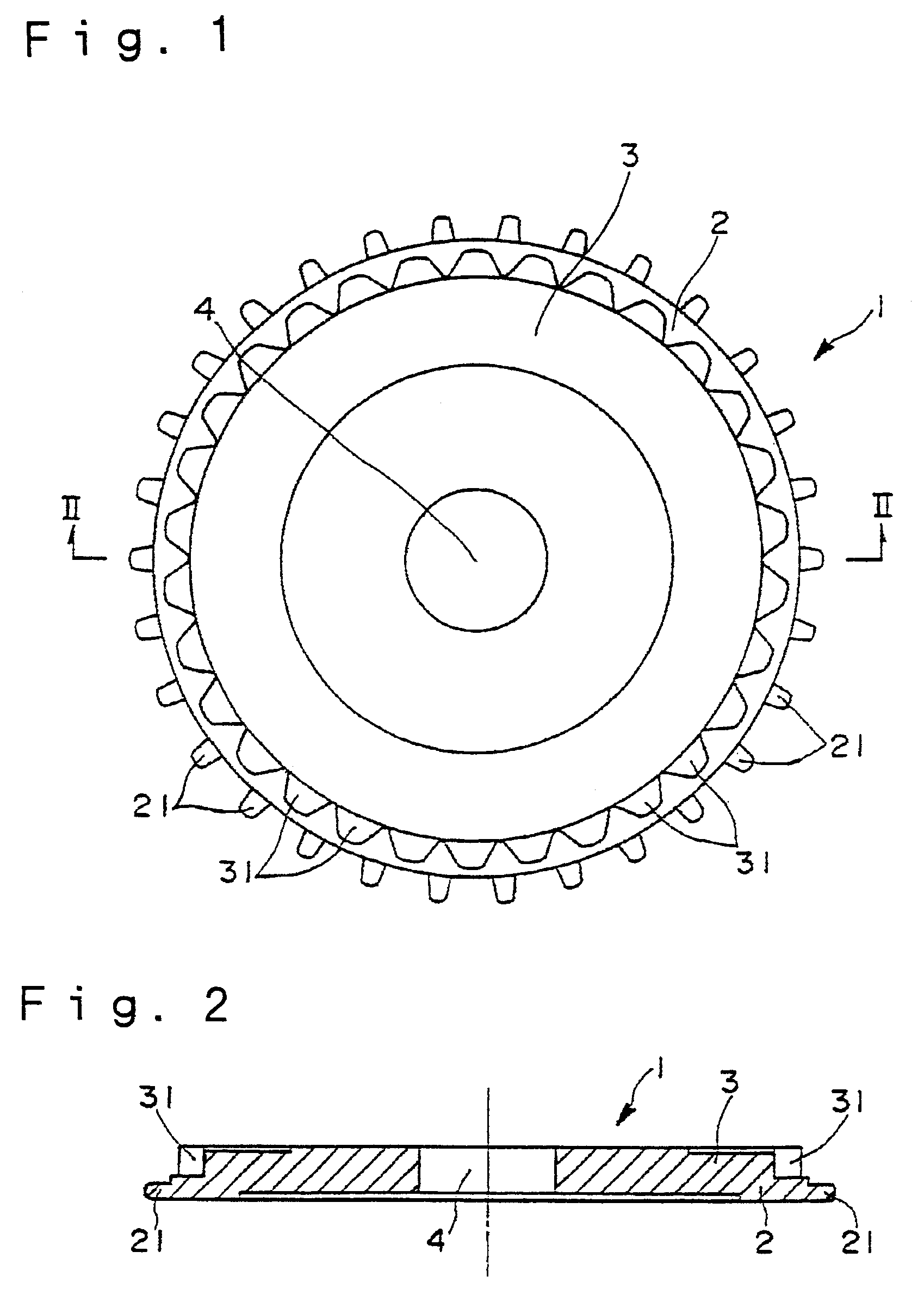
Figure 1 
Figure 2
Abstract
Description
TECHNOLOGY FIELDThis invention relates to a metal sintered part, which is obtained from sintering metal powder and its production method.PRIOR ART TECHNOLOGYThe following method, referred to as tape automatic bonding (TAB), is utilized in semiconductor mounting technology. (i) Semiconductor chips are fixed on the carrier tape (long length film). They are placed at regular intervals along the edge side of the tape. (ii) The tape is traveled, and these semiconductor chips are conveyed in the manufacturing process. Simultaneously, wire bonding or similar bonding methods are utilized for each semiconductor chip.This carrier tape is given momentum by the following process. (1) The wheel tooth of a sprocket gear engages with an aperture, which is created along the edges of the tape. (2) The turning sprocket gear moves the long length film. This sprocket gear has a ratchet gear, which (a) turns toward one direction, and (b) has multiple ratchet teeth in order to control the spinning amount...
Examples
embodiment 1
Metal powder, which is comprised of the nickel based self-fluxing alloy with an average diameter of 12 .mu.m is prepared. The composition is as follows:
The composition of the binding material is as follows:
The metal power, the binding material and the plasticizer material are combined and mixed with a kneading machine under the 110.degree. C. and 1 hour conditions.
Next, this feed stock is infused by the `metal injection molding (MIM)` method using the injection molding machine. Then, a green body with a shape, which is indicated in FIG. 1 and FIG. 2, is obtained. The molding conditions at the injection molding are (a) mold temperature: 30.degree. C., and (b) injection pressure: 110 kgf / cm.sup.2.
The content amount of the metal powder in the green body is approximately 94.2 wt %. Next, the de-binding process is conducted for the subject green body using the de-binding furnace. The de-binding conditions are (a) under the reduced pressure (1.times.10.sup.-3 Torr), (b) 450.degree. C., an...
embodiment 2
Metal powder, which was comprised of the nickel based self-fluxing alloy with an average diameter of 15 .mu.m is prepared. The metal sintered part is produced with the same procedure as with Embodiment 1, except the metal composition is varied. This composition is as follows:
The characteristics of the produced metal sintered parts (the power transmission component, which are illustrated in FIG. 1 and FIG. 2) for Embodiments 1 and 2 were researched. The results are indicated in the below-mentioned Table 2.
As illustrated in FIG. 2, the metal sintered parts for Embodiments 1 and 2 are confirmed to have the following characteristics: (a) high density (low vacancy rate), (b) high degree of hardness, (c) superior wear resistance, (d) precise dimensional accuracy, (e) no defects, such as crack or deformation. The metal sintered parts were over-all high quality.
As described above, this invention can offer a metal sintered part with a high degree of hardness and a superior wear resistance, a...