
Muteins of tear lipocalin and methods for obtaining the same
Patent Information
- Authority / Receiving Office
- US · United States
- Current Assignee / Owner
- Publication Date
- 2012-11-20
Smart Images
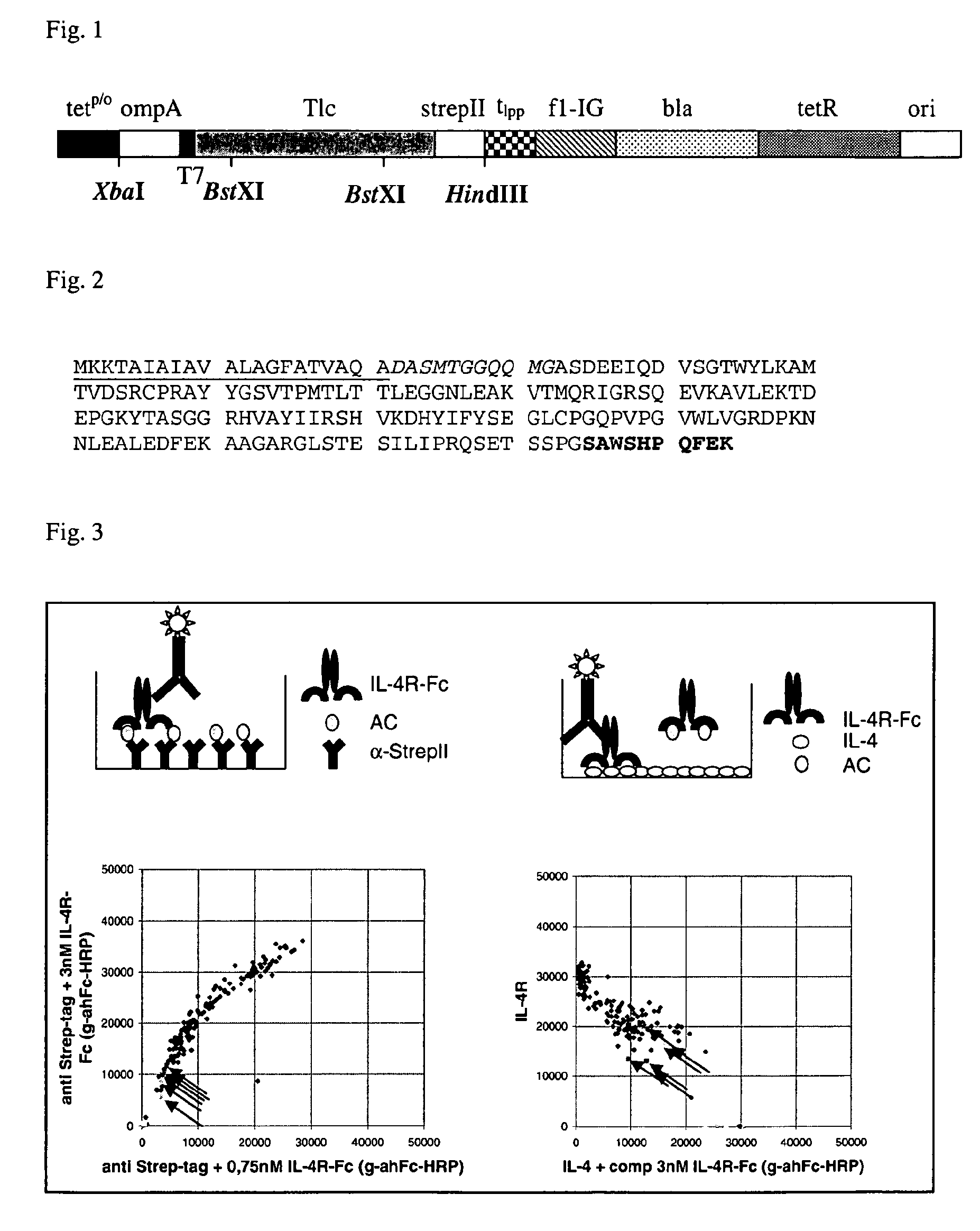
Figure 1 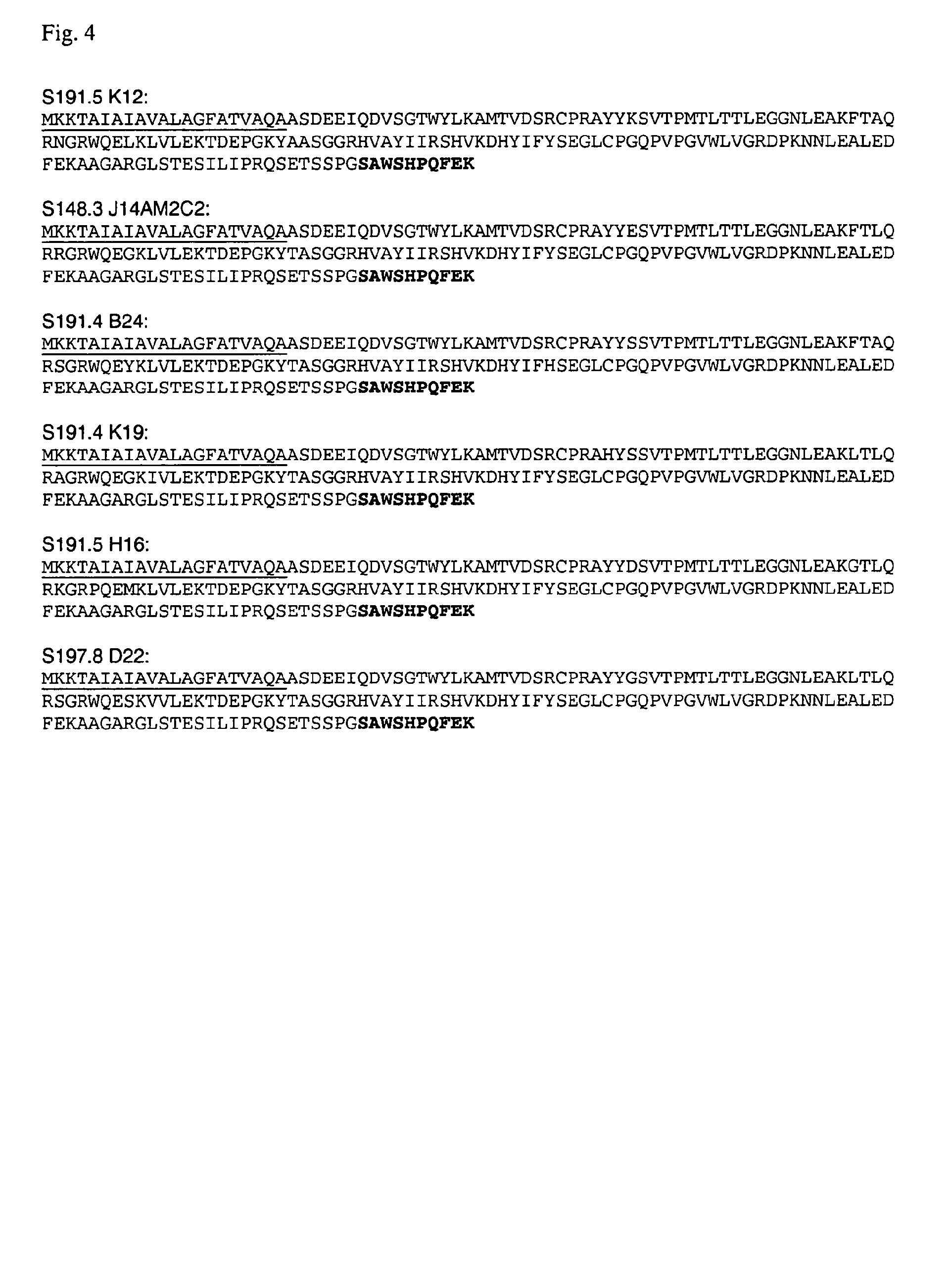
Figure 2 
Figure 3
Abstract
Description
CROSS-REFERENCE TO RELATED APPLICATIONS
[0001] This application is a National Stage application of PCT / EP2007 / 057971, filed Aug. 1, 2007, which claims priority from U.S. Provisional Applications 60 / 821,073, filed Aug. 1, 2006, and 60 / 912,013, filed Apr. 16, 2007.
[0002] The instant application contains a Sequence Listing which has been submitted in ANSI format via EFS-WEB and is hereby incorporated by reference in its entirety. Said ANSI copy, created on Jan. 23, 2012 is named sequence.txt and is 103 KB.BACKGROUND OF THE INVENTION
[0003] 1. Field of the Invention
[0004] The present invention relates to novel muteins derived from human tear lipocalin that bind a given non-natural ligand with detectable affinity. The invention also relates to corresponding nucleic acid molecules encoding such a mutein and to a method for their generation. The invention further relates a method for producing such a mutein. Finally, the invention is directed to a pharmaceutical composition comprising such a lip...
Examples
example 1
Generation of a Library with 2×10⁹ Independent TLC Muteins
[0253]A random library of tear lipocalin (Tlc) with high complexity was prepared by concerted mutagenesis of the 18 selected amino acid positions 26, 27, 28, 29, 30, 31, 32, 33, 34, 56, 57, 58, 80, 83, 104, 105, 106, and 108 of the mature wild type human tear lipocalin. To this end, a gene cassette wherein the corresponding codons were randomized in a targeted fashion was assembled via polymerase chain reaction (PCR) with degenerate primer oligodeoxynucleotides in two steps according to a strategy described before (Skerra, A. (2001) “Anticalins”: a new class of engineered-ligand-binding proteins with antibody-like properties. J. Biotechnol. 74, 257-275). In this library design the first 4 N-terminal amino acid residues (HHLA) as well as the two last C-terminal amino acid residues (SD) of the wild type sequence of tear lipocalin were deleted (for this reason, all tear lipocalin muteins shown in the attached Sequence Listing ha...
example 2
Phagemid Presentation and Selection of Tlc Muteins with Affinity for IL-4 Receptor Alpha
[0265]Phagemid display and selection was performed employing the phagemids obtained from Example 1 essentially as described in WO 2006 / 56464 Example 2 with the following modifications: The target protein (IL-4 receptor alpha, Peprotech) was employed at a concentration of 200 nM and was presented to the library as biotinylated protein with subsequent capture of the phage-target complex using streptavidin beads (Dynal). Alternatively, the target protein was employed as Fc-fusion protein (IL-4 receptor alpha-Fc, R&D Systems) at a concentration of 200 nM and subsequent capture of the phage-target complex using protein G beads (Dynal) and by immobilization of Fc-fusion protein on anti-human Fc capture antibody (Jackson Immuno Research) coated immunosticks (Nunc) according to the instructions of the manufacturer. Three or four rounds of selection were performed.
example 3
Identification of IL-4 Receptor Alpha-Specific Muteins Using High-Throughput ELISA Screening
[0266]Screening of the muteins selected according to Example 2 was performed essentially as described in Example 3 of WO 2006 / 56464 with the following modifications: Expression vector was pTLPC10 (FIG. 1). Target protein used was IL-4 receptor alpha-Fc (R&D Systems) and IL-4 receptor alpha (Peprotech) both at 2 μg / ml.
[0267]Screening 5632 clones, selected as described in Example 2, lead to the identification of 2294 primary hits indicating that successful isolation of muteins from the library had taken place. Using this approach the clone S148.3 J14 (SEQ ID NO:2) was identified. The sequence of S148.3 J14 is also depicted in FIG. 2.