
Use of Hsp70 as a regulator of enzymatic activity
a technology of enzymatic activity and hsp70, which is applied in the field of modulation of enzyme activity, can solve the problems of devastating effects for affected individuals, no treatment is available for most lysosomal storage diseases, and the molecular mechanism remains unclear. , to achieve the effect of increasing the uptake of a substan
Patent Information
- Authority / Receiving Office
- US · United States
- Patent Type
- Patents(United States)
- Current Assignee / Owner
- Publication Date
- 2013-09-24
Smart Images
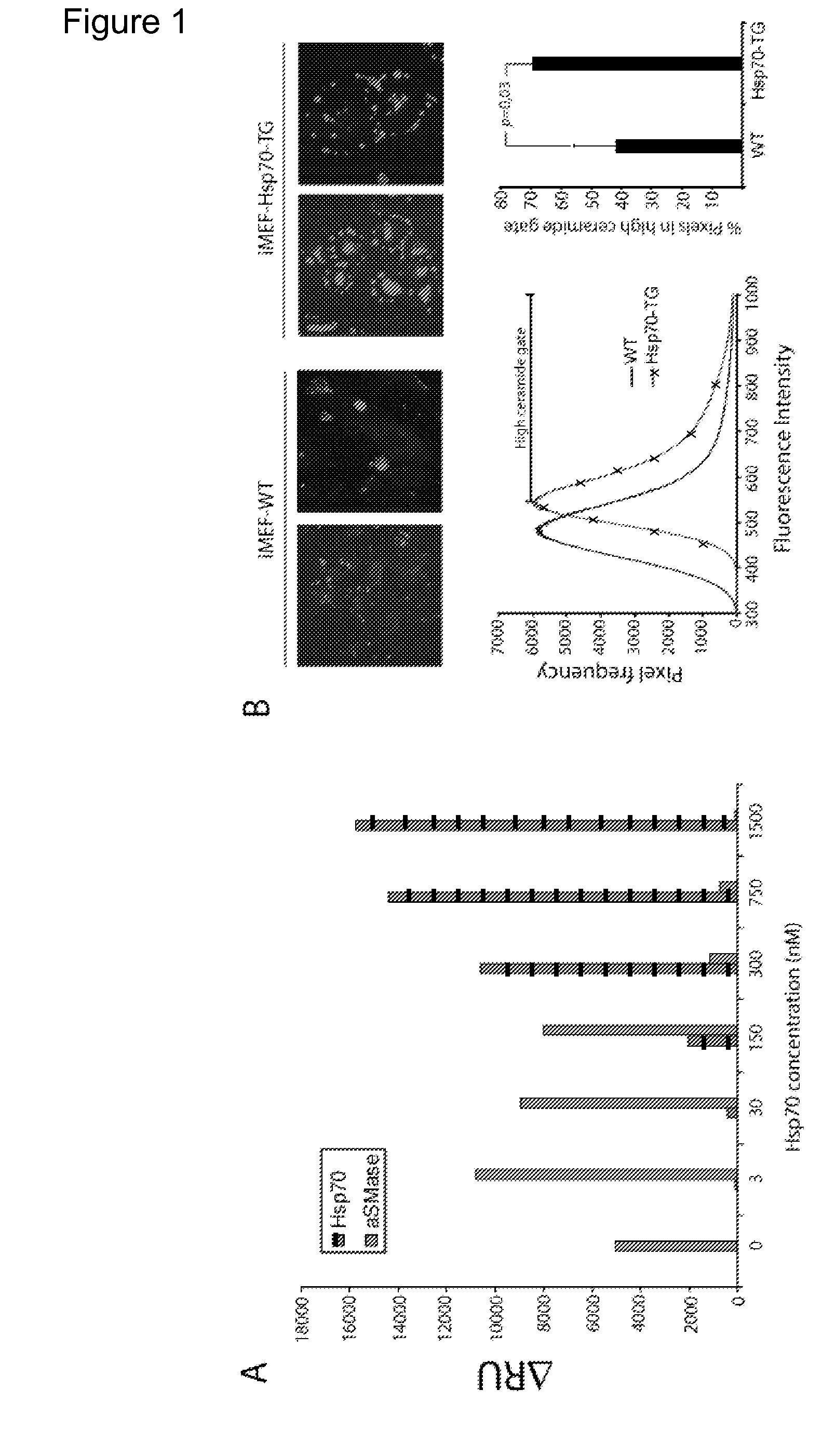
Figure 1 
Figure 2 
Figure 3
Abstract
Description
[0001] This application is a non-provisional application of DK patent application PA 2008 00885 filed on Jun. 26, 2008, which is hereby incorporated by reference in its entirety. All patent and non-patent references cited in the provisional application, or in the present application, are also hereby incorporated by reference in their entirety.FIELD OF INVENTION
[0002] The present invention relates to the field of modulation of enzyme activity by exploiting the interaction between the molecular chaperone Hsp70 and the lysosomal phospholipid Bis(monoacylglycero)phosphate (BMP, also known under the nome LBPA). The Hsp70-BMP interaction modulates the activity of BMP-interacting enzymes of the lysosomal compartment, and the present invention thus provides a means for reversing the pathology of lysosomal storage diseases.BACKGROUND OF INVENTION
[0003] The molecular chaperones are found in all compartments of a cell where conformational rearrangements of proteins occur, and although protein syn...
Examples
example 1
Interaction Between Hsp70 and bis(monoacylglycero)phosphate Stabilizes Lysosomes and Promotes Cell Survival
Abstract
[0592]Lysosomal membrane permeabilization is an evolutionarily conserved hallmark of stress-induced cell death. Here the inventors show that the major stress-inducible heat shock protein 70 (Hsp70) enhances cell survival by stabilizing lysosomes through a pH-dependent high affinity binding to an endo-lysosomal anionic phospholipid bis(monoacylglycero)phosphate (BMP; also referred to as lysobisphosphatidic acid). The positively charged ATPase domain of Hsp70 is responsible for the binding but the substrate-binding domain is also required for effective stabilization of lysosomes. Importantly, the cytoprotective effect can be obtained by endocytic delivery of recombinant Hsp70 and specifically reverted by extra cellular administration of BMP antibodies or Hsp70 inhibitors. Thus, this protein-lipid interaction opens exciting possibilities for the development of cytoprotecti...
example 2
Interaction Between Hsp70 and bis(monoacylglycero)phosphate Activates Acid Sphingomyelinase, Stabilizes Lysosomal Membranes and Promotes Cell Survival
[0636]Heat shock protein 70 (Hsp70) is an evolutionarily highly conserved molecular chaperone that promotes the survival of stressed cells by inhibiting lysosomal membrane permeabilization, a hallmark of stress-induced cell death. Clues to its molecular mechanism of action may lay in the recently reported stress- and cancer-associated translocation of a small portion of Hsp70 to the lysosomal compartment. Here, we show that Hsp70 stabilizes lysosomes by enhancing the activity of acid sphingomyelinase (ASM), a lysosomal lipase that hydrolyzes sphingomyelin to ceramide and phosphorylcholine. In acidic environment Hsp70 binds with high affinity and specificity to an endo-lysosomal anionic phospholipid bis(monoacylglycero)phosphate (BMP), an essential co-factor for ASM, thereby facilitating the binding of ASM to BMP and stimulating ASM act...
example 3
Effect of Benzyl Alcohol on Lysosomal Storage Disease
[0652]It is shown in Examples 2 and 3 that Hsp70 has a lysosome stabilizing effect via an interaction with BMP. In order to evaluate if this effect is also observed when exposing cells to a chemical Hsp70 inducer, Niemann-Pick Type A (NPDA) patient fibroblasts were treated with the small molecule Hsp70 inducer; Benzyl Alcohol (BA). Results are shown in FIG. 11. First, NPDA cells were treated with increasing doses of BA (0, 20, 30, 35, 40, 45 mM), lysed, and analysed by western blotting. The same amount of protein was loaded in each well. Hsp70 protein expression was evaluated for each condition, and shows that BA induced Hsp70 expression in a dose-dependent manner (primary antibody: Stressgen SPA-810, specific for Hsp70). Next, the stability of NPDA Götz lysosomes after treatment with 40 mM BA was evaluated, using the same methods as described in Example 2. An increased lysosomal stability was observed in response to BA. Finally, ...