Achieving Stable Magnetron Operation: Key Parameters
AUG 28, 20259 MIN READ
Generate Your Research Report Instantly with AI Agent
PatSnap Eureka helps you evaluate technical feasibility & market potential.
Magnetron Technology Background and Objectives
Magnetron technology has evolved significantly since its invention in the early 20th century, with its development accelerating during World War II for radar applications. The fundamental operating principle involves electrons moving in a crossed electric and magnetic field configuration, generating microwave radiation through the interaction between the electron cloud and resonant cavities. Over decades, magnetrons have transitioned from military applications to become ubiquitous in consumer appliances, industrial heating systems, and medical equipment.
The evolution trajectory shows a consistent focus on improving stability, efficiency, and control precision. Early magnetrons suffered from frequency drift, inconsistent power output, and limited operational lifespans. Modern iterations have addressed many of these challenges through advanced materials, improved cavity designs, and sophisticated control systems, yet achieving truly stable operation remains a persistent engineering challenge across applications.
Current technological trends point toward miniaturization, increased power density, and enhanced operational stability across wider environmental conditions. The integration of digital control systems and feedback mechanisms represents a significant advancement in addressing the inherent instability issues that have historically plagued magnetron operation.
The primary technical objective in magnetron development centers on achieving stable operation across varying load conditions, input power fluctuations, and environmental factors. Stability in this context encompasses consistent frequency output, predictable power delivery, minimal mode-hopping, and extended operational lifetime. These parameters are interdependent, creating a complex optimization challenge that requires holistic engineering approaches.
Secondary objectives include improving energy efficiency, reducing manufacturing costs, minimizing electromagnetic interference, and enhancing control precision for specialized applications. The industrial demand for magnetrons with predictable behavior under varying conditions continues to drive research into fundamental operating parameters and their relationships.
The scientific community has identified several critical parameters affecting magnetron stability: cathode temperature uniformity, magnetic field homogeneity, anode voltage regulation, resonant cavity design, and load matching characteristics. Understanding the complex interactions between these parameters represents the frontier of magnetron research, with computational modeling playing an increasingly important role in predicting operational behavior.
Achieving stable magnetron operation requires balancing competing design considerations while accounting for manufacturing tolerances and material properties. The technical goals for next-generation magnetrons include developing adaptive control systems that can compensate for parameter variations in real-time, creating more robust designs that maintain stability across wider operating ranges, and implementing advanced diagnostic capabilities to predict and prevent instability events.
The evolution trajectory shows a consistent focus on improving stability, efficiency, and control precision. Early magnetrons suffered from frequency drift, inconsistent power output, and limited operational lifespans. Modern iterations have addressed many of these challenges through advanced materials, improved cavity designs, and sophisticated control systems, yet achieving truly stable operation remains a persistent engineering challenge across applications.
Current technological trends point toward miniaturization, increased power density, and enhanced operational stability across wider environmental conditions. The integration of digital control systems and feedback mechanisms represents a significant advancement in addressing the inherent instability issues that have historically plagued magnetron operation.
The primary technical objective in magnetron development centers on achieving stable operation across varying load conditions, input power fluctuations, and environmental factors. Stability in this context encompasses consistent frequency output, predictable power delivery, minimal mode-hopping, and extended operational lifetime. These parameters are interdependent, creating a complex optimization challenge that requires holistic engineering approaches.
Secondary objectives include improving energy efficiency, reducing manufacturing costs, minimizing electromagnetic interference, and enhancing control precision for specialized applications. The industrial demand for magnetrons with predictable behavior under varying conditions continues to drive research into fundamental operating parameters and their relationships.
The scientific community has identified several critical parameters affecting magnetron stability: cathode temperature uniformity, magnetic field homogeneity, anode voltage regulation, resonant cavity design, and load matching characteristics. Understanding the complex interactions between these parameters represents the frontier of magnetron research, with computational modeling playing an increasingly important role in predicting operational behavior.
Achieving stable magnetron operation requires balancing competing design considerations while accounting for manufacturing tolerances and material properties. The technical goals for next-generation magnetrons include developing adaptive control systems that can compensate for parameter variations in real-time, creating more robust designs that maintain stability across wider operating ranges, and implementing advanced diagnostic capabilities to predict and prevent instability events.
Market Applications and Demand Analysis
Magnetron technology has witnessed substantial market growth across multiple sectors, with the global magnetron market valued at approximately 6.8 billion USD in 2022 and projected to reach 9.5 billion USD by 2028, representing a compound annual growth rate of 5.7%. This growth is primarily driven by expanding applications in both traditional and emerging sectors where stable magnetron operation is critical to performance and reliability.
The household appliance sector continues to dominate magnetron demand, with microwave ovens representing the largest application segment. Over 90 million microwave ovens are sold annually worldwide, each requiring a magnetron as its core component. Consumer expectations for faster cooking times, more uniform heating, and longer device lifespans are pushing manufacturers to develop magnetrons with increasingly stable operational parameters.
Industrial heating applications form the second-largest market segment, with food processing, material drying, and chemical processing industries increasingly adopting microwave technology for its energy efficiency and process control advantages. These applications demand magnetrons with exceptional stability under continuous operation conditions, often requiring specialized cooling systems and precise power control mechanisms.
The medical sector represents a rapidly growing market for stable magnetron technology, particularly in radiation therapy equipment. Cancer treatment devices utilizing magnetrons for generating microwave energy require extremely precise and stable operation to ensure patient safety and treatment efficacy. This sector's demand is expected to grow at 7.2% annually through 2030, driven by increasing cancer incidence rates globally.
Telecommunications and radar systems constitute another significant market segment, where magnetron stability directly impacts signal quality and detection accuracy. Defense applications alone account for approximately 1.2 billion USD of the magnetron market, with stringent requirements for operational stability under extreme environmental conditions.
Emerging applications in plasma generation for semiconductor manufacturing, materials processing, and environmental remediation are creating new demand vectors for stable magnetron technology. The semiconductor industry's push toward smaller node sizes requires increasingly precise plasma control, driving innovation in magnetron stability parameters.
Regional analysis reveals Asia-Pacific as the largest market for magnetrons, accounting for 45% of global demand, followed by North America (28%) and Europe (20%). China, Japan, and South Korea lead manufacturing capacity, while research into stability enhancement technologies is concentrated in the United States, Germany, and Japan.
The household appliance sector continues to dominate magnetron demand, with microwave ovens representing the largest application segment. Over 90 million microwave ovens are sold annually worldwide, each requiring a magnetron as its core component. Consumer expectations for faster cooking times, more uniform heating, and longer device lifespans are pushing manufacturers to develop magnetrons with increasingly stable operational parameters.
Industrial heating applications form the second-largest market segment, with food processing, material drying, and chemical processing industries increasingly adopting microwave technology for its energy efficiency and process control advantages. These applications demand magnetrons with exceptional stability under continuous operation conditions, often requiring specialized cooling systems and precise power control mechanisms.
The medical sector represents a rapidly growing market for stable magnetron technology, particularly in radiation therapy equipment. Cancer treatment devices utilizing magnetrons for generating microwave energy require extremely precise and stable operation to ensure patient safety and treatment efficacy. This sector's demand is expected to grow at 7.2% annually through 2030, driven by increasing cancer incidence rates globally.
Telecommunications and radar systems constitute another significant market segment, where magnetron stability directly impacts signal quality and detection accuracy. Defense applications alone account for approximately 1.2 billion USD of the magnetron market, with stringent requirements for operational stability under extreme environmental conditions.
Emerging applications in plasma generation for semiconductor manufacturing, materials processing, and environmental remediation are creating new demand vectors for stable magnetron technology. The semiconductor industry's push toward smaller node sizes requires increasingly precise plasma control, driving innovation in magnetron stability parameters.
Regional analysis reveals Asia-Pacific as the largest market for magnetrons, accounting for 45% of global demand, followed by North America (28%) and Europe (20%). China, Japan, and South Korea lead manufacturing capacity, while research into stability enhancement technologies is concentrated in the United States, Germany, and Japan.
Current Challenges in Magnetron Stability
Despite significant advancements in magnetron technology, achieving consistent operational stability remains a formidable challenge in both industrial applications and research environments. Current magnetron systems frequently encounter performance fluctuations that manifest as arcing, mode hopping, and power delivery inconsistencies. These instabilities not only reduce production efficiency but also compromise the quality of deposited films in coating applications and affect the reliability of microwave generation systems.
The primary technical obstacle lies in the complex plasma dynamics within the magnetron discharge region. Researchers have identified that even minor variations in magnetic field configuration can trigger substantial changes in electron confinement patterns, leading to unpredictable discharge behavior. Recent studies from Tokyo Institute of Technology demonstrate that a 5% deviation in magnetic field strength can result in up to 30% power fluctuation during operation.
Material-related challenges further complicate stability issues. Target erosion profiles evolve during operation, progressively altering the effective magnetic field geometry and consequently shifting the operational parameters away from optimal conditions. This "moving target" phenomenon necessitates sophisticated real-time adjustment capabilities that current control systems often lack.
Thermal management represents another critical stability factor. As documented by researchers at Fraunhofer Institute, temperature variations across the magnetron assembly can induce mechanical deformations that affect critical dimensions and spacing, particularly in high-power applications exceeding 10 kW. These thermal gradients create a feedback loop where instability begets further instability through progressive mechanical distortion.
Power supply limitations constitute a significant constraint on stability improvement efforts. Conventional power delivery systems struggle to respond adequately to the rapid impedance changes characteristic of magnetron discharges. The response time gap between plasma behavior changes (nanoseconds to microseconds) and power adjustment capabilities (typically milliseconds) creates windows of vulnerability where instabilities can cascade.
Gas dynamics and pressure control systems present additional challenges. Pressure fluctuations as small as 1-2% can trigger significant discharge variations, yet achieving such precision in industrial environments remains difficult, particularly in reactive sputtering processes where gas composition must be precisely maintained despite ongoing chemical consumption.
Recent industry reports indicate that these stability challenges collectively account for approximately 15-20% production efficiency losses in manufacturing settings and represent a major barrier to further miniaturization of magnetron-based devices. The interdependent nature of these factors creates a multi-dimensional optimization problem that continues to resist straightforward engineering solutions.
The primary technical obstacle lies in the complex plasma dynamics within the magnetron discharge region. Researchers have identified that even minor variations in magnetic field configuration can trigger substantial changes in electron confinement patterns, leading to unpredictable discharge behavior. Recent studies from Tokyo Institute of Technology demonstrate that a 5% deviation in magnetic field strength can result in up to 30% power fluctuation during operation.
Material-related challenges further complicate stability issues. Target erosion profiles evolve during operation, progressively altering the effective magnetic field geometry and consequently shifting the operational parameters away from optimal conditions. This "moving target" phenomenon necessitates sophisticated real-time adjustment capabilities that current control systems often lack.
Thermal management represents another critical stability factor. As documented by researchers at Fraunhofer Institute, temperature variations across the magnetron assembly can induce mechanical deformations that affect critical dimensions and spacing, particularly in high-power applications exceeding 10 kW. These thermal gradients create a feedback loop where instability begets further instability through progressive mechanical distortion.
Power supply limitations constitute a significant constraint on stability improvement efforts. Conventional power delivery systems struggle to respond adequately to the rapid impedance changes characteristic of magnetron discharges. The response time gap between plasma behavior changes (nanoseconds to microseconds) and power adjustment capabilities (typically milliseconds) creates windows of vulnerability where instabilities can cascade.
Gas dynamics and pressure control systems present additional challenges. Pressure fluctuations as small as 1-2% can trigger significant discharge variations, yet achieving such precision in industrial environments remains difficult, particularly in reactive sputtering processes where gas composition must be precisely maintained despite ongoing chemical consumption.
Recent industry reports indicate that these stability challenges collectively account for approximately 15-20% production efficiency losses in manufacturing settings and represent a major barrier to further miniaturization of magnetron-based devices. The interdependent nature of these factors creates a multi-dimensional optimization problem that continues to resist straightforward engineering solutions.
Current Stability Control Solutions
01 Power supply control for magnetron stability
Controlling the power supply to a magnetron is crucial for stable operation. This includes regulating voltage and current to prevent fluctuations that could lead to unstable operation. Advanced power supply systems incorporate feedback mechanisms that monitor the magnetron's performance and adjust power delivery accordingly. These systems help maintain consistent output power and frequency, which are essential for applications requiring precise energy delivery.- Power supply control for magnetron stability: Controlling the power supply to a magnetron is crucial for its stable operation. This includes regulating voltage and current to prevent fluctuations that could lead to unstable operation. Advanced power supply systems incorporate feedback mechanisms that monitor the magnetron's performance and adjust power delivery accordingly. These systems help maintain consistent output power and frequency, which are essential for stable magnetron operation in various applications.
- Cooling systems for thermal stability: Effective cooling systems are essential for maintaining the thermal stability of magnetrons during operation. Heat generation during magnetron operation can lead to frequency drift and reduced performance. Cooling methods include liquid cooling, forced air cooling, and heat sink designs that efficiently dissipate heat from critical components. Proper thermal management ensures consistent electron emission and prevents damage to the magnetron structure, contributing to stable long-term operation.
- Magnetic field optimization techniques: Optimizing the magnetic field configuration is critical for stable magnetron operation. This involves precise design and placement of permanent magnets or electromagnets to create the appropriate field strength and uniformity. Advanced magnetron designs incorporate magnetic field shaping techniques to control electron trajectories and prevent mode hopping. Stable magnetic fields ensure consistent electron circulation within the magnetron cavity, leading to reliable microwave generation and reduced operational instabilities.
- Impedance matching and load stabilization: Proper impedance matching between the magnetron and its load is essential for stable operation. Mismatched impedance can cause power reflection back to the magnetron, leading to frequency pulling, mode jumping, and potential damage. Load stabilization techniques include waveguide tuners, circulators, and isolators that protect the magnetron from reflected power. Advanced matching networks can dynamically adjust to changing load conditions, ensuring optimal power transfer and stable magnetron performance across various operating conditions.
- Cathode and anode design improvements: Innovations in cathode and anode design significantly impact magnetron stability. Enhanced cathode materials and structures improve electron emission consistency and longevity. Precision-engineered anode cavities with optimized dimensions and surface treatments reduce arcing and mode competition. Some advanced designs incorporate novel geometries that suppress unwanted oscillation modes. These improvements in the core components of magnetrons lead to more predictable behavior, reduced noise, and extended operational stability across varying power levels.
02 Cooling systems for thermal stability
Effective cooling systems are essential for maintaining magnetron thermal stability during operation. Heat generation during magnetron operation can lead to frequency drift and reduced efficiency. Cooling methods include liquid cooling circuits, heat sinks, and forced air systems that dissipate heat from critical components. Proper thermal management ensures consistent performance and extends the operational lifespan of the magnetron by preventing thermal damage to sensitive components.Expand Specific Solutions03 Magnetic field optimization techniques
Optimizing the magnetic field configuration is fundamental to achieving stable magnetron operation. This involves precise design and placement of permanent magnets or electromagnets to create the appropriate field strength and uniformity. Advanced techniques include adjustable magnetic field systems that can be tuned during operation to compensate for changes in operating conditions. Proper magnetic field configuration ensures consistent electron trajectories within the magnetron, leading to stable microwave generation.Expand Specific Solutions04 Impedance matching and load control
Impedance matching between the magnetron and its load is critical for stable operation. Systems that dynamically adjust to maintain optimal impedance matching prevent power reflection that can destabilize the magnetron. This includes waveguide components, circulators, and tuning elements that ensure efficient power transfer. Load variations can cause frequency pulling and pushing effects, so proper load control mechanisms are implemented to maintain stable operating conditions regardless of changes in the application environment.Expand Specific Solutions05 Cathode and anode design improvements
Advanced cathode and anode designs significantly improve magnetron stability. Innovations include specialized cathode materials that provide consistent electron emission and anode structures optimized for mode stability. Some designs incorporate segmented anodes or strapped configurations that suppress unwanted oscillation modes. Proper spacing between cathode and anode components ensures consistent electric field distribution, while surface treatments and coatings can enhance emission characteristics and reduce arcing, contributing to more stable operation.Expand Specific Solutions
Leading Manufacturers and Research Institutions
The magnetron operation stability market is currently in a growth phase, with increasing demand across various industries including electronics, healthcare, and telecommunications. The market size is estimated to be expanding at a steady rate due to applications in microwave technology, medical imaging, and semiconductor manufacturing. Technologically, companies like Toshiba Corp., Samsung Electronics, and Applied Materials are leading innovation with advanced parameter control systems, while research organizations such as Fraunhofer-Gesellschaft contribute significant R&D. Emerging players like NAURA Microelectronics and BOE Technology are gaining ground with specialized solutions. The technology shows varying maturity levels across applications, with established parameters in consumer electronics but ongoing development in advanced semiconductor processes and medical applications.
Toshiba Corp.
Technical Solution: Toshiba has developed advanced magnetron stabilization technology focusing on precise power control systems. Their approach involves implementing digital feedback loops that continuously monitor and adjust key parameters including magnetic field strength, cathode temperature, and anode voltage. Toshiba's magnetrons incorporate proprietary cathode materials with enhanced electron emission properties and specialized cooling systems that maintain optimal operating temperatures even under high-power conditions. Their design includes adaptive impedance matching networks that automatically compensate for load variations, ensuring stable operation across varying conditions. Toshiba has also pioneered pulse-width modulation techniques that allow for finer control of output power while minimizing instabilities during operation transitions. Their magnetrons feature carefully engineered magnetic circuit designs that create uniform field distributions, reducing the likelihood of mode-hopping and frequency drift that typically plague less sophisticated systems.
Strengths: Superior thermal management allowing for extended operational lifetimes and higher power stability. Advanced digital control systems provide exceptional frequency stability even under varying load conditions. Weaknesses: Higher manufacturing costs compared to simpler designs, and more complex implementation requiring specialized knowledge for maintenance and repair.
Samsung Electronics Co., Ltd.
Technical Solution: Samsung Electronics has developed a comprehensive magnetron stabilization approach centered on their proprietary "Smart Resonance Control" technology. This system employs real-time monitoring of multiple operational parameters including cathode current, magnetic field intensity, and cavity resonance characteristics. Samsung's magnetrons feature advanced thermal management systems with precision-engineered heat sinks and cooling channels that maintain optimal temperature gradients across critical components. Their design incorporates specialized filament power supplies with active current regulation that prevents cathode emission fluctuations, a common source of instability. Samsung has also implemented sophisticated RF matching networks that automatically adjust to compensate for load variations and environmental changes. Their magnetrons utilize high-precision manufacturing techniques for critical components, ensuring tight tolerances in the interaction space geometry which significantly reduces mode competition issues that can lead to unstable operation.
Strengths: Exceptional frequency stability across wide power ranges due to their adaptive control systems. Superior manufacturing consistency resulting in highly predictable performance characteristics. Weaknesses: Higher initial cost compared to conventional magnetrons, and increased complexity requiring more sophisticated diagnostic equipment for servicing.
Critical Parameters and Operating Principles
Injection locked magnetron microwave generator with recycle of spurious energy
PatentInactiveUS20150270091A1
Innovation
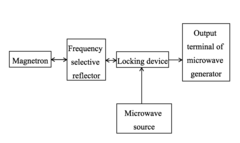
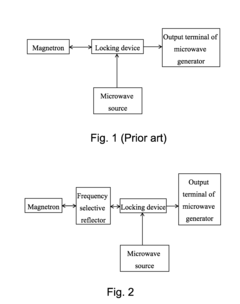
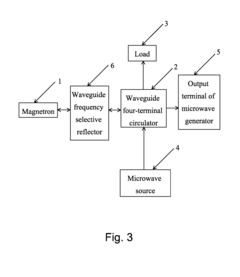
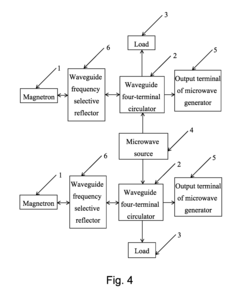
- A magnetron microwave generator with a frequency selective reflector that recycles spurious energy, allowing a low-power injection signal to lock a high-output-power magnetron, using multiple magnetrons and locking devices connected to a shared microwave source, and a waveguide frequency selective reflector to adjust and reflect spurious signals back to the magnetron for re-locking.
High frequency heating device
PatentInactiveUS20040004439A1
Innovation
- A high frequency heating device with a filtering inductor, central tap transformer, filtering capacitor, and resonant circuit design that reduces direct current bias, enhances power factor, and enables zero-current-switching to improve efficiency and power density.


Thermal Management Considerations
Thermal management represents a critical aspect of magnetron design and operation, directly impacting performance stability, reliability, and operational lifespan. During magnetron operation, significant heat is generated primarily through electron bombardment of the anode, inefficient energy conversion processes, and resistive heating in various components. Without proper thermal management, these heat sources can lead to thermal expansion of critical components, altering the resonant cavity dimensions and consequently shifting operational frequencies.
The anode block typically experiences the highest thermal load, with temperatures potentially exceeding 200°C during continuous operation. This necessitates efficient cooling systems, commonly implemented through water cooling channels integrated directly into the anode structure. The design of these cooling channels requires careful consideration of flow rates, channel geometry, and thermal interface materials to maximize heat transfer efficiency while minimizing pressure drops across the system.
Cathode thermal management presents unique challenges due to its central role in electron emission. Excessive cathode temperatures can accelerate filament degradation and increase evaporation rates of emissive materials, while insufficient heating may result in inadequate electron emission. Modern magnetrons employ sophisticated temperature control systems that maintain optimal cathode temperatures throughout the operational cycle, often utilizing closed-loop feedback mechanisms to adjust heating current based on real-time temperature measurements.
Thermal gradients across magnetron components represent another significant consideration, as uneven heating can induce mechanical stresses that lead to component deformation or failure. Computational fluid dynamics (CFD) and finite element analysis (FEA) have become essential tools in predicting these thermal gradients during the design phase, allowing engineers to optimize component geometries and material selections before physical prototyping.
Material selection plays a crucial role in thermal management strategies. Copper remains the predominant material for anode blocks due to its excellent thermal conductivity (approximately 400 W/m·K), while various ceramic materials are employed for insulators based on their specific thermal expansion coefficients and dielectric properties. Advanced thermal interface materials, including specialized thermal greases and phase-change materials, are increasingly utilized at component junctions to minimize thermal resistance across mechanical interfaces.
For high-power industrial applications, auxiliary cooling systems may be implemented, including forced-air cooling for peripheral components and oil-based cooling systems for specialized high-power scenarios. These systems must be carefully integrated with the primary cooling mechanisms to ensure comprehensive thermal management across all operational conditions, from startup transients to steady-state operation and shutdown procedures.
The anode block typically experiences the highest thermal load, with temperatures potentially exceeding 200°C during continuous operation. This necessitates efficient cooling systems, commonly implemented through water cooling channels integrated directly into the anode structure. The design of these cooling channels requires careful consideration of flow rates, channel geometry, and thermal interface materials to maximize heat transfer efficiency while minimizing pressure drops across the system.
Cathode thermal management presents unique challenges due to its central role in electron emission. Excessive cathode temperatures can accelerate filament degradation and increase evaporation rates of emissive materials, while insufficient heating may result in inadequate electron emission. Modern magnetrons employ sophisticated temperature control systems that maintain optimal cathode temperatures throughout the operational cycle, often utilizing closed-loop feedback mechanisms to adjust heating current based on real-time temperature measurements.
Thermal gradients across magnetron components represent another significant consideration, as uneven heating can induce mechanical stresses that lead to component deformation or failure. Computational fluid dynamics (CFD) and finite element analysis (FEA) have become essential tools in predicting these thermal gradients during the design phase, allowing engineers to optimize component geometries and material selections before physical prototyping.
Material selection plays a crucial role in thermal management strategies. Copper remains the predominant material for anode blocks due to its excellent thermal conductivity (approximately 400 W/m·K), while various ceramic materials are employed for insulators based on their specific thermal expansion coefficients and dielectric properties. Advanced thermal interface materials, including specialized thermal greases and phase-change materials, are increasingly utilized at component junctions to minimize thermal resistance across mechanical interfaces.
For high-power industrial applications, auxiliary cooling systems may be implemented, including forced-air cooling for peripheral components and oil-based cooling systems for specialized high-power scenarios. These systems must be carefully integrated with the primary cooling mechanisms to ensure comprehensive thermal management across all operational conditions, from startup transients to steady-state operation and shutdown procedures.
Energy Efficiency and Sustainability Factors
Energy efficiency has emerged as a critical factor in magnetron operation, particularly as industries face increasing pressure to reduce carbon footprints and operational costs. Modern magnetron systems demonstrate significant improvements in energy conversion efficiency, with state-of-the-art models achieving 65-75% efficiency compared to 40-50% in earlier generations. This efficiency gain translates directly to reduced power consumption and operational expenses, making magnetrons increasingly attractive for industrial applications.
The sustainability profile of magnetron operations depends heavily on cooling system design and implementation. Water-cooled systems, while more efficient at heat dissipation, raise concerns regarding water usage in water-stressed regions. Air-cooled alternatives, though less efficient thermally, offer reduced environmental impact in terms of water consumption. Recent innovations in hybrid cooling technologies have shown promise in balancing these competing priorities.
Material selection plays a crucial role in both the environmental impact and longevity of magnetron systems. The transition from beryllium oxide to aluminum nitride ceramics as insulators represents a significant advancement in reducing toxic material usage while maintaining performance standards. Similarly, developments in cathode materials have extended operational lifespans from 2,000 hours to over 10,000 hours in industrial settings, substantially reducing replacement frequency and associated waste.
Power supply optimization represents another frontier in magnetron sustainability. Pulse-width modulation and variable frequency drives have enabled more precise power control, reducing energy waste during partial-load operations by up to 30%. These technologies allow magnetrons to operate at optimal efficiency points across varying load conditions, rather than at fixed power levels that may be excessive for actual requirements.
Heat recovery systems integrated with magnetron operations offer promising pathways to further sustainability improvements. By capturing waste heat for facility heating or preheating process inputs, overall system efficiency can increase by 15-25%. Several manufacturing facilities have successfully implemented such systems, achieving payback periods of 18-36 months while significantly reducing natural gas consumption for heating.
Lifecycle assessment studies indicate that the environmental impact of magnetron systems is dominated by operational energy use rather than manufacturing or disposal phases. This underscores the importance of efficiency improvements and proper maintenance protocols in achieving sustainability goals. Regular maintenance, particularly of cooling systems and power supplies, can prevent efficiency degradation of up to 20% over the operational lifetime of the equipment.
The sustainability profile of magnetron operations depends heavily on cooling system design and implementation. Water-cooled systems, while more efficient at heat dissipation, raise concerns regarding water usage in water-stressed regions. Air-cooled alternatives, though less efficient thermally, offer reduced environmental impact in terms of water consumption. Recent innovations in hybrid cooling technologies have shown promise in balancing these competing priorities.
Material selection plays a crucial role in both the environmental impact and longevity of magnetron systems. The transition from beryllium oxide to aluminum nitride ceramics as insulators represents a significant advancement in reducing toxic material usage while maintaining performance standards. Similarly, developments in cathode materials have extended operational lifespans from 2,000 hours to over 10,000 hours in industrial settings, substantially reducing replacement frequency and associated waste.
Power supply optimization represents another frontier in magnetron sustainability. Pulse-width modulation and variable frequency drives have enabled more precise power control, reducing energy waste during partial-load operations by up to 30%. These technologies allow magnetrons to operate at optimal efficiency points across varying load conditions, rather than at fixed power levels that may be excessive for actual requirements.
Heat recovery systems integrated with magnetron operations offer promising pathways to further sustainability improvements. By capturing waste heat for facility heating or preheating process inputs, overall system efficiency can increase by 15-25%. Several manufacturing facilities have successfully implemented such systems, achieving payback periods of 18-36 months while significantly reducing natural gas consumption for heating.
Lifecycle assessment studies indicate that the environmental impact of magnetron systems is dominated by operational energy use rather than manufacturing or disposal phases. This underscores the importance of efficiency improvements and proper maintenance protocols in achieving sustainability goals. Regular maintenance, particularly of cooling systems and power supplies, can prevent efficiency degradation of up to 20% over the operational lifetime of the equipment.
Unlock deeper insights with PatSnap Eureka Quick Research — get a full tech report to explore trends and direct your research. Try now!
Generate Your Research Report Instantly with AI Agent
Supercharge your innovation with PatSnap Eureka AI Agent Platform!