Advancements in AMOLED’s image processing support.
JUL 17, 20259 MIN READ
Generate Your Research Report Instantly with AI Agent
Patsnap Eureka helps you evaluate technical feasibility & market potential.
AMOLED Image Processing Evolution and Objectives
Active-Matrix Organic Light-Emitting Diode (AMOLED) technology has revolutionized display systems, offering superior image quality, energy efficiency, and flexibility. The evolution of AMOLED image processing support has been a critical factor in its widespread adoption across various devices, from smartphones to large-scale televisions.
The journey of AMOLED image processing began with basic color management and contrast enhancement techniques. Early iterations focused on leveraging the technology's inherent advantages, such as true blacks and vibrant colors. As the technology matured, more sophisticated processing algorithms were developed to address challenges like color accuracy, motion blur, and power consumption.
A significant milestone in AMOLED image processing was the introduction of High Dynamic Range (HDR) support. This advancement allowed for a wider range of luminance and color, resulting in more lifelike images with enhanced detail in both bright and dark areas. The implementation of HDR in AMOLED displays required substantial improvements in image processing capabilities to fully utilize the expanded color gamut and contrast ratio.
Another key development has been the integration of artificial intelligence (AI) and machine learning algorithms into AMOLED image processing. These technologies enable real-time scene recognition, adaptive brightness control, and content-aware image enhancement. AI-driven processing has significantly improved the viewing experience by optimizing display parameters based on ambient lighting conditions and content type.
The ongoing evolution of AMOLED image processing aims to address several key objectives. Firstly, there is a push towards achieving perfect color accuracy across various viewing conditions. This involves developing advanced color management systems that can adapt to different ambient light situations while maintaining true-to-life colors.
Secondly, reducing power consumption remains a critical goal. As AMOLED displays become more prevalent in mobile devices, optimizing image processing to minimize energy usage without compromising visual quality is paramount. This includes developing more efficient algorithms for local dimming and selective pixel activation.
Thirdly, enhancing motion handling capabilities is a focus area. With the increasing popularity of high-refresh-rate displays, AMOLED image processing must evolve to support smoother motion rendering and reduce artifacts in fast-moving scenes. This involves implementing advanced frame interpolation techniques and motion estimation algorithms.
Lastly, improving the overall visual experience through advanced image enhancement techniques is an ongoing objective. This includes developing more sophisticated algorithms for noise reduction, sharpness enhancement, and contrast adjustment, all while maintaining a natural and pleasing image appearance.
The journey of AMOLED image processing began with basic color management and contrast enhancement techniques. Early iterations focused on leveraging the technology's inherent advantages, such as true blacks and vibrant colors. As the technology matured, more sophisticated processing algorithms were developed to address challenges like color accuracy, motion blur, and power consumption.
A significant milestone in AMOLED image processing was the introduction of High Dynamic Range (HDR) support. This advancement allowed for a wider range of luminance and color, resulting in more lifelike images with enhanced detail in both bright and dark areas. The implementation of HDR in AMOLED displays required substantial improvements in image processing capabilities to fully utilize the expanded color gamut and contrast ratio.
Another key development has been the integration of artificial intelligence (AI) and machine learning algorithms into AMOLED image processing. These technologies enable real-time scene recognition, adaptive brightness control, and content-aware image enhancement. AI-driven processing has significantly improved the viewing experience by optimizing display parameters based on ambient lighting conditions and content type.
The ongoing evolution of AMOLED image processing aims to address several key objectives. Firstly, there is a push towards achieving perfect color accuracy across various viewing conditions. This involves developing advanced color management systems that can adapt to different ambient light situations while maintaining true-to-life colors.
Secondly, reducing power consumption remains a critical goal. As AMOLED displays become more prevalent in mobile devices, optimizing image processing to minimize energy usage without compromising visual quality is paramount. This includes developing more efficient algorithms for local dimming and selective pixel activation.
Thirdly, enhancing motion handling capabilities is a focus area. With the increasing popularity of high-refresh-rate displays, AMOLED image processing must evolve to support smoother motion rendering and reduce artifacts in fast-moving scenes. This involves implementing advanced frame interpolation techniques and motion estimation algorithms.
Lastly, improving the overall visual experience through advanced image enhancement techniques is an ongoing objective. This includes developing more sophisticated algorithms for noise reduction, sharpness enhancement, and contrast adjustment, all while maintaining a natural and pleasing image appearance.
Market Demand for Advanced AMOLED Displays
The demand for advanced AMOLED displays with enhanced image processing capabilities has been steadily increasing across various market segments. This growth is primarily driven by the consumer electronics sector, particularly smartphones and high-end televisions, where visual quality and energy efficiency are paramount.
In the smartphone market, AMOLED displays have become a standard feature in premium devices, with manufacturers competing to offer the best visual experience. The integration of advanced image processing support in AMOLED technology has enabled features such as high dynamic range (HDR), wide color gamut, and improved contrast ratios. These enhancements have resonated strongly with consumers, leading to a significant market pull for devices equipped with cutting-edge AMOLED displays.
The television industry has also witnessed a surge in demand for AMOLED technology, especially in the high-end and luxury segments. Consumers are increasingly seeking immersive viewing experiences, driving the adoption of large-format AMOLED displays with superior image quality and processing capabilities. The ability of AMOLED technology to deliver deep blacks, vibrant colors, and fast response times has made it a preferred choice for home entertainment systems.
Emerging applications in the automotive sector have further expanded the market for advanced AMOLED displays. As vehicles become more connected and autonomous, there is a growing need for high-quality, flexible displays for infotainment systems, digital dashboards, and heads-up displays. The automotive industry's shift towards electric vehicles has also increased the emphasis on energy-efficient display technologies, aligning well with AMOLED's power-saving characteristics.
The wearable technology market, including smartwatches and fitness trackers, has embraced AMOLED displays for their thin profile, power efficiency, and ability to display vivid colors even in bright outdoor conditions. As these devices become more sophisticated, the demand for displays capable of processing and presenting complex health and fitness data in an easily digestible format has grown significantly.
In the professional and industrial sectors, there is an increasing demand for AMOLED displays in medical imaging equipment, design workstations, and simulation systems. The superior color accuracy and contrast offered by AMOLED technology, combined with advanced image processing support, make it ideal for applications requiring precise visual representation and analysis.
The global shift towards remote work and digital collaboration has also boosted the demand for high-quality displays in laptops and monitors. AMOLED technology's ability to deliver crisp text, accurate colors, and reduced eye strain has made it an attractive option for professionals spending extended hours in front of screens.
In the smartphone market, AMOLED displays have become a standard feature in premium devices, with manufacturers competing to offer the best visual experience. The integration of advanced image processing support in AMOLED technology has enabled features such as high dynamic range (HDR), wide color gamut, and improved contrast ratios. These enhancements have resonated strongly with consumers, leading to a significant market pull for devices equipped with cutting-edge AMOLED displays.
The television industry has also witnessed a surge in demand for AMOLED technology, especially in the high-end and luxury segments. Consumers are increasingly seeking immersive viewing experiences, driving the adoption of large-format AMOLED displays with superior image quality and processing capabilities. The ability of AMOLED technology to deliver deep blacks, vibrant colors, and fast response times has made it a preferred choice for home entertainment systems.
Emerging applications in the automotive sector have further expanded the market for advanced AMOLED displays. As vehicles become more connected and autonomous, there is a growing need for high-quality, flexible displays for infotainment systems, digital dashboards, and heads-up displays. The automotive industry's shift towards electric vehicles has also increased the emphasis on energy-efficient display technologies, aligning well with AMOLED's power-saving characteristics.
The wearable technology market, including smartwatches and fitness trackers, has embraced AMOLED displays for their thin profile, power efficiency, and ability to display vivid colors even in bright outdoor conditions. As these devices become more sophisticated, the demand for displays capable of processing and presenting complex health and fitness data in an easily digestible format has grown significantly.
In the professional and industrial sectors, there is an increasing demand for AMOLED displays in medical imaging equipment, design workstations, and simulation systems. The superior color accuracy and contrast offered by AMOLED technology, combined with advanced image processing support, make it ideal for applications requiring precise visual representation and analysis.
The global shift towards remote work and digital collaboration has also boosted the demand for high-quality displays in laptops and monitors. AMOLED technology's ability to deliver crisp text, accurate colors, and reduced eye strain has made it an attractive option for professionals spending extended hours in front of screens.
Current AMOLED Image Processing Challenges
AMOLED displays have revolutionized the mobile device industry with their superior image quality and energy efficiency. However, as consumer expectations for display performance continue to rise, AMOLED technology faces several significant challenges in image processing.
One of the primary challenges is the management of power consumption while maintaining high image quality. AMOLED displays consume varying amounts of power depending on the content displayed, with bright and colorful images requiring more energy. Balancing power efficiency with visual fidelity remains a complex task, especially in mobile devices where battery life is crucial.
Color accuracy and consistency present another major hurdle. AMOLED displays are known for their vibrant colors, but achieving precise color reproduction across different viewing angles and ambient lighting conditions is challenging. The organic nature of AMOLED pixels can lead to color shifts and degradation over time, necessitating advanced compensation algorithms.
Motion handling is a critical area where AMOLED displays still face difficulties. The response time of organic pixels, while generally fast, can sometimes result in motion blur or ghosting effects, particularly in high-speed content such as action scenes or gaming. Developing effective motion compensation techniques without introducing artifacts is an ongoing challenge.
HDR (High Dynamic Range) implementation on AMOLED displays poses unique challenges. While AMOLED technology excels in producing deep blacks, managing peak brightness for HDR content without compromising the display's lifespan or increasing power consumption significantly is a delicate balance to strike.
Burn-in prevention remains a persistent issue for AMOLED displays. Static elements on the screen can cause uneven wear of the organic pixels, leading to permanent image retention. Developing more sophisticated pixel shifting and compensation algorithms is crucial to extend the longevity of AMOLED displays.
The complexity of driving AMOLED displays at high refresh rates, particularly in mobile devices, presents both hardware and software challenges. Achieving smooth motion and responsiveness while managing heat generation and power consumption requires advanced image processing techniques and hardware optimizations.
Lastly, the integration of under-display cameras and sensors with AMOLED panels introduces new image processing challenges. Ensuring display quality is not compromised in areas covering these components, while maintaining their functionality, demands innovative solutions in pixel arrangement and image compensation algorithms.
One of the primary challenges is the management of power consumption while maintaining high image quality. AMOLED displays consume varying amounts of power depending on the content displayed, with bright and colorful images requiring more energy. Balancing power efficiency with visual fidelity remains a complex task, especially in mobile devices where battery life is crucial.
Color accuracy and consistency present another major hurdle. AMOLED displays are known for their vibrant colors, but achieving precise color reproduction across different viewing angles and ambient lighting conditions is challenging. The organic nature of AMOLED pixels can lead to color shifts and degradation over time, necessitating advanced compensation algorithms.
Motion handling is a critical area where AMOLED displays still face difficulties. The response time of organic pixels, while generally fast, can sometimes result in motion blur or ghosting effects, particularly in high-speed content such as action scenes or gaming. Developing effective motion compensation techniques without introducing artifacts is an ongoing challenge.
HDR (High Dynamic Range) implementation on AMOLED displays poses unique challenges. While AMOLED technology excels in producing deep blacks, managing peak brightness for HDR content without compromising the display's lifespan or increasing power consumption significantly is a delicate balance to strike.
Burn-in prevention remains a persistent issue for AMOLED displays. Static elements on the screen can cause uneven wear of the organic pixels, leading to permanent image retention. Developing more sophisticated pixel shifting and compensation algorithms is crucial to extend the longevity of AMOLED displays.
The complexity of driving AMOLED displays at high refresh rates, particularly in mobile devices, presents both hardware and software challenges. Achieving smooth motion and responsiveness while managing heat generation and power consumption requires advanced image processing techniques and hardware optimizations.
Lastly, the integration of under-display cameras and sensors with AMOLED panels introduces new image processing challenges. Ensuring display quality is not compromised in areas covering these components, while maintaining their functionality, demands innovative solutions in pixel arrangement and image compensation algorithms.
Existing AMOLED Image Processing Solutions
01 Image compensation techniques for AMOLED displays
Various methods are employed to compensate for image quality issues in AMOLED displays, such as non-uniformity, color shift, and brightness variations. These techniques involve analyzing pixel data, applying correction factors, and adjusting drive signals to improve overall image quality and consistency across the display.- Image compensation techniques for AMOLED displays: Various methods are employed to compensate for image quality issues in AMOLED displays, such as non-uniformity, color shift, and brightness variations. These techniques involve analyzing pixel data, applying correction factors, and adjusting driving signals to improve overall image quality and consistency across the display.
- Power consumption optimization in AMOLED displays: Techniques are developed to optimize power consumption in AMOLED displays while maintaining image quality. These methods include selective pixel dimming, adaptive brightness control, and power-efficient driving schemes that consider the content being displayed and ambient lighting conditions.
- Color management and gamut enhancement: Advanced color management systems are implemented to improve color accuracy and expand the color gamut of AMOLED displays. These systems involve color space conversion, gamut mapping, and dynamic adjustment of color parameters based on content and viewing conditions.
- High dynamic range (HDR) processing for AMOLED: Specialized image processing techniques are developed to enhance the high dynamic range capabilities of AMOLED displays. These methods involve tone mapping, local contrast enhancement, and adaptive brightness control to maximize the display's ability to render HDR content effectively.
- Pixel structure and driving method improvements: Innovations in pixel structure design and driving methods are implemented to enhance image quality and efficiency in AMOLED displays. These improvements include sub-pixel arrangements, novel driving circuits, and compensation schemes to address issues such as image retention and non-uniformity.
02 AMOLED pixel circuit design and driving methods
Advanced pixel circuit designs and driving methods are developed to enhance AMOLED display performance. These innovations focus on improving pixel response time, reducing power consumption, and increasing display lifespan through optimized transistor configurations and driving schemes.Expand Specific Solutions03 Color management and gamut enhancement for AMOLED displays
Techniques for improving color accuracy, expanding color gamut, and enhancing color perception on AMOLED displays are implemented. These methods involve color space conversion, gamut mapping, and adaptive color processing to achieve more vibrant and accurate color reproduction.Expand Specific Solutions04 Power efficiency and brightness control in AMOLED displays
Innovative approaches are developed to optimize power consumption and brightness control in AMOLED displays. These techniques include adaptive brightness adjustment, selective pixel dimming, and power-efficient driving schemes to extend battery life while maintaining image quality.Expand Specific Solutions05 AMOLED display panel structure and manufacturing processes
Advancements in AMOLED display panel structure and manufacturing processes are made to improve overall display performance and yield. These innovations include new materials, fabrication techniques, and panel designs that enhance display quality, durability, and production efficiency.Expand Specific Solutions
Key AMOLED Display Manufacturers and Innovators
The AMOLED image processing support market is in a growth phase, driven by increasing demand for high-quality displays in smartphones, wearables, and other devices. The market size is expanding rapidly, with major players like Samsung Electronics, BOE Technology, and LG Electronics competing for market share. Technological advancements are focused on improving image quality, energy efficiency, and integration with other features. Companies like Everdisplay Optronics and Visionox are also making significant strides in AMOLED technology, while established players like Innolux and Novatek Microelectronics are leveraging their expertise in display technologies to enhance AMOLED image processing capabilities. The competition is intensifying as more companies invest in R&D to develop innovative solutions and gain a competitive edge in this growing market.
BOE Technology Group Co., Ltd.
Technical Solution: BOE has made significant strides in AMOLED image processing support, focusing on both hardware and software innovations. The company has developed its own AI-powered image processing chip, which enhances picture quality through intelligent scene recognition and adaptive content optimization[7]. BOE's AMOLED displays feature high refresh rates of up to 144Hz, providing smoother motion and reduced motion blur in fast-moving content. The company has also implemented advanced local dimming technology, which improves contrast ratios and enhances HDR performance[8]. Additionally, BOE has introduced AI-based color management systems that adjust color temperature and saturation based on ambient lighting conditions and content type, ensuring optimal viewing experiences across various environments[9].
Strengths: Cost-effective AMOLED production, high refresh rates, and growing market share in the display industry. Weaknesses: Less established brand reputation compared to Samsung and LG, potentially lower peak brightness in some models.
LG Electronics, Inc.
Technical Solution: LG has made substantial progress in AMOLED image processing support, particularly with their α9 (Alpha 9) AI Processor. This advanced chip utilizes deep learning algorithms to analyze and optimize image quality in real-time. The processor employs AI-enhanced upscaling to improve lower resolution content, bringing it closer to 4K or 8K quality[4]. LG's OLED displays feature pixel-level dimming, allowing for perfect blacks and infinite contrast ratios. The company has also introduced AI Picture Pro technology, which uses machine learning to identify and enhance objects and scenes within images, improving sharpness, detail, and color accuracy[5]. Furthermore, LG has implemented AI Brightness Control, which adjusts screen brightness based on ambient lighting conditions to optimize viewing experience and reduce eye strain[6].
Strengths: Excellent picture quality, perfect blacks, wide viewing angles, and advanced AI-driven image processing. Weaknesses: Potential for image retention or burn-in, lower peak brightness compared to some QLED displays.
Breakthrough AMOLED Processing Patents
Amoled double-side display
PatentActiveUS20200219957A1
Innovation
- An AMOLED double-sided display design featuring a substrate with alternating top-emitting and bottom-emitting OLED units, where the anode of top-emitting units is thicker and reflective, and the cathode of bottom-emitting units is thicker and light-transmissive, allowing for single IC control and eliminating mirrored images.
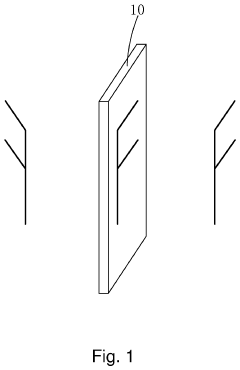
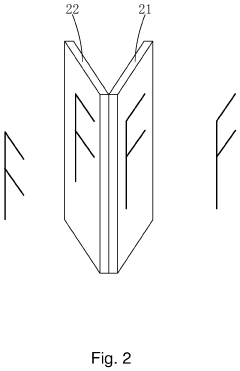
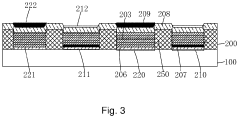
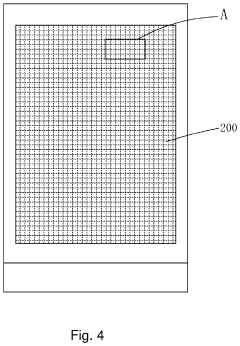
Active matrix organic light emitting diode display
PatentInactiveUS20090201235A1
Innovation
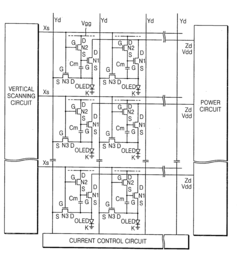
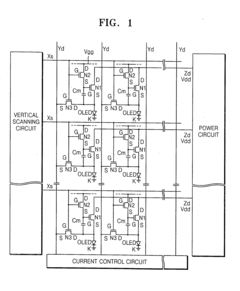
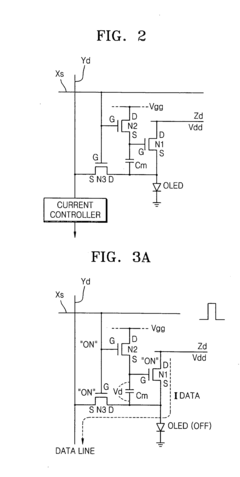
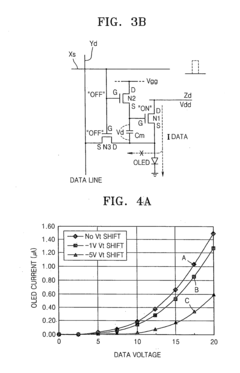
- An AMOLED display with a 3-transistor-1-capacitor structure using N-channel transistors, including a driving transistor, a switching transistor, and a programming transistor, along with a current controller, which determines the current flowing through the transistors to maintain uniform brightness by compensating for threshold voltage shifts, allowing for the use of amorphous silicon and simplifying the pixel structure.
AMOLED Power Efficiency Optimization Strategies
AMOLED power efficiency optimization strategies have become increasingly crucial as display technology continues to evolve. These strategies focus on reducing power consumption while maintaining or enhancing image quality, addressing the growing demand for energy-efficient devices.
One key approach involves pixel-level power management. By selectively controlling the power supplied to individual pixels, AMOLED displays can significantly reduce overall energy consumption. This technique is particularly effective in scenarios where only a portion of the screen needs to be illuminated, such as always-on displays or partial screen updates.
Another important strategy is the implementation of advanced color management systems. These systems optimize the use of color gamuts, adjusting the display's output based on ambient lighting conditions and content type. By fine-tuning color reproduction, AMOLED displays can achieve vibrant visuals while minimizing unnecessary power usage.
Dynamic refresh rate adaptation is a promising technique for power efficiency. This approach allows the display to adjust its refresh rate in real-time, based on the content being displayed. For static images or low-motion content, the refresh rate can be lowered, resulting in significant power savings without compromising user experience.
Advancements in OLED materials and manufacturing processes also contribute to power efficiency. The development of more efficient organic compounds and improved pixel structures enables AMOLED displays to achieve higher luminous efficacy, reducing the power required to produce the same level of brightness.
Intelligent brightness control mechanisms play a crucial role in optimizing power consumption. These systems utilize ambient light sensors and machine learning algorithms to automatically adjust screen brightness, ensuring optimal visibility while minimizing power usage across various lighting conditions.
Power-efficient driving schemes represent another area of focus. By optimizing the voltage and current applied to OLED pixels, manufacturers can reduce power loss and improve overall efficiency. This includes techniques such as advanced voltage programming and current-mode driving.
Lastly, the integration of AI-powered image processing algorithms offers significant potential for power optimization. These algorithms can analyze and adjust image content in real-time, optimizing contrast, color, and brightness levels to achieve the desired visual output with minimal power consumption.
One key approach involves pixel-level power management. By selectively controlling the power supplied to individual pixels, AMOLED displays can significantly reduce overall energy consumption. This technique is particularly effective in scenarios where only a portion of the screen needs to be illuminated, such as always-on displays or partial screen updates.
Another important strategy is the implementation of advanced color management systems. These systems optimize the use of color gamuts, adjusting the display's output based on ambient lighting conditions and content type. By fine-tuning color reproduction, AMOLED displays can achieve vibrant visuals while minimizing unnecessary power usage.
Dynamic refresh rate adaptation is a promising technique for power efficiency. This approach allows the display to adjust its refresh rate in real-time, based on the content being displayed. For static images or low-motion content, the refresh rate can be lowered, resulting in significant power savings without compromising user experience.
Advancements in OLED materials and manufacturing processes also contribute to power efficiency. The development of more efficient organic compounds and improved pixel structures enables AMOLED displays to achieve higher luminous efficacy, reducing the power required to produce the same level of brightness.
Intelligent brightness control mechanisms play a crucial role in optimizing power consumption. These systems utilize ambient light sensors and machine learning algorithms to automatically adjust screen brightness, ensuring optimal visibility while minimizing power usage across various lighting conditions.
Power-efficient driving schemes represent another area of focus. By optimizing the voltage and current applied to OLED pixels, manufacturers can reduce power loss and improve overall efficiency. This includes techniques such as advanced voltage programming and current-mode driving.
Lastly, the integration of AI-powered image processing algorithms offers significant potential for power optimization. These algorithms can analyze and adjust image content in real-time, optimizing contrast, color, and brightness levels to achieve the desired visual output with minimal power consumption.
AMOLED Display Integration in Emerging Devices
The integration of AMOLED displays in emerging devices represents a significant technological advancement, particularly in the realm of image processing support. As AMOLED technology continues to evolve, its application in various devices beyond smartphones is expanding rapidly, offering enhanced visual experiences across a wide range of products.
One of the key areas of development is the integration of AMOLED displays in wearable devices. Smartwatches and fitness trackers are increasingly adopting AMOLED screens due to their superior color reproduction, energy efficiency, and flexibility. These displays allow for always-on features without significant battery drain, a crucial factor for wearable devices with limited power resources.
In the automotive industry, AMOLED displays are finding their way into dashboard systems and infotainment units. The high contrast ratios and deep blacks provided by AMOLED technology contribute to improved readability in various lighting conditions, enhancing both safety and user experience. Additionally, the ability to create curved and flexible displays allows for more innovative interior designs in vehicles.
The gaming industry is another sector benefiting from AMOLED integration. Handheld gaming devices and VR headsets are leveraging AMOLED's fast response times and high refresh rates to deliver smoother, more immersive gaming experiences. The technology's ability to produce vivid colors and true blacks significantly enhances the visual quality of games, particularly in dark scenes.
AMOLED displays are also making inroads in the smart home sector. Digital assistants with screens, smart mirrors, and even appliances are incorporating AMOLED technology to provide more vibrant and energy-efficient displays. These applications often require always-on displays, making AMOLED's low power consumption in dark modes particularly advantageous.
In the field of professional equipment, AMOLED displays are being integrated into high-end cameras, drones, and other imaging devices. The technology's superior color accuracy and high dynamic range are particularly valuable in these applications, allowing for more precise image monitoring and adjustment in the field.
As AMOLED technology continues to advance, we can expect to see its integration expand into even more diverse device categories. Improvements in durability, cost-effectiveness, and manufacturing processes are likely to drive wider adoption across various industries, further solidifying AMOLED's position as a leading display technology in emerging devices.
One of the key areas of development is the integration of AMOLED displays in wearable devices. Smartwatches and fitness trackers are increasingly adopting AMOLED screens due to their superior color reproduction, energy efficiency, and flexibility. These displays allow for always-on features without significant battery drain, a crucial factor for wearable devices with limited power resources.
In the automotive industry, AMOLED displays are finding their way into dashboard systems and infotainment units. The high contrast ratios and deep blacks provided by AMOLED technology contribute to improved readability in various lighting conditions, enhancing both safety and user experience. Additionally, the ability to create curved and flexible displays allows for more innovative interior designs in vehicles.
The gaming industry is another sector benefiting from AMOLED integration. Handheld gaming devices and VR headsets are leveraging AMOLED's fast response times and high refresh rates to deliver smoother, more immersive gaming experiences. The technology's ability to produce vivid colors and true blacks significantly enhances the visual quality of games, particularly in dark scenes.
AMOLED displays are also making inroads in the smart home sector. Digital assistants with screens, smart mirrors, and even appliances are incorporating AMOLED technology to provide more vibrant and energy-efficient displays. These applications often require always-on displays, making AMOLED's low power consumption in dark modes particularly advantageous.
In the field of professional equipment, AMOLED displays are being integrated into high-end cameras, drones, and other imaging devices. The technology's superior color accuracy and high dynamic range are particularly valuable in these applications, allowing for more precise image monitoring and adjustment in the field.
As AMOLED technology continues to advance, we can expect to see its integration expand into even more diverse device categories. Improvements in durability, cost-effectiveness, and manufacturing processes are likely to drive wider adoption across various industries, further solidifying AMOLED's position as a leading display technology in emerging devices.
Unlock deeper insights with Patsnap Eureka Quick Research — get a full tech report to explore trends and direct your research. Try now!
Generate Your Research Report Instantly with AI Agent
Supercharge your innovation with Patsnap Eureka AI Agent Platform!