

Advances in AMOLED's emissive layer technologies.
JUL 17, 20258 MIN READ
Generate Your Research Report Instantly with AI Agent
PatSnap Eureka helps you evaluate technical feasibility & market potential.
AMOLED Evolution
The evolution of AMOLED technology has been a remarkable journey, marked by significant advancements in display quality, energy efficiency, and form factor flexibility. Initially developed in the late 1990s, AMOLED displays have undergone several generations of improvements, each addressing key challenges and expanding their application potential.
The first generation of AMOLED displays faced issues with limited lifespan and color accuracy. Early emissive layers suffered from rapid degradation, particularly in blue subpixels, leading to color shifts and reduced overall display longevity. However, these challenges spurred intensive research and development efforts, resulting in the introduction of more stable organic materials and improved pixel architectures.
As the technology matured, the second generation of AMOLED displays saw significant enhancements in color gamut and power efficiency. The introduction of phosphorescent materials for green and red subpixels marked a crucial milestone, dramatically improving quantum efficiency and reducing power consumption. This period also witnessed the development of more sophisticated thin-film transistor (TFT) backplanes, enabling higher pixel densities and improved image quality.
The third generation brought about a revolution in form factor flexibility. The inherent thinness of AMOLED displays, combined with advancements in flexible substrate technologies, paved the way for curved and foldable displays. This opened up new design possibilities for smartphones, wearables, and other consumer electronics, fundamentally changing the way users interact with their devices.
Recent years have seen the emergence of the fourth generation of AMOLED technology, characterized by further improvements in energy efficiency, color accuracy, and longevity. The development of advanced blue OLED emitters, including thermally activated delayed fluorescence (TADF) materials, has addressed one of the long-standing challenges in AMOLED technology. Additionally, the integration of quantum dot color conversion layers has expanded the color gamut, approaching or even exceeding the BT.2020 standard.
Looking ahead, the AMOLED evolution continues with promising developments on the horizon. Research into micro-LED integration, advanced light extraction techniques, and novel emissive materials points towards even more efficient and vibrant displays. The ongoing pursuit of improved manufacturing processes and yield rates is expected to drive down costs, potentially expanding AMOLED adoption across a broader range of applications and market segments.
The first generation of AMOLED displays faced issues with limited lifespan and color accuracy. Early emissive layers suffered from rapid degradation, particularly in blue subpixels, leading to color shifts and reduced overall display longevity. However, these challenges spurred intensive research and development efforts, resulting in the introduction of more stable organic materials and improved pixel architectures.
As the technology matured, the second generation of AMOLED displays saw significant enhancements in color gamut and power efficiency. The introduction of phosphorescent materials for green and red subpixels marked a crucial milestone, dramatically improving quantum efficiency and reducing power consumption. This period also witnessed the development of more sophisticated thin-film transistor (TFT) backplanes, enabling higher pixel densities and improved image quality.
The third generation brought about a revolution in form factor flexibility. The inherent thinness of AMOLED displays, combined with advancements in flexible substrate technologies, paved the way for curved and foldable displays. This opened up new design possibilities for smartphones, wearables, and other consumer electronics, fundamentally changing the way users interact with their devices.
Recent years have seen the emergence of the fourth generation of AMOLED technology, characterized by further improvements in energy efficiency, color accuracy, and longevity. The development of advanced blue OLED emitters, including thermally activated delayed fluorescence (TADF) materials, has addressed one of the long-standing challenges in AMOLED technology. Additionally, the integration of quantum dot color conversion layers has expanded the color gamut, approaching or even exceeding the BT.2020 standard.
Looking ahead, the AMOLED evolution continues with promising developments on the horizon. Research into micro-LED integration, advanced light extraction techniques, and novel emissive materials points towards even more efficient and vibrant displays. The ongoing pursuit of improved manufacturing processes and yield rates is expected to drive down costs, potentially expanding AMOLED adoption across a broader range of applications and market segments.
Market Demand Analysis
The market demand for AMOLED displays with advanced emissive layer technologies has been experiencing significant growth in recent years. This surge is primarily driven by the increasing adoption of AMOLED displays in smartphones, televisions, and other consumer electronics. The superior image quality, energy efficiency, and form factor advantages of AMOLED displays have made them increasingly attractive to both manufacturers and consumers.
In the smartphone sector, which represents the largest market for AMOLED displays, there is a growing demand for devices with higher screen-to-body ratios, improved color accuracy, and longer battery life. Advanced emissive layer technologies play a crucial role in meeting these requirements by enhancing display performance and reducing power consumption. As a result, major smartphone manufacturers are increasingly incorporating AMOLED displays into their flagship and mid-range devices.
The television market has also shown a strong interest in AMOLED technology, particularly for high-end and premium models. Consumers are seeking larger screens with better picture quality, deeper blacks, and wider color gamuts. AMOLED displays with advanced emissive layers can deliver these features, making them an attractive option for manufacturers looking to differentiate their products in a competitive market.
Emerging applications in wearable devices, automotive displays, and virtual/augmented reality headsets are creating new opportunities for AMOLED technology. These sectors require displays with high brightness, wide viewing angles, and flexibility, which can be achieved through advancements in emissive layer technologies.
The market demand is further fueled by the ongoing trend towards foldable and rollable displays. These innovative form factors rely heavily on the flexibility and durability of AMOLED technology, with the emissive layer playing a critical role in maintaining display performance under various bending and folding conditions.
Industry analysts project that the global AMOLED market will continue to grow at a compound annual growth rate of over 20% in the coming years. This growth is expected to be driven by increasing demand in both established and emerging markets, as well as the expansion of AMOLED technology into new application areas.
However, challenges remain in meeting the market demand for advanced AMOLED displays. These include the need for improved manufacturing yields, reduced production costs, and enhanced longevity of organic materials used in the emissive layers. Addressing these challenges through continued research and development in emissive layer technologies will be crucial for meeting the growing market demand and expanding the adoption of AMOLED displays across various industries.
In the smartphone sector, which represents the largest market for AMOLED displays, there is a growing demand for devices with higher screen-to-body ratios, improved color accuracy, and longer battery life. Advanced emissive layer technologies play a crucial role in meeting these requirements by enhancing display performance and reducing power consumption. As a result, major smartphone manufacturers are increasingly incorporating AMOLED displays into their flagship and mid-range devices.
The television market has also shown a strong interest in AMOLED technology, particularly for high-end and premium models. Consumers are seeking larger screens with better picture quality, deeper blacks, and wider color gamuts. AMOLED displays with advanced emissive layers can deliver these features, making them an attractive option for manufacturers looking to differentiate their products in a competitive market.
Emerging applications in wearable devices, automotive displays, and virtual/augmented reality headsets are creating new opportunities for AMOLED technology. These sectors require displays with high brightness, wide viewing angles, and flexibility, which can be achieved through advancements in emissive layer technologies.
The market demand is further fueled by the ongoing trend towards foldable and rollable displays. These innovative form factors rely heavily on the flexibility and durability of AMOLED technology, with the emissive layer playing a critical role in maintaining display performance under various bending and folding conditions.
Industry analysts project that the global AMOLED market will continue to grow at a compound annual growth rate of over 20% in the coming years. This growth is expected to be driven by increasing demand in both established and emerging markets, as well as the expansion of AMOLED technology into new application areas.
However, challenges remain in meeting the market demand for advanced AMOLED displays. These include the need for improved manufacturing yields, reduced production costs, and enhanced longevity of organic materials used in the emissive layers. Addressing these challenges through continued research and development in emissive layer technologies will be crucial for meeting the growing market demand and expanding the adoption of AMOLED displays across various industries.
Emissive Layer Challenges
The emissive layer in AMOLED displays faces several critical challenges that hinder the advancement of this technology. One of the primary issues is the degradation of organic materials over time, which leads to a decrease in luminescence efficiency and color accuracy. This degradation is particularly pronounced in blue emitters, which have shorter lifespans compared to their red and green counterparts. The instability of blue emitters results in color shift and reduced display longevity, impacting the overall performance and user experience of AMOLED devices.
Another significant challenge is achieving uniform emission across the entire display area. Variations in the thickness of the emissive layer or inconsistencies in the deposition process can lead to non-uniform brightness and color reproduction. This issue becomes more pronounced as display sizes increase, making it difficult to maintain consistent quality across large-format AMOLED panels.
The quest for higher energy efficiency also presents a considerable challenge. While AMOLED displays are generally more energy-efficient than traditional LCD technology, there is still room for improvement. The emissive layer's quantum efficiency, which determines how effectively electrical energy is converted into light, remains a key area of focus. Enhancing this efficiency is crucial for reducing power consumption and extending battery life in mobile devices.
Color gamut and color accuracy pose additional challenges for the emissive layer. As consumer demand for more vibrant and lifelike displays grows, manufacturers must develop materials capable of producing a wider color gamut while maintaining color accuracy across different viewing angles and brightness levels. This requires fine-tuning the emission spectra of organic materials and improving color filtering techniques.
Thermal management is another critical issue affecting the emissive layer. High operating temperatures can accelerate the degradation of organic materials and lead to uneven emission across the display. Developing heat-resistant materials and implementing effective thermal dissipation strategies are essential for maintaining long-term display performance and reliability.
Lastly, the complexity of manufacturing processes for advanced emissive layers presents significant challenges. Precise control over layer thickness, doping concentrations, and material purity is crucial for achieving optimal performance. As AMOLED technology evolves towards more sophisticated structures, such as tandem or stacked emissive layers, the manufacturing complexity increases, potentially impacting production yields and costs.
Another significant challenge is achieving uniform emission across the entire display area. Variations in the thickness of the emissive layer or inconsistencies in the deposition process can lead to non-uniform brightness and color reproduction. This issue becomes more pronounced as display sizes increase, making it difficult to maintain consistent quality across large-format AMOLED panels.
The quest for higher energy efficiency also presents a considerable challenge. While AMOLED displays are generally more energy-efficient than traditional LCD technology, there is still room for improvement. The emissive layer's quantum efficiency, which determines how effectively electrical energy is converted into light, remains a key area of focus. Enhancing this efficiency is crucial for reducing power consumption and extending battery life in mobile devices.
Color gamut and color accuracy pose additional challenges for the emissive layer. As consumer demand for more vibrant and lifelike displays grows, manufacturers must develop materials capable of producing a wider color gamut while maintaining color accuracy across different viewing angles and brightness levels. This requires fine-tuning the emission spectra of organic materials and improving color filtering techniques.
Thermal management is another critical issue affecting the emissive layer. High operating temperatures can accelerate the degradation of organic materials and lead to uneven emission across the display. Developing heat-resistant materials and implementing effective thermal dissipation strategies are essential for maintaining long-term display performance and reliability.
Lastly, the complexity of manufacturing processes for advanced emissive layers presents significant challenges. Precise control over layer thickness, doping concentrations, and material purity is crucial for achieving optimal performance. As AMOLED technology evolves towards more sophisticated structures, such as tandem or stacked emissive layers, the manufacturing complexity increases, potentially impacting production yields and costs.
Current Emissive Solutions
01 Composition of AMOLED emissive layers
The emissive layer in AMOLED displays typically consists of organic materials that emit light when an electric current is applied. These materials can include small molecule organic compounds or polymers that are designed to produce specific colors of light. The composition and structure of the emissive layer play a crucial role in determining the efficiency, color purity, and lifetime of the OLED device.- Composition of AMOLED emissive layers: The emissive layer in AMOLED displays typically consists of organic materials that emit light when an electric current is applied. These materials can include small molecule organic compounds or polymers that are designed to produce specific colors of light. The composition and structure of the emissive layer are crucial for determining the efficiency, color purity, and lifetime of the OLED device.
- Multi-layer structure in AMOLED devices: AMOLED devices often employ a multi-layer structure, with the emissive layer sandwiched between other functional layers such as hole transport layers, electron transport layers, and blocking layers. This complex structure helps to improve charge injection, transport, and recombination, leading to enhanced device performance and efficiency.
- Doping of emissive layers: Doping the emissive layer with specific materials can enhance the performance of AMOLED displays. This can involve incorporating phosphorescent or fluorescent dopants into the host material to improve light emission efficiency, color purity, and device lifetime. The choice and concentration of dopants play a crucial role in optimizing the overall performance of the OLED device.
- Fabrication techniques for emissive layers: Various fabrication techniques are used to deposit and pattern the emissive layers in AMOLED displays. These can include thermal evaporation, solution processing methods such as spin-coating or inkjet printing, and vapor deposition techniques. The choice of fabrication method can affect the uniformity, thickness control, and overall quality of the emissive layer, which in turn impacts the display performance.
- Emissive layer optimization for color and efficiency: Optimizing the emissive layer is crucial for achieving high color gamut and energy efficiency in AMOLED displays. This can involve tailoring the molecular structure of emissive materials, engineering the energy levels of different layers, and developing novel device architectures. Researchers are continuously working on new materials and designs to improve color purity, increase quantum efficiency, and extend the operational lifetime of OLED devices.
02 Multi-layer structure of AMOLED devices
AMOLED devices often employ a multi-layer structure, with the emissive layer sandwiched between other functional layers. These additional layers may include hole transport layers, electron transport layers, and blocking layers. The careful design and arrangement of these layers help to improve charge injection, transport, and recombination within the emissive layer, enhancing overall device performance.Expand Specific Solutions03 Doping of emissive layers
Doping the emissive layer with specific materials can enhance its performance. This may involve incorporating guest emitter molecules into a host material or using phosphorescent dopants to improve light emission efficiency. Doping can also be used to tune the color of light emitted and improve the stability of the emissive layer.Expand Specific Solutions04 Fabrication techniques for emissive layers
Various fabrication techniques are used to create the emissive layer in AMOLED devices. These may include vacuum thermal evaporation, solution processing methods such as spin-coating or inkjet printing, and vapor deposition techniques. The choice of fabrication method can affect the uniformity, thickness, and performance of the emissive layer.Expand Specific Solutions05 Novel materials and structures for improved performance
Research in AMOLED technology focuses on developing novel materials and structures for the emissive layer to enhance device performance. This includes exploring new organic compounds, quantum dot materials, and hybrid organic-inorganic structures. These innovations aim to improve color gamut, efficiency, and longevity of AMOLED displays.Expand Specific Solutions
Key AMOLED Manufacturers
The AMOLED emissive layer technology market is in a growth phase, driven by increasing demand for high-quality displays in smartphones, TVs, and other devices. The global AMOLED market size is projected to reach significant value in the coming years, indicating substantial growth potential. Technologically, AMOLED is maturing but still evolving, with ongoing research to improve efficiency and longevity. Key players like Samsung Display, LG Display, and BOE Technology are leading innovation, while companies such as Universal Display Corporation are developing advanced OLED materials. Other significant contributors include AUO Corp, Tianma Microelectronics, and Everdisplay Optronics, all working to enhance AMOLED technology and expand its applications.
BOE Technology Group Co., Ltd.
Technical Solution: BOE has made significant advances in AMOLED emissive layer technologies, focusing on improving efficiency and longevity. They have developed a proprietary OLED material system that enhances color gamut and reduces power consumption. BOE's latest AMOLED panels utilize a multi-stack emissive layer structure, incorporating both fluorescent and phosphorescent materials to optimize performance[1]. The company has also introduced a novel vapor deposition process for more precise control of the emissive layer thickness, resulting in improved uniformity and yield rates[2]. Additionally, BOE has implemented advanced encapsulation techniques to protect the sensitive organic materials from moisture and oxygen, significantly extending the lifespan of their AMOLED displays[3].
Strengths: Large-scale production capability, diverse product portfolio, and strong R&D investments. Weaknesses: Relatively new to high-end AMOLED market compared to some competitors, potential yield rate challenges in cutting-edge technologies.
Universal Display Corp.
Technical Solution: Universal Display Corporation (UDC) is at the forefront of AMOLED emissive layer technologies with its pioneering work in phosphorescent OLED (PHOLED) materials. UDC's latest advancements include the development of blue PHOLED emitters with improved efficiency and lifetime, addressing a long-standing challenge in the industry[4]. The company has also made progress in solution-processable OLED materials, which could enable more cost-effective manufacturing processes for large-area displays[5]. UDC's research extends to thermally activated delayed fluorescence (TADF) emitters, potentially offering a new pathway for highly efficient blue OLEDs[6]. Furthermore, UDC has developed novel host materials that enhance charge transport and energy transfer within the emissive layer, leading to overall improvements in OLED performance[7].
Strengths: Industry-leading PHOLED technology, extensive patent portfolio, and strong partnerships with major display manufacturers. Weaknesses: Heavy reliance on OLED market dynamics, potential challenges from emerging technologies.
Emissive Layer Innovations
Organic light-emitting diode structure and fabrication method thereof, related display panel, and related display device
PatentWO2017070892A1
Innovation
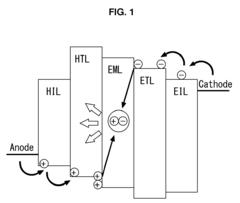
- Addressing the low efficiency and short service time of blue light-emitting organic materials in AMOLED displays.
- Developing a novel OLED structure to enhance the performance of blue light-emitting components.
- Implementing advanced fabrication methods to optimize the blue light-emitting layer in AMOLED panels.


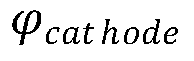
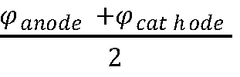
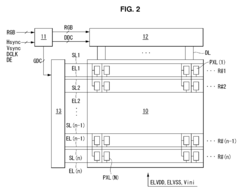
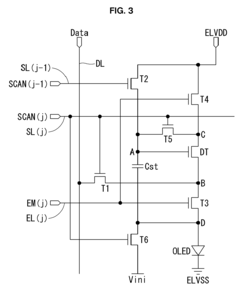
Organic light emitting display and circuit thereof
PatentActiveEP3098805A1
Innovation
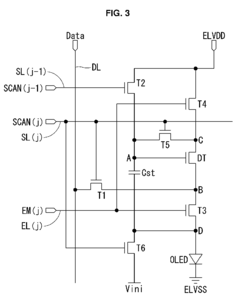
- The implementation of a pixel structure with a capacitor and multiple transistors that sample and compensate for the threshold voltage of driving transistors, reducing power consumption by eliminating the need for a reference voltage and minimizing the effect of mobile charges through efficient voltage management and transistor design.
Material Science Impact
The impact of material science on AMOLED's emissive layer technologies has been profound and transformative. Advancements in this field have led to significant improvements in display performance, efficiency, and longevity.
One of the most crucial developments has been the creation of new organic light-emitting materials. These materials, including small molecules and polymers, have been engineered to emit light more efficiently and with greater color purity. Researchers have focused on developing materials with improved quantum yields, better charge transport properties, and enhanced thermal stability.
The introduction of phosphorescent emitters has been a game-changer in AMOLED technology. These materials can achieve nearly 100% internal quantum efficiency by harvesting both singlet and triplet excitons. This breakthrough has dramatically increased the overall efficiency of OLED displays, leading to lower power consumption and extended battery life in mobile devices.
Another significant advancement has been the development of thermally activated delayed fluorescence (TADF) materials. TADF emitters can achieve high efficiencies similar to phosphorescent materials but without the need for rare and expensive heavy metals. This innovation has the potential to reduce production costs while maintaining high performance.
Material scientists have also made progress in creating more stable blue emitters, which have traditionally been the weakest link in OLED displays. New molecular designs and host-dopant systems have improved the lifetime and efficiency of blue OLEDs, bringing them closer to parity with their red and green counterparts.
The field of quantum dot (QD) materials has opened up new possibilities for AMOLED displays. QD-OLED hybrid technologies combine the color purity and efficiency of quantum dots with the self-emissive properties of OLEDs, potentially offering superior color performance and energy efficiency.
Advancements in encapsulation materials have significantly enhanced the longevity of OLED displays. New barrier films and getter materials provide better protection against moisture and oxygen, which are primary causes of OLED degradation. This has led to more durable displays suitable for a wider range of applications.
The development of solution-processable materials has paved the way for more cost-effective manufacturing methods, such as inkjet printing of OLED displays. This could potentially reduce production costs and enable the creation of larger-area displays.
In summary, material science has been instrumental in driving the evolution of AMOLED's emissive layer technologies. These advancements have not only improved existing display characteristics but also opened up new possibilities for future innovations in the field of organic electronics.
One of the most crucial developments has been the creation of new organic light-emitting materials. These materials, including small molecules and polymers, have been engineered to emit light more efficiently and with greater color purity. Researchers have focused on developing materials with improved quantum yields, better charge transport properties, and enhanced thermal stability.
The introduction of phosphorescent emitters has been a game-changer in AMOLED technology. These materials can achieve nearly 100% internal quantum efficiency by harvesting both singlet and triplet excitons. This breakthrough has dramatically increased the overall efficiency of OLED displays, leading to lower power consumption and extended battery life in mobile devices.
Another significant advancement has been the development of thermally activated delayed fluorescence (TADF) materials. TADF emitters can achieve high efficiencies similar to phosphorescent materials but without the need for rare and expensive heavy metals. This innovation has the potential to reduce production costs while maintaining high performance.
Material scientists have also made progress in creating more stable blue emitters, which have traditionally been the weakest link in OLED displays. New molecular designs and host-dopant systems have improved the lifetime and efficiency of blue OLEDs, bringing them closer to parity with their red and green counterparts.
The field of quantum dot (QD) materials has opened up new possibilities for AMOLED displays. QD-OLED hybrid technologies combine the color purity and efficiency of quantum dots with the self-emissive properties of OLEDs, potentially offering superior color performance and energy efficiency.
Advancements in encapsulation materials have significantly enhanced the longevity of OLED displays. New barrier films and getter materials provide better protection against moisture and oxygen, which are primary causes of OLED degradation. This has led to more durable displays suitable for a wider range of applications.
The development of solution-processable materials has paved the way for more cost-effective manufacturing methods, such as inkjet printing of OLED displays. This could potentially reduce production costs and enable the creation of larger-area displays.
In summary, material science has been instrumental in driving the evolution of AMOLED's emissive layer technologies. These advancements have not only improved existing display characteristics but also opened up new possibilities for future innovations in the field of organic electronics.
Energy Efficiency Trends
The energy efficiency of AMOLED displays has seen significant improvements in recent years, driven by advancements in emissive layer technologies. These developments have focused on enhancing the quantum efficiency of organic light-emitting materials and optimizing the device structure to reduce power consumption.
One of the key trends in energy efficiency is the development of phosphorescent emitters. These materials have demonstrated internal quantum efficiencies approaching 100%, a substantial improvement over traditional fluorescent emitters. Iridium-based complexes have been particularly successful in this regard, with ongoing research aimed at further refining their molecular structures to achieve even higher efficiencies and longer operational lifetimes.
Another important trend is the exploration of thermally activated delayed fluorescence (TADF) materials. TADF emitters offer the potential for high efficiency without relying on rare and expensive metal complexes. Recent advancements in TADF molecular design have led to improved energy transfer between singlet and triplet states, resulting in enhanced light emission efficiency and reduced power consumption.
The development of tandem OLED structures has also contributed to improved energy efficiency. By stacking multiple emissive layers, these devices can achieve higher luminance at lower current densities, effectively reducing power consumption. Advances in charge generation layers and interface engineering have been crucial in optimizing the performance of tandem OLEDs.
Researchers are also focusing on enhancing charge carrier balance within the emissive layer. This involves fine-tuning the energy levels of hole and electron transport materials to ensure efficient recombination of charge carriers. Improved charge balance leads to higher external quantum efficiencies and reduced energy loss through non-radiative processes.
The integration of quantum dots into OLED structures represents another promising direction for energy efficiency improvements. Quantum dot-OLED hybrids have shown potential for achieving high color purity and improved efficiency, particularly in the blue spectral region where traditional OLED materials have faced challenges.
As AMOLED technology continues to evolve, there is a growing emphasis on developing more sustainable and environmentally friendly materials. This includes research into metal-free organic emitters and the use of earth-abundant elements in place of rare metals. These efforts aim to address both energy efficiency and broader environmental concerns associated with display production.
One of the key trends in energy efficiency is the development of phosphorescent emitters. These materials have demonstrated internal quantum efficiencies approaching 100%, a substantial improvement over traditional fluorescent emitters. Iridium-based complexes have been particularly successful in this regard, with ongoing research aimed at further refining their molecular structures to achieve even higher efficiencies and longer operational lifetimes.
Another important trend is the exploration of thermally activated delayed fluorescence (TADF) materials. TADF emitters offer the potential for high efficiency without relying on rare and expensive metal complexes. Recent advancements in TADF molecular design have led to improved energy transfer between singlet and triplet states, resulting in enhanced light emission efficiency and reduced power consumption.
The development of tandem OLED structures has also contributed to improved energy efficiency. By stacking multiple emissive layers, these devices can achieve higher luminance at lower current densities, effectively reducing power consumption. Advances in charge generation layers and interface engineering have been crucial in optimizing the performance of tandem OLEDs.
Researchers are also focusing on enhancing charge carrier balance within the emissive layer. This involves fine-tuning the energy levels of hole and electron transport materials to ensure efficient recombination of charge carriers. Improved charge balance leads to higher external quantum efficiencies and reduced energy loss through non-radiative processes.
The integration of quantum dots into OLED structures represents another promising direction for energy efficiency improvements. Quantum dot-OLED hybrids have shown potential for achieving high color purity and improved efficiency, particularly in the blue spectral region where traditional OLED materials have faced challenges.
As AMOLED technology continues to evolve, there is a growing emphasis on developing more sustainable and environmentally friendly materials. This includes research into metal-free organic emitters and the use of earth-abundant elements in place of rare metals. These efforts aim to address both energy efficiency and broader environmental concerns associated with display production.
Unlock deeper insights with PatSnap Eureka Quick Research — get a full tech report to explore trends and direct your research. Try now!
Generate Your Research Report Instantly with AI Agent
Supercharge your innovation with PatSnap Eureka AI Agent Platform!