AMOLED integration challenges in non-rectangular displays.
JUL 17, 20259 MIN READ
Generate Your Research Report Instantly with AI Agent
PatSnap Eureka helps you evaluate technical feasibility & market potential.
AMOLED Non-Rectangular Display Evolution
The evolution of AMOLED technology in non-rectangular displays has been driven by the increasing demand for innovative and aesthetically pleasing device designs. This journey began with the introduction of curved displays in smartphones, which marked a significant departure from traditional flat screens. These early curved displays, while still essentially rectangular, paved the way for more adventurous form factors.
As manufacturing techniques improved, the industry saw the emergence of truly non-rectangular AMOLED displays. This included circular displays for smartwatches, which presented unique challenges in terms of pixel arrangement and light distribution. The circular form factor required a complete rethinking of display architecture, leading to innovations in both hardware and software to accommodate the unconventional shape.
The next major milestone was the development of flexible AMOLED displays. These displays could be bent, folded, or rolled, opening up a whole new realm of possibilities for device design. Flexible displays allowed for the creation of foldable smartphones and rollable televisions, pushing the boundaries of what was previously thought possible in display technology.
Concurrently, automotive manufacturers began incorporating curved and irregularly shaped AMOLED displays into vehicle interiors. These displays conformed to the contours of dashboards and center consoles, enhancing both aesthetics and functionality. This application demonstrated the versatility of AMOLED technology in adapting to diverse form factors beyond consumer electronics.
More recently, the industry has seen the development of hole-punch and notch displays in smartphones. These designs integrate the front-facing camera and sensors directly into the display area, maximizing screen real estate while maintaining essential functionality. This evolution required significant advancements in pixel arrangement and light management to ensure seamless integration of non-display elements within the active display area.
The latest frontier in non-rectangular AMOLED displays involves completely bezel-less designs with rounded corners and irregular shapes. These displays aim to create a more immersive user experience by eliminating visible borders and maximizing the screen-to-body ratio. Achieving this requires overcoming challenges related to edge light emission, touch sensitivity at the periphery, and structural integrity.
Throughout this evolution, manufacturers have had to continuously innovate in areas such as pixel layout, backplane design, and encapsulation techniques. Each new form factor has presented unique challenges in maintaining display quality, color accuracy, and longevity while adapting to non-standard shapes. The ongoing development of non-rectangular AMOLED displays continues to push the boundaries of display technology, driving advancements that benefit the entire industry.
As manufacturing techniques improved, the industry saw the emergence of truly non-rectangular AMOLED displays. This included circular displays for smartwatches, which presented unique challenges in terms of pixel arrangement and light distribution. The circular form factor required a complete rethinking of display architecture, leading to innovations in both hardware and software to accommodate the unconventional shape.
The next major milestone was the development of flexible AMOLED displays. These displays could be bent, folded, or rolled, opening up a whole new realm of possibilities for device design. Flexible displays allowed for the creation of foldable smartphones and rollable televisions, pushing the boundaries of what was previously thought possible in display technology.
Concurrently, automotive manufacturers began incorporating curved and irregularly shaped AMOLED displays into vehicle interiors. These displays conformed to the contours of dashboards and center consoles, enhancing both aesthetics and functionality. This application demonstrated the versatility of AMOLED technology in adapting to diverse form factors beyond consumer electronics.
More recently, the industry has seen the development of hole-punch and notch displays in smartphones. These designs integrate the front-facing camera and sensors directly into the display area, maximizing screen real estate while maintaining essential functionality. This evolution required significant advancements in pixel arrangement and light management to ensure seamless integration of non-display elements within the active display area.
The latest frontier in non-rectangular AMOLED displays involves completely bezel-less designs with rounded corners and irregular shapes. These displays aim to create a more immersive user experience by eliminating visible borders and maximizing the screen-to-body ratio. Achieving this requires overcoming challenges related to edge light emission, touch sensitivity at the periphery, and structural integrity.
Throughout this evolution, manufacturers have had to continuously innovate in areas such as pixel layout, backplane design, and encapsulation techniques. Each new form factor has presented unique challenges in maintaining display quality, color accuracy, and longevity while adapting to non-standard shapes. The ongoing development of non-rectangular AMOLED displays continues to push the boundaries of display technology, driving advancements that benefit the entire industry.
Market Demand Analysis
The market demand for non-rectangular AMOLED displays has been steadily growing, driven by the increasing consumer appetite for innovative and aesthetically pleasing devices. This trend is particularly evident in the smartphone and wearable technology sectors, where manufacturers are constantly seeking ways to differentiate their products in a highly competitive market.
In the smartphone industry, non-rectangular displays offer a unique selling point, allowing for more screen real estate without increasing the overall device size. This design approach has gained traction with consumers who desire larger displays for content consumption and multitasking, while still maintaining a compact form factor. Major smartphone manufacturers have already introduced devices with curved edges, notched displays, and even foldable screens, indicating a strong market pull for non-traditional display shapes.
The wearable technology market, including smartwatches and fitness trackers, has also shown significant interest in non-rectangular AMOLED displays. These devices often require displays that conform to the natural contours of the human body, making circular or other non-rectangular shapes more ergonomic and visually appealing. The ability to integrate AMOLED technology into these form factors has opened up new possibilities for design and functionality in wearables.
Beyond consumer electronics, there is growing demand for non-rectangular AMOLED displays in automotive applications. Car manufacturers are increasingly incorporating curved and irregularly shaped displays into dashboard designs, enhancing both aesthetics and functionality. These displays offer improved visibility and can be seamlessly integrated into the vehicle's interior, providing a more immersive and futuristic driving experience.
The market for non-rectangular AMOLED displays is also expanding in the retail and advertising sectors. Curved and uniquely shaped displays are being used to create eye-catching digital signage and interactive kiosks, offering new ways to engage customers and enhance brand visibility.
However, the market demand is not without challenges. The higher production costs associated with non-rectangular AMOLED displays can limit their adoption in mid-range and budget devices. Additionally, software optimization for these unique display shapes remains an ongoing concern, as developers must ensure that applications and content render correctly on various non-standard screen configurations.
Despite these challenges, industry analysts project continued growth in the non-rectangular AMOLED display market. The increasing consumer preference for innovative design, coupled with advancements in manufacturing techniques, is expected to drive demand across multiple sectors. As production costs decrease and software ecosystems adapt, the market for these displays is likely to expand further, potentially becoming a standard feature in premium devices across various industries.
In the smartphone industry, non-rectangular displays offer a unique selling point, allowing for more screen real estate without increasing the overall device size. This design approach has gained traction with consumers who desire larger displays for content consumption and multitasking, while still maintaining a compact form factor. Major smartphone manufacturers have already introduced devices with curved edges, notched displays, and even foldable screens, indicating a strong market pull for non-traditional display shapes.
The wearable technology market, including smartwatches and fitness trackers, has also shown significant interest in non-rectangular AMOLED displays. These devices often require displays that conform to the natural contours of the human body, making circular or other non-rectangular shapes more ergonomic and visually appealing. The ability to integrate AMOLED technology into these form factors has opened up new possibilities for design and functionality in wearables.
Beyond consumer electronics, there is growing demand for non-rectangular AMOLED displays in automotive applications. Car manufacturers are increasingly incorporating curved and irregularly shaped displays into dashboard designs, enhancing both aesthetics and functionality. These displays offer improved visibility and can be seamlessly integrated into the vehicle's interior, providing a more immersive and futuristic driving experience.
The market for non-rectangular AMOLED displays is also expanding in the retail and advertising sectors. Curved and uniquely shaped displays are being used to create eye-catching digital signage and interactive kiosks, offering new ways to engage customers and enhance brand visibility.
However, the market demand is not without challenges. The higher production costs associated with non-rectangular AMOLED displays can limit their adoption in mid-range and budget devices. Additionally, software optimization for these unique display shapes remains an ongoing concern, as developers must ensure that applications and content render correctly on various non-standard screen configurations.
Despite these challenges, industry analysts project continued growth in the non-rectangular AMOLED display market. The increasing consumer preference for innovative design, coupled with advancements in manufacturing techniques, is expected to drive demand across multiple sectors. As production costs decrease and software ecosystems adapt, the market for these displays is likely to expand further, potentially becoming a standard feature in premium devices across various industries.
Technical Challenges
The integration of AMOLED technology into non-rectangular displays presents several significant technical challenges. These challenges stem from the inherent properties of AMOLED displays and the complexities introduced by non-standard shapes.
One of the primary challenges is the pixel layout and distribution. Traditional rectangular displays have a uniform pixel grid, but non-rectangular shapes require innovative approaches to pixel arrangement. This is particularly challenging at curved edges or corners, where maintaining consistent pixel density and image quality becomes problematic. Engineers must develop new algorithms and manufacturing techniques to ensure uniform light emission and color accuracy across the entire display surface.
Power management and heat dissipation pose another set of challenges. AMOLED displays require precise control of current flow to each pixel, and non-rectangular shapes can lead to uneven power distribution. This can result in hotspots or areas of reduced brightness, affecting overall display performance and lifespan. Developing efficient power management systems that can adapt to irregular display shapes is crucial for maintaining consistent performance and preventing premature degradation of OLED materials.
The flexibility required for non-rectangular displays also introduces structural integrity issues. AMOLED panels are typically built on thin, flexible substrates, which can be more susceptible to damage when shaped into non-standard forms. Ensuring the durability and longevity of these displays under various environmental conditions and user interactions is a significant engineering challenge.
Another technical hurdle is the development of suitable touch-sensing technology for non-rectangular AMOLED displays. Traditional capacitive touch sensors are designed for flat, rectangular surfaces. Adapting these sensors to curved or irregularly shaped displays while maintaining accuracy and responsiveness across the entire surface area requires innovative solutions in both hardware design and software algorithms.
The manufacturing process itself presents numerous challenges. Existing production lines and equipment are optimized for rectangular displays, and retooling for non-rectangular shapes can be costly and complex. Achieving high yields and maintaining quality control for these unconventional displays requires significant advancements in manufacturing technology and processes.
Lastly, the integration of other components, such as cameras, speakers, and sensors, becomes more complicated in non-rectangular displays. Finding optimal placement for these elements while preserving the aesthetic appeal and functionality of the non-standard shape adds another layer of complexity to the design and engineering process.
Addressing these technical challenges requires a multidisciplinary approach, combining innovations in materials science, electrical engineering, manufacturing processes, and software development. As the demand for unique and immersive display experiences grows, overcoming these hurdles will be crucial for the widespread adoption of AMOLED technology in non-rectangular displays across various consumer and industrial applications.
One of the primary challenges is the pixel layout and distribution. Traditional rectangular displays have a uniform pixel grid, but non-rectangular shapes require innovative approaches to pixel arrangement. This is particularly challenging at curved edges or corners, where maintaining consistent pixel density and image quality becomes problematic. Engineers must develop new algorithms and manufacturing techniques to ensure uniform light emission and color accuracy across the entire display surface.
Power management and heat dissipation pose another set of challenges. AMOLED displays require precise control of current flow to each pixel, and non-rectangular shapes can lead to uneven power distribution. This can result in hotspots or areas of reduced brightness, affecting overall display performance and lifespan. Developing efficient power management systems that can adapt to irregular display shapes is crucial for maintaining consistent performance and preventing premature degradation of OLED materials.
The flexibility required for non-rectangular displays also introduces structural integrity issues. AMOLED panels are typically built on thin, flexible substrates, which can be more susceptible to damage when shaped into non-standard forms. Ensuring the durability and longevity of these displays under various environmental conditions and user interactions is a significant engineering challenge.
Another technical hurdle is the development of suitable touch-sensing technology for non-rectangular AMOLED displays. Traditional capacitive touch sensors are designed for flat, rectangular surfaces. Adapting these sensors to curved or irregularly shaped displays while maintaining accuracy and responsiveness across the entire surface area requires innovative solutions in both hardware design and software algorithms.
The manufacturing process itself presents numerous challenges. Existing production lines and equipment are optimized for rectangular displays, and retooling for non-rectangular shapes can be costly and complex. Achieving high yields and maintaining quality control for these unconventional displays requires significant advancements in manufacturing technology and processes.
Lastly, the integration of other components, such as cameras, speakers, and sensors, becomes more complicated in non-rectangular displays. Finding optimal placement for these elements while preserving the aesthetic appeal and functionality of the non-standard shape adds another layer of complexity to the design and engineering process.
Addressing these technical challenges requires a multidisciplinary approach, combining innovations in materials science, electrical engineering, manufacturing processes, and software development. As the demand for unique and immersive display experiences grows, overcoming these hurdles will be crucial for the widespread adoption of AMOLED technology in non-rectangular displays across various consumer and industrial applications.
Current Integration Solutions
01 AMOLED display panel structure and fabrication
This category focuses on the structural design and manufacturing processes of AMOLED display panels. It includes innovations in pixel arrangements, thin-film transistor (TFT) designs, and layer compositions to improve display performance and efficiency. Advanced fabrication techniques are employed to enhance the integration of various components within the AMOLED structure.- AMOLED display panel structure and fabrication: This category focuses on the structural design and manufacturing processes of AMOLED display panels. It includes innovations in pixel arrangements, thin-film transistor (TFT) designs, and layer compositions to improve display performance and efficiency. Advancements in fabrication techniques aim to enhance the overall quality and yield of AMOLED displays.
- Touch integration in AMOLED displays: This area covers the integration of touch functionality into AMOLED displays. It includes techniques for incorporating touch sensors within the display stack, improving touch sensitivity, and reducing interference between touch and display functions. These advancements aim to create thinner, more responsive touchscreen AMOLED devices.
- AMOLED display driving and control: This category encompasses methods and circuits for driving and controlling AMOLED displays. It includes innovations in pixel driving schemes, compensation techniques for non-uniformity and aging effects, and power management strategies. These advancements aim to improve display quality, longevity, and energy efficiency.
- Flexible and foldable AMOLED displays: This area focuses on the development of flexible and foldable AMOLED displays. It includes innovations in substrate materials, encapsulation techniques, and mechanical designs to enable bendable and foldable form factors. These advancements aim to create more versatile and durable AMOLED displays for various applications.
- AMOLED display color management and image quality enhancement: This category covers techniques for improving color reproduction and overall image quality in AMOLED displays. It includes color calibration methods, gamut mapping algorithms, and image processing techniques to enhance contrast, brightness, and color accuracy. These advancements aim to deliver superior visual experiences on AMOLED devices.
02 Touch integration in AMOLED displays
This area covers the integration of touch functionality directly into AMOLED displays. It involves the development of in-cell or on-cell touch sensors, reducing the overall thickness of the display module. The integration aims to improve touch sensitivity, reduce power consumption, and enhance the user interface experience in AMOLED-based devices.Expand Specific Solutions03 Driving and control circuits for AMOLED displays
This category encompasses the design and implementation of driving and control circuits for AMOLED displays. It includes innovations in pixel driving schemes, compensation circuits to address non-uniformity issues, and power management techniques to optimize display performance and energy efficiency.Expand Specific Solutions04 Flexible and foldable AMOLED display integration
This area focuses on the integration of AMOLED technology into flexible and foldable display applications. It covers advancements in substrate materials, encapsulation techniques, and mechanical designs to enable bendable and foldable AMOLED displays while maintaining their performance and durability.Expand Specific Solutions05 AMOLED display system integration and optimization
This category deals with the integration of AMOLED displays into various electronic devices and systems. It includes optimizations for power consumption, heat management, and overall system performance. Additionally, it covers techniques for enhancing display quality, such as color management and brightness control, in different application scenarios.Expand Specific Solutions
Key Industry Players
The AMOLED integration in non-rectangular displays market is in its growth phase, with increasing demand for innovative display solutions in various industries. The market size is expanding rapidly, driven by the adoption of flexible and curved displays in smartphones, wearables, and automotive applications. Technologically, the field is advancing but still faces challenges in achieving uniform performance across non-standard shapes. Key players like BOE Technology Group, TCL China Star Optoelectronics, and Visionox Technology are investing heavily in R&D to overcome these integration hurdles. Companies such as IGNIS Innovation and Everdisplay Optronics are focusing on developing specialized solutions for AMOLED implementation in unconventional form factors, indicating a competitive and dynamic market landscape.
BOE Technology Group Co., Ltd.
Technical Solution: BOE has developed innovative solutions for AMOLED integration in non-rectangular displays. Their approach involves using flexible AMOLED panels with advanced pixel compensation algorithms to address the challenges of uneven pixel distribution in curved areas[1]. They have also implemented a unique driver IC design that allows for efficient control of irregularly shaped active areas[3]. BOE's technology enables the creation of displays with complex shapes while maintaining image quality and color uniformity across the entire surface[5]. Their latest advancements include the use of micro-LEDs in conjunction with AMOLED for improved brightness and energy efficiency in non-standard display formats[7].
Strengths: Advanced pixel compensation, flexible panel technology, and innovative driver IC design. Weaknesses: Potential increased production costs and complexity in manufacturing process for non-standard shapes.
Wuhan China Star Optoelectronics Semicon Display Tech Co.
Technical Solution: Wuhan China Star has developed a proprietary AMOLED integration technique for non-rectangular displays, focusing on enhancing the flexibility of the display substrate. Their approach utilizes a unique thin-film encapsulation method that allows for precise shaping of the active display area without compromising the integrity of the OLED materials[2]. They have also implemented advanced circuit designs that compensate for the varying current densities in irregularly shaped displays, ensuring uniform brightness and color across the entire screen[4]. Additionally, their technology incorporates a novel touch integration solution specifically designed for curved and non-standard display shapes, improving user interaction with uniquely formed devices[6].
Strengths: Highly flexible substrate technology, advanced encapsulation methods, and specialized touch integration for curved surfaces. Weaknesses: Potential limitations in scalability for mass production of diverse non-rectangular shapes.
Core Patents and Innovations
Display substrate, manufacturing method thereof, and display apparatus
PatentPendingUS20250022422A1
Innovation
- The display substrate design includes a bendable extension part with a conductive structure featuring a lower and upper part stacked perpendicular to the substrate, where the upper part acts as a protection layer, simplifying the manufacturing process by eliminating the need for additional protection layers and allowing for direct contact with the lower part, thereby reducing resistance and enhancing signal transmission.
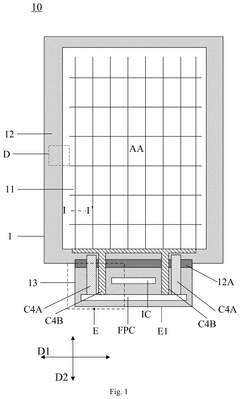
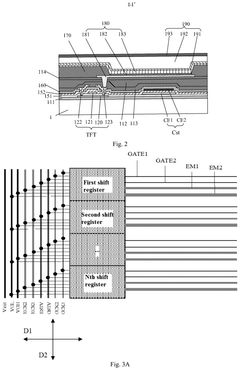
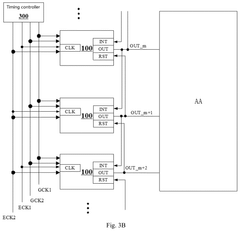
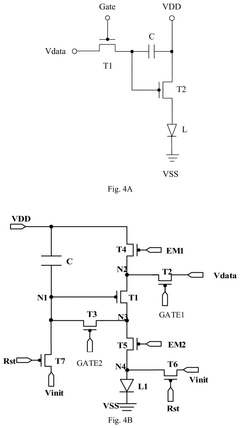
Active matrix organic light emitting diode (amoled) display panel
PatentInactiveUS20210343972A1
Innovation
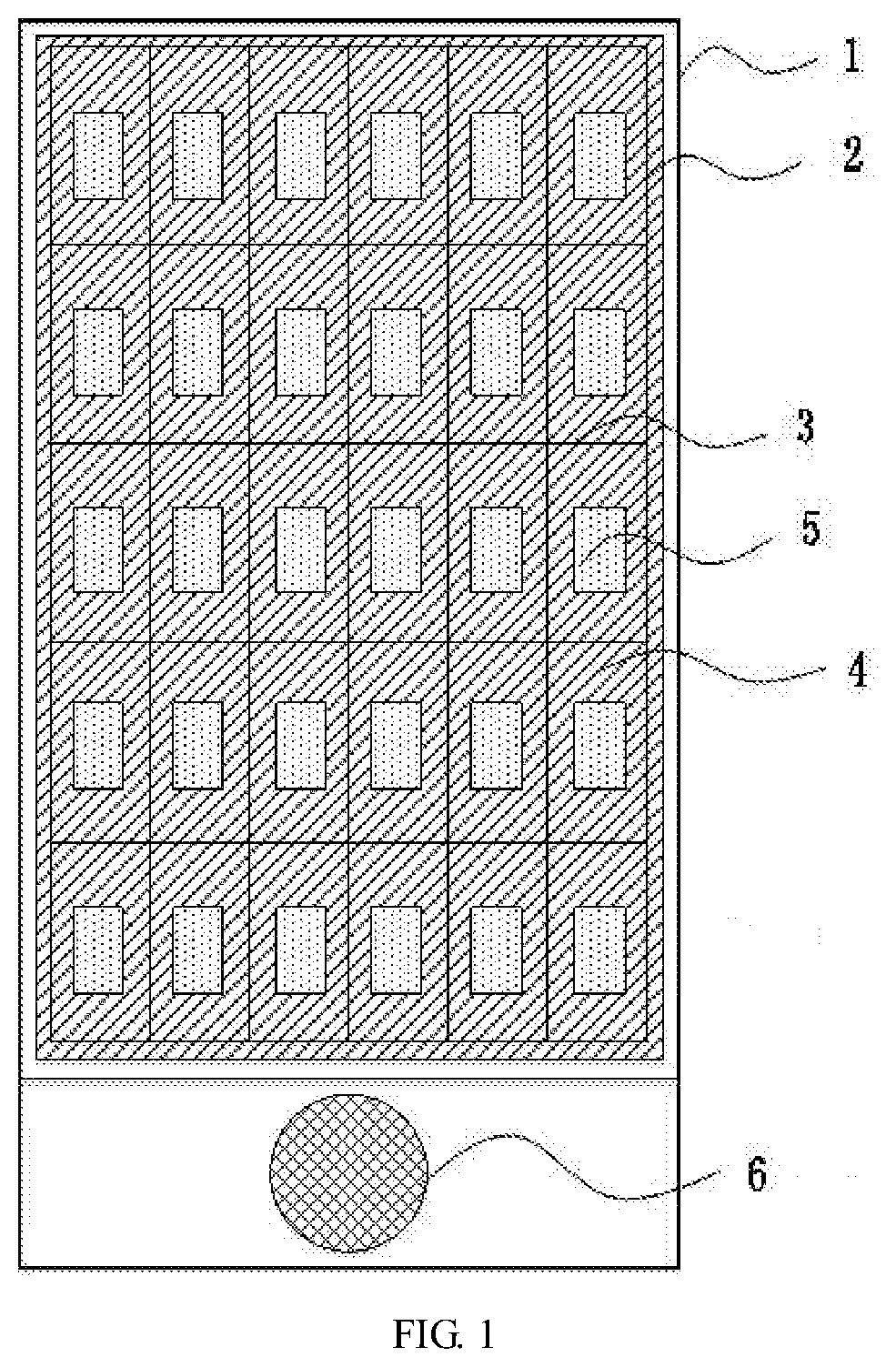
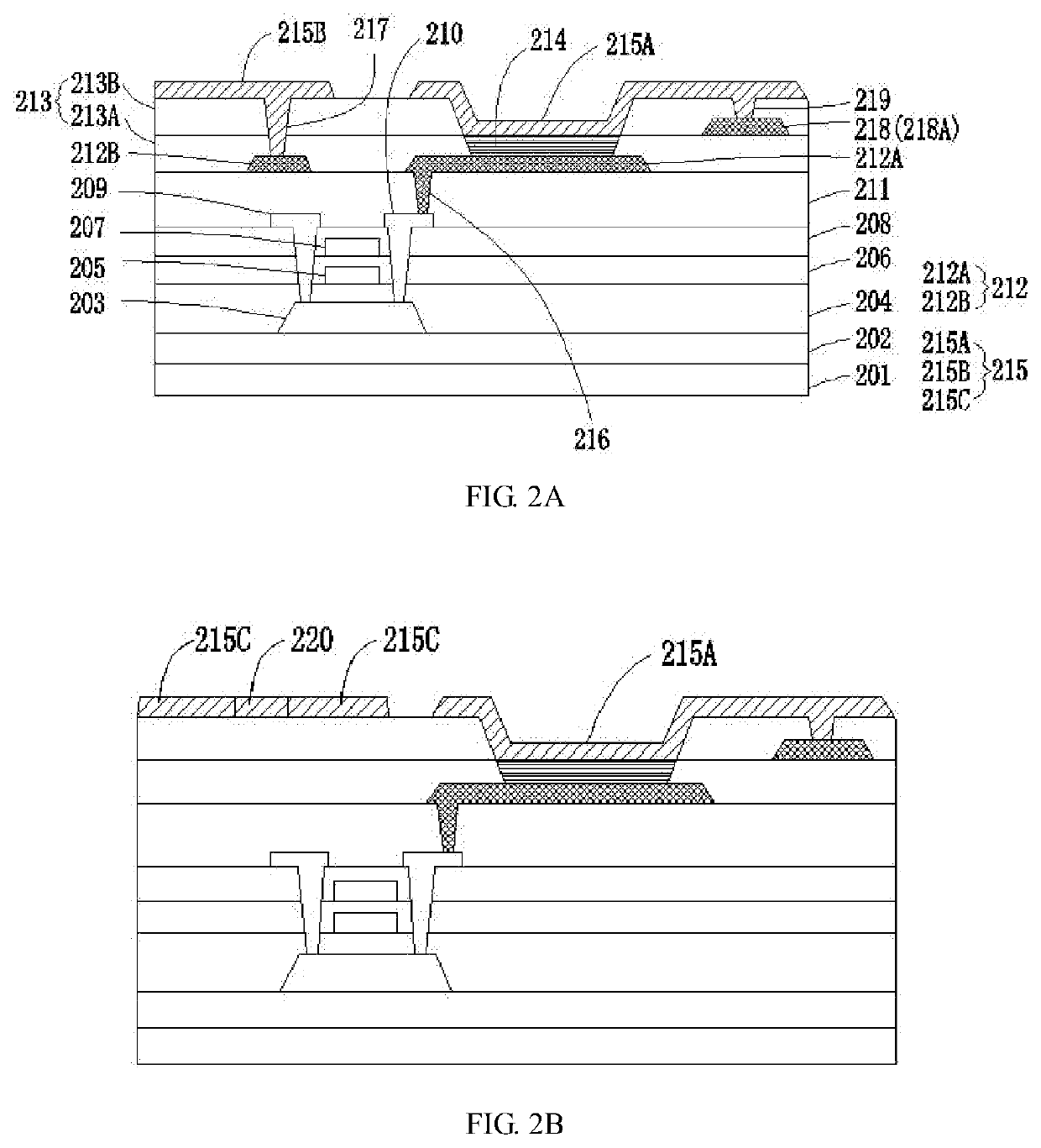
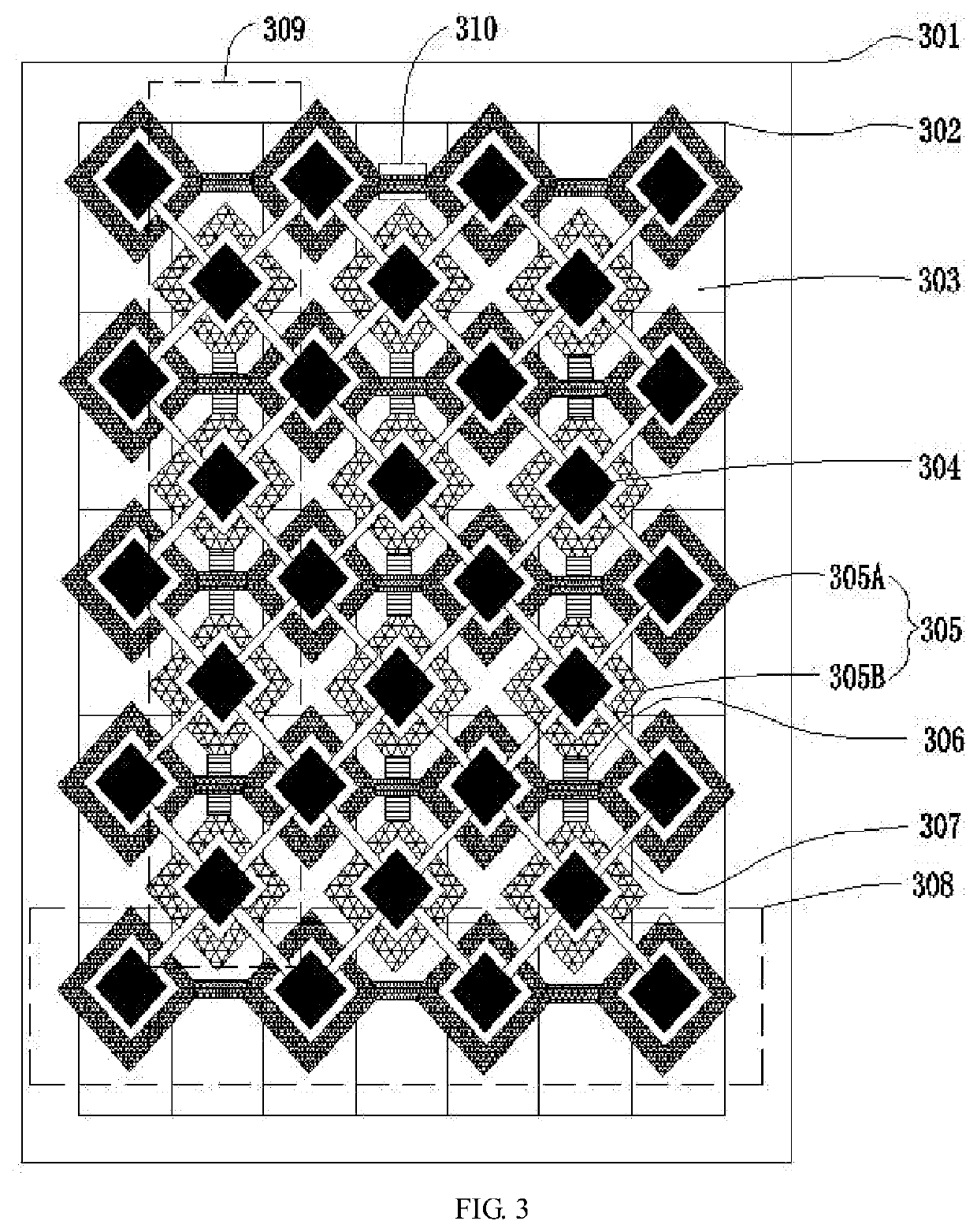
- The integration of sensing electrodes into the AMOLED display panel allows for underscreen fingerprint identification, utilizing a patterned cathode layer with insulated first and second electrode rows and conductive bridges to form capacitors for fingerprint recognition, thereby embedding fingerprint identification within the screen and increasing the display area ratio.
Manufacturing Process Optimization
The optimization of manufacturing processes for AMOLED integration in non-rectangular displays presents unique challenges that require innovative solutions. One of the primary focus areas is the development of flexible substrate materials that can withstand the stress of bending and folding while maintaining the integrity of the OLED layers. Advanced polymer-based substrates, such as polyimide films, have shown promise in this regard, offering a balance between flexibility and durability.
Deposition techniques for OLED materials on non-planar surfaces have also undergone significant refinement. Vacuum thermal evaporation (VTE) remains a widely used method, but adaptations have been made to ensure uniform layer thickness across curved or irregular surfaces. The implementation of shadow masks with precise curvatures and advanced rotation mechanisms has improved the accuracy of material deposition on non-rectangular substrates.
Encapsulation processes have been adapted to address the unique geometry of non-rectangular displays. Thin-film encapsulation (TFE) techniques have been enhanced to provide consistent barrier properties across curved surfaces, utilizing multi-layer structures of inorganic and organic materials. Atomic Layer Deposition (ALD) has emerged as a promising method for creating ultra-thin, conformal barrier layers that can protect OLED devices from moisture and oxygen ingress.
The integration of touch sensors and other functional layers in non-rectangular displays has necessitated the development of new patterning techniques. Photolithography processes have been modified to accommodate curved surfaces, while direct printing methods, such as inkjet printing and screen printing, have been optimized for depositing conductive materials on flexible substrates with complex geometries.
Quality control and testing procedures have also evolved to meet the demands of non-rectangular AMOLED production. Advanced optical inspection systems with 3D imaging capabilities have been developed to detect defects on curved surfaces. Stress testing protocols have been established to evaluate the long-term reliability of flexible displays under various bending and folding conditions.
Yield improvement remains a critical aspect of manufacturing process optimization. Manufacturers have implemented advanced statistical process control (SPC) methods and machine learning algorithms to identify and mitigate yield-limiting factors specific to non-rectangular display production. This data-driven approach has led to continuous refinement of process parameters and reduction of defect rates.
Deposition techniques for OLED materials on non-planar surfaces have also undergone significant refinement. Vacuum thermal evaporation (VTE) remains a widely used method, but adaptations have been made to ensure uniform layer thickness across curved or irregular surfaces. The implementation of shadow masks with precise curvatures and advanced rotation mechanisms has improved the accuracy of material deposition on non-rectangular substrates.
Encapsulation processes have been adapted to address the unique geometry of non-rectangular displays. Thin-film encapsulation (TFE) techniques have been enhanced to provide consistent barrier properties across curved surfaces, utilizing multi-layer structures of inorganic and organic materials. Atomic Layer Deposition (ALD) has emerged as a promising method for creating ultra-thin, conformal barrier layers that can protect OLED devices from moisture and oxygen ingress.
The integration of touch sensors and other functional layers in non-rectangular displays has necessitated the development of new patterning techniques. Photolithography processes have been modified to accommodate curved surfaces, while direct printing methods, such as inkjet printing and screen printing, have been optimized for depositing conductive materials on flexible substrates with complex geometries.
Quality control and testing procedures have also evolved to meet the demands of non-rectangular AMOLED production. Advanced optical inspection systems with 3D imaging capabilities have been developed to detect defects on curved surfaces. Stress testing protocols have been established to evaluate the long-term reliability of flexible displays under various bending and folding conditions.
Yield improvement remains a critical aspect of manufacturing process optimization. Manufacturers have implemented advanced statistical process control (SPC) methods and machine learning algorithms to identify and mitigate yield-limiting factors specific to non-rectangular display production. This data-driven approach has led to continuous refinement of process parameters and reduction of defect rates.
Design Flexibility and Customization
The integration of AMOLED technology into non-rectangular displays presents unique opportunities for design flexibility and customization. This advancement allows manufacturers to break free from traditional rectangular form factors, enabling the creation of displays with curved edges, circular shapes, and even irregular contours. Such flexibility opens up new possibilities for product designers across various industries, from wearables to automotive displays.
One of the key advantages of AMOLED in non-rectangular displays is its ability to conform to diverse form factors. Unlike traditional LCD technology, AMOLED panels can be fabricated on flexible substrates, allowing them to bend and curve without compromising image quality. This characteristic is particularly valuable in creating seamless, bezel-less designs that maximize screen real estate within unconventional shapes.
The customization potential of AMOLED in non-rectangular displays extends beyond mere shape. Designers can now incorporate unique features such as cut-outs, holes, or transparent areas within the display itself. This capability enables innovative designs where functional elements like cameras, sensors, or physical buttons can be integrated directly into the display area, enhancing both aesthetics and functionality.
In the wearable technology sector, AMOLED's design flexibility has been instrumental in creating smartwatches with circular displays that mimic traditional timepieces. These displays can be customized to include complications and watch faces that take full advantage of the circular form, providing a more natural and appealing user interface.
Automotive applications have also benefited significantly from AMOLED's customization capabilities in non-rectangular displays. Curved dashboard displays that seamlessly blend with the vehicle's interior design are now possible, offering improved ergonomics and a more immersive driving experience. Additionally, the ability to create displays with irregular shapes allows for better integration with existing vehicle controls and structures.
However, the implementation of these design flexibilities comes with its own set of challenges. Ensuring uniform brightness and color accuracy across curved or irregularly shaped surfaces requires sophisticated manufacturing processes and calibration techniques. Moreover, the durability of flexible AMOLED panels in various environmental conditions, particularly in automotive applications, remains an ongoing area of research and development.
As the technology continues to evolve, we can expect even greater design possibilities. Future advancements may include displays that can dynamically change shape or transparency, further blurring the lines between display and form. This ongoing innovation in AMOLED technology for non-rectangular displays will continue to push the boundaries of product design and user interaction across multiple industries.
One of the key advantages of AMOLED in non-rectangular displays is its ability to conform to diverse form factors. Unlike traditional LCD technology, AMOLED panels can be fabricated on flexible substrates, allowing them to bend and curve without compromising image quality. This characteristic is particularly valuable in creating seamless, bezel-less designs that maximize screen real estate within unconventional shapes.
The customization potential of AMOLED in non-rectangular displays extends beyond mere shape. Designers can now incorporate unique features such as cut-outs, holes, or transparent areas within the display itself. This capability enables innovative designs where functional elements like cameras, sensors, or physical buttons can be integrated directly into the display area, enhancing both aesthetics and functionality.
In the wearable technology sector, AMOLED's design flexibility has been instrumental in creating smartwatches with circular displays that mimic traditional timepieces. These displays can be customized to include complications and watch faces that take full advantage of the circular form, providing a more natural and appealing user interface.
Automotive applications have also benefited significantly from AMOLED's customization capabilities in non-rectangular displays. Curved dashboard displays that seamlessly blend with the vehicle's interior design are now possible, offering improved ergonomics and a more immersive driving experience. Additionally, the ability to create displays with irregular shapes allows for better integration with existing vehicle controls and structures.
However, the implementation of these design flexibilities comes with its own set of challenges. Ensuring uniform brightness and color accuracy across curved or irregularly shaped surfaces requires sophisticated manufacturing processes and calibration techniques. Moreover, the durability of flexible AMOLED panels in various environmental conditions, particularly in automotive applications, remains an ongoing area of research and development.
As the technology continues to evolve, we can expect even greater design possibilities. Future advancements may include displays that can dynamically change shape or transparency, further blurring the lines between display and form. This ongoing innovation in AMOLED technology for non-rectangular displays will continue to push the boundaries of product design and user interaction across multiple industries.
Unlock deeper insights with PatSnap Eureka Quick Research — get a full tech report to explore trends and direct your research. Try now!
Generate Your Research Report Instantly with AI Agent
Supercharge your innovation with PatSnap Eureka AI Agent Platform!