

AMOLED's potential in transparent biometric displays.
JUL 17, 20259 MIN READ
Generate Your Research Report Instantly with AI Agent
PatSnap Eureka helps you evaluate technical feasibility & market potential.
AMOLED Transparent Display Evolution
AMOLED technology has undergone significant evolution since its inception, particularly in the realm of transparent displays. The journey began with the development of basic OLED structures in the 1980s, which laid the groundwork for AMOLED technology. As research progressed, the focus shifted towards creating displays with higher transparency and improved performance.
The early 2000s marked a crucial turning point with the introduction of transparent OLED prototypes. These initial designs, while groundbreaking, faced challenges in terms of efficiency and durability. The subsequent years saw rapid advancements in materials science and manufacturing processes, leading to enhanced transparency and color reproduction.
By the mid-2010s, transparent AMOLED displays began to emerge as a viable technology for commercial applications. This period witnessed significant improvements in pixel density, power efficiency, and overall display quality. The integration of touch functionality and flexible substrates further expanded the potential use cases for transparent AMOLEDs.
Recent years have seen a surge in research focused on incorporating biometric capabilities into transparent AMOLED displays. This convergence of display and sensing technologies has opened up new possibilities for seamless user authentication and interaction. Innovations in transparent electrode materials and pixel architectures have been crucial in achieving higher levels of transparency without compromising display performance.
The evolution of AMOLED transparent displays has also been characterized by advancements in manufacturing techniques. Roll-to-roll processing and improved encapsulation methods have contributed to increased production efficiency and enhanced device longevity. These developments have been instrumental in making transparent AMOLED technology more accessible for various applications.
As the technology continues to mature, we are witnessing the emergence of novel applications that leverage the unique properties of transparent AMOLEDs. From automotive head-up displays to smart windows in buildings, the potential use cases are expanding rapidly. The integration of biometric features, such as fingerprint sensors and facial recognition systems, directly into the display itself represents a significant leap forward in user interface design and security implementation.
Looking ahead, the evolution of AMOLED transparent displays is expected to focus on further improving transparency levels, energy efficiency, and durability. Research into new materials and pixel architectures will likely play a crucial role in overcoming current limitations and unlocking new possibilities for transparent biometric displays.
The early 2000s marked a crucial turning point with the introduction of transparent OLED prototypes. These initial designs, while groundbreaking, faced challenges in terms of efficiency and durability. The subsequent years saw rapid advancements in materials science and manufacturing processes, leading to enhanced transparency and color reproduction.
By the mid-2010s, transparent AMOLED displays began to emerge as a viable technology for commercial applications. This period witnessed significant improvements in pixel density, power efficiency, and overall display quality. The integration of touch functionality and flexible substrates further expanded the potential use cases for transparent AMOLEDs.
Recent years have seen a surge in research focused on incorporating biometric capabilities into transparent AMOLED displays. This convergence of display and sensing technologies has opened up new possibilities for seamless user authentication and interaction. Innovations in transparent electrode materials and pixel architectures have been crucial in achieving higher levels of transparency without compromising display performance.
The evolution of AMOLED transparent displays has also been characterized by advancements in manufacturing techniques. Roll-to-roll processing and improved encapsulation methods have contributed to increased production efficiency and enhanced device longevity. These developments have been instrumental in making transparent AMOLED technology more accessible for various applications.
As the technology continues to mature, we are witnessing the emergence of novel applications that leverage the unique properties of transparent AMOLEDs. From automotive head-up displays to smart windows in buildings, the potential use cases are expanding rapidly. The integration of biometric features, such as fingerprint sensors and facial recognition systems, directly into the display itself represents a significant leap forward in user interface design and security implementation.
Looking ahead, the evolution of AMOLED transparent displays is expected to focus on further improving transparency levels, energy efficiency, and durability. Research into new materials and pixel architectures will likely play a crucial role in overcoming current limitations and unlocking new possibilities for transparent biometric displays.
Biometric Integration Market Demand
The integration of biometric technologies with transparent displays, particularly AMOLED-based solutions, is driving significant market demand across various sectors. This convergence addresses the growing need for seamless, secure, and user-friendly authentication methods in an increasingly digital world.
In the consumer electronics sector, smartphones and wearable devices are at the forefront of adopting transparent biometric displays. The market for these devices is experiencing robust growth, with consumers showing a strong preference for sleek, bezel-less designs that incorporate advanced security features. Transparent AMOLED displays with integrated fingerprint sensors or facial recognition capabilities are becoming a standard expectation in high-end devices, driving manufacturers to invest heavily in this technology.
The automotive industry is another key driver of demand for transparent biometric displays. As vehicles become more connected and autonomous, there is a growing need for advanced driver authentication and personalization systems. Transparent AMOLED displays integrated into windshields or side windows, coupled with biometric sensors, offer a unique solution for driver identification, personalized settings, and enhanced security features.
In the healthcare sector, the demand for transparent biometric displays is rising due to the increasing adoption of telemedicine and remote patient monitoring. These displays can be integrated into medical devices or wearable health monitors, allowing for seamless biometric data collection and display without compromising the visibility of the underlying information.
The financial services industry is also showing significant interest in transparent biometric displays for enhancing security in ATMs, point-of-sale terminals, and mobile banking applications. These displays offer a more intuitive and secure way to authenticate transactions, reducing the risk of fraud while improving the user experience.
Government and security sectors are exploring the potential of transparent biometric displays for border control, access management, and surveillance applications. The ability to discreetly integrate biometric authentication into existing infrastructure without obstructing visibility is particularly appealing for these high-security environments.
Market analysts project substantial growth in the transparent biometric display sector over the next five years, with a compound annual growth rate expected to exceed the overall display market average. This growth is driven by increasing awareness of security risks, the need for more intuitive user interfaces, and the continuous advancement of AMOLED technology.
However, challenges such as high production costs, technical complexities in integrating biometric sensors with transparent displays, and privacy concerns may initially limit widespread adoption. Despite these hurdles, the potential benefits and diverse applications across multiple industries suggest a strong and sustained market demand for AMOLED-based transparent biometric displays in the foreseeable future.
In the consumer electronics sector, smartphones and wearable devices are at the forefront of adopting transparent biometric displays. The market for these devices is experiencing robust growth, with consumers showing a strong preference for sleek, bezel-less designs that incorporate advanced security features. Transparent AMOLED displays with integrated fingerprint sensors or facial recognition capabilities are becoming a standard expectation in high-end devices, driving manufacturers to invest heavily in this technology.
The automotive industry is another key driver of demand for transparent biometric displays. As vehicles become more connected and autonomous, there is a growing need for advanced driver authentication and personalization systems. Transparent AMOLED displays integrated into windshields or side windows, coupled with biometric sensors, offer a unique solution for driver identification, personalized settings, and enhanced security features.
In the healthcare sector, the demand for transparent biometric displays is rising due to the increasing adoption of telemedicine and remote patient monitoring. These displays can be integrated into medical devices or wearable health monitors, allowing for seamless biometric data collection and display without compromising the visibility of the underlying information.
The financial services industry is also showing significant interest in transparent biometric displays for enhancing security in ATMs, point-of-sale terminals, and mobile banking applications. These displays offer a more intuitive and secure way to authenticate transactions, reducing the risk of fraud while improving the user experience.
Government and security sectors are exploring the potential of transparent biometric displays for border control, access management, and surveillance applications. The ability to discreetly integrate biometric authentication into existing infrastructure without obstructing visibility is particularly appealing for these high-security environments.
Market analysts project substantial growth in the transparent biometric display sector over the next five years, with a compound annual growth rate expected to exceed the overall display market average. This growth is driven by increasing awareness of security risks, the need for more intuitive user interfaces, and the continuous advancement of AMOLED technology.
However, challenges such as high production costs, technical complexities in integrating biometric sensors with transparent displays, and privacy concerns may initially limit widespread adoption. Despite these hurdles, the potential benefits and diverse applications across multiple industries suggest a strong and sustained market demand for AMOLED-based transparent biometric displays in the foreseeable future.
Technical Challenges in Transparency
The pursuit of transparent AMOLED displays for biometric applications faces several significant technical challenges. One of the primary obstacles is achieving sufficient transparency without compromising display quality. Traditional AMOLED displays rely on opaque components, such as the cathode layer and thin-film transistors (TFTs), which inherently limit transparency. Developing transparent alternatives for these components while maintaining their electrical properties is a complex task.
Another major challenge lies in the integration of biometric sensors with transparent displays. The sensors must be able to function accurately through the display layers without interference from the display's operation. This requires careful consideration of materials and design to ensure compatibility between the display and sensing technologies.
Light management presents a further hurdle in transparent biometric displays. The display must be able to emit light for visual output while simultaneously allowing light to pass through for biometric sensing. This dual functionality demands sophisticated optical engineering to balance light transmission and emission without compromising either function.
Power efficiency is also a critical concern. Transparent displays typically require more power to achieve the same brightness as their opaque counterparts due to light loss through transmission. This challenge is compounded when integrating power-hungry biometric sensors, necessitating innovative power management solutions.
Durability and reliability pose additional challenges. Transparent displays are often more susceptible to environmental factors such as humidity and temperature fluctuations. Ensuring long-term stability and consistent performance of both the display and biometric components in various conditions is crucial for practical applications.
Manufacturing scalability remains a significant obstacle. Current production processes for transparent AMOLED displays are complex and costly, limiting their widespread adoption. Developing efficient, cost-effective manufacturing techniques that can produce high-quality transparent biometric displays at scale is essential for commercial viability.
Lastly, the challenge of achieving uniform transparency across the entire display area is noteworthy. Variations in transparency can affect both the visual quality of the display and the accuracy of biometric sensing. Overcoming this requires precise control over material properties and fabrication processes to ensure consistent optical characteristics throughout the display.
Another major challenge lies in the integration of biometric sensors with transparent displays. The sensors must be able to function accurately through the display layers without interference from the display's operation. This requires careful consideration of materials and design to ensure compatibility between the display and sensing technologies.
Light management presents a further hurdle in transparent biometric displays. The display must be able to emit light for visual output while simultaneously allowing light to pass through for biometric sensing. This dual functionality demands sophisticated optical engineering to balance light transmission and emission without compromising either function.
Power efficiency is also a critical concern. Transparent displays typically require more power to achieve the same brightness as their opaque counterparts due to light loss through transmission. This challenge is compounded when integrating power-hungry biometric sensors, necessitating innovative power management solutions.
Durability and reliability pose additional challenges. Transparent displays are often more susceptible to environmental factors such as humidity and temperature fluctuations. Ensuring long-term stability and consistent performance of both the display and biometric components in various conditions is crucial for practical applications.
Manufacturing scalability remains a significant obstacle. Current production processes for transparent AMOLED displays are complex and costly, limiting their widespread adoption. Developing efficient, cost-effective manufacturing techniques that can produce high-quality transparent biometric displays at scale is essential for commercial viability.
Lastly, the challenge of achieving uniform transparency across the entire display area is noteworthy. Variations in transparency can affect both the visual quality of the display and the accuracy of biometric sensing. Overcoming this requires precise control over material properties and fabrication processes to ensure consistent optical characteristics throughout the display.
Current Transparent AMOLED Solutions
01 Transparent AMOLED display structure
AMOLED displays can be designed with transparent components, including transparent electrodes, organic light-emitting layers, and substrates. This allows for the creation of see-through displays that can overlay digital information on the real world, enabling applications in augmented reality and smart windows.- Transparent AMOLED display structure: AMOLED displays can be designed with transparent structures, allowing light to pass through the display. This is achieved by using transparent materials for electrodes and organic layers, and optimizing the arrangement of opaque components to maximize light transmission. The transparent structure enables see-through displays and augmented reality applications.
- Pixel circuit design for transparent AMOLEDs: Specialized pixel circuits are developed for transparent AMOLED displays to maintain display performance while maximizing transparency. These circuits may include transparent thin-film transistors, optimized layouts to reduce opaque areas, and novel driving schemes to balance transparency and image quality.
- Transparent electrode materials and fabrication: Development of transparent electrode materials is crucial for AMOLED transparency. This includes the use of materials such as indium tin oxide (ITO), graphene, or metal nanowires. Advanced fabrication techniques are employed to create highly transparent and conductive electrodes while maintaining OLED performance.
- Integration of transparent AMOLEDs in devices: Transparent AMOLED displays are integrated into various devices, including smartphones, wearables, and automotive applications. This integration involves addressing challenges such as power consumption, durability, and compatibility with other device components while maintaining transparency.
- Transparency control and adaptive display: Methods for dynamically controlling the transparency of AMOLED displays are developed. This includes techniques for adjusting transparency levels based on ambient conditions, user preferences, or application requirements. Adaptive display technologies enable seamless transitions between transparent and opaque states.
02 Pixel circuit design for transparent AMOLEDs
Specialized pixel circuits are developed for transparent AMOLED displays to maintain image quality and transparency simultaneously. These circuits often incorporate thin-film transistors (TFTs) and capacitors arranged in a way that minimizes their visibility while ensuring proper display operation.Expand Specific Solutions03 Transparency control in AMOLED displays
Methods for dynamically adjusting the transparency of AMOLED displays are developed, allowing users to switch between fully transparent, partially transparent, and opaque modes. This is achieved through various techniques such as voltage control, material selection, and pixel arrangement.Expand Specific Solutions04 Integration of transparent AMOLEDs in devices
Transparent AMOLED displays are integrated into various devices such as smartphones, wearables, and automotive applications. This integration requires careful consideration of factors like power consumption, durability, and user interface design to maximize the benefits of transparency.Expand Specific Solutions05 Manufacturing processes for transparent AMOLEDs
Specialized manufacturing techniques are developed to produce transparent AMOLED displays. These processes focus on depositing transparent conductive materials, creating uniform organic layers, and ensuring proper encapsulation to protect the sensitive organic components while maintaining transparency.Expand Specific Solutions
Key AMOLED Display Manufacturers
The AMOLED transparent biometric display market is in its early growth stage, with significant potential for expansion. The technology's maturity is advancing rapidly, driven by key players like BOE Technology, TCL China Star Optoelectronics, and Tianma Microelectronics. These companies are investing heavily in R&D to overcome challenges such as transparency and integration of biometric sensors. The market size is expected to grow substantially as applications in smartphones, wearables, and automotive sectors increase. However, technical hurdles and high production costs currently limit widespread adoption, indicating a competitive landscape where innovation and cost-efficiency will be crucial for market leadership.
BOE Technology Group Co., Ltd.
Technical Solution: BOE has developed advanced AMOLED technology for transparent biometric displays. Their solution integrates under-display fingerprint sensors with high-transparency AMOLED panels. The company utilizes a unique pixel structure that allows for both light transmission and fingerprint detection[1]. BOE's transparent AMOLED displays achieve up to 80% light transmittance while maintaining high color accuracy and contrast ratios[2]. The biometric functionality is enabled by integrating optical fingerprint sensors beneath the display, which can capture fingerprint data through the transparent AMOLED layer[3]. This technology has been successfully implemented in prototype smartphones and is being further developed for automotive and smart home applications.
Strengths: High transparency, seamless integration of biometrics, versatile applications. Weaknesses: Potential higher production costs, challenges in mass production scalability.
Tianma Microelectronics Co., Ltd.
Technical Solution: Tianma has developed innovative AMOLED solutions for transparent biometric displays, focusing on high transparency and low power consumption. Their approach utilizes a novel pixel design that allows for up to 60% transparency while maintaining AMOLED's color performance[10]. Tianma's biometric integration involves optical fingerprint sensors embedded within the display stack, capable of reading fingerprints through the transparent AMOLED layer. The company has also developed advanced touch technology that works in conjunction with the transparent display, allowing for multi-touch functionality and pressure sensitivity[11]. Tianma's transparent AMOLED technology has been demonstrated in prototype devices and is being developed for applications in smartphones, wearables, and automotive displays.
Strengths: Good balance of transparency and display performance, low power consumption, versatile applications. Weaknesses: Lower transparency compared to some competitors, potential challenges in mass production.
Biometric Sensing Innovations
Light-emitting diode, array substrate, and method of making the same
PatentWO2018223647A1
Innovation
- Introducing a substantially transparent protective layer between the second electrode and a transparent conductive layer to enhance device stability.
- Utilizing a transparent conductive layer on top of the protective layer to reduce IR drop while maintaining high transmissivity.
- Electrically connecting the transparent conductive layer to the second electrode through vias to ensure proper current distribution.




Method for driving a display panel to display image, display apparatus thereof, and driver enabled to perform the method
PatentWO2018223643A1
Innovation
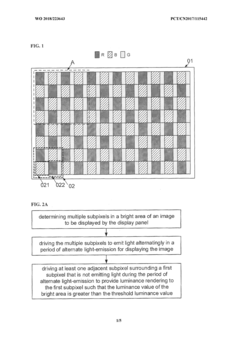
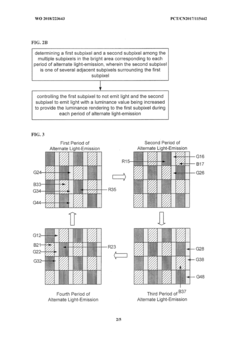
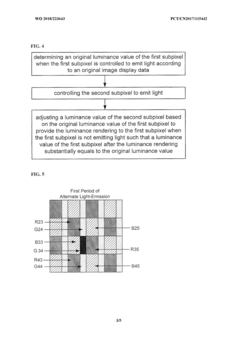
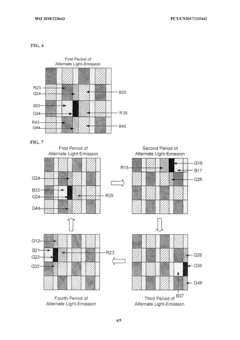
- AMOLED displays offer ultra-thin panel thickness, ultra-high contrast ratio, ultra-wide color gamut, ultra-fast response rate, ultra-wide viewing angle, and ultra-large curvature deflection.
- The display panel uses thin-film transistors (TFT) to control individual subpixels, allowing for precise control of light emission and image display.
- Luminance value of subpixels can be raised to enhance image contrast ratio, but prolonged high luminance can lead to degradation of electro-optical conversion efficiency.
Regulatory Framework for Biometrics
The regulatory framework for biometrics in transparent AMOLED displays is a complex and evolving landscape. As these technologies converge, policymakers and industry stakeholders must navigate a delicate balance between innovation, privacy, and security.
At the international level, organizations such as the International Organization for Standardization (ISO) and the International Electrotechnical Commission (IEC) have developed standards for biometric data capture and processing. These standards, including ISO/IEC 19794 and 24745, provide guidelines for biometric data interchange formats and security techniques, respectively. However, they do not specifically address the unique challenges posed by transparent display technologies.
In the United States, the regulatory approach to biometrics is fragmented. While there is no comprehensive federal law governing biometric data, several states have enacted their own legislation. The Illinois Biometric Information Privacy Act (BIPA) is particularly noteworthy, requiring informed consent for biometric data collection and establishing strict guidelines for data storage and destruction. Other states, such as Texas and Washington, have followed suit with similar laws.
The European Union's General Data Protection Regulation (GDPR) sets a high bar for biometric data protection, classifying it as sensitive personal data subject to stringent processing requirements. The GDPR's principles of data minimization and purpose limitation are particularly relevant to transparent biometric displays, as they may capture more information than traditional biometric systems.
In Asia, countries like China and Japan have taken different approaches. China's Cybersecurity Law and Personal Information Protection Law provide a framework for biometric data protection, albeit with significant government access provisions. Japan's Act on the Protection of Personal Information includes specific provisions for biometric data, emphasizing the need for explicit consent and secure handling.
As transparent AMOLED biometric displays advance, regulators face new challenges. These include addressing the potential for covert data collection, ensuring the accuracy and reliability of biometric data captured through transparent displays, and developing standards for the secure integration of display and biometric technologies.
Industry self-regulation also plays a crucial role. Organizations such as the FIDO Alliance are working to develop interoperable authentication standards that could be applied to transparent biometric displays. However, these efforts must be complemented by robust government oversight to ensure public trust and protect individual rights.
At the international level, organizations such as the International Organization for Standardization (ISO) and the International Electrotechnical Commission (IEC) have developed standards for biometric data capture and processing. These standards, including ISO/IEC 19794 and 24745, provide guidelines for biometric data interchange formats and security techniques, respectively. However, they do not specifically address the unique challenges posed by transparent display technologies.
In the United States, the regulatory approach to biometrics is fragmented. While there is no comprehensive federal law governing biometric data, several states have enacted their own legislation. The Illinois Biometric Information Privacy Act (BIPA) is particularly noteworthy, requiring informed consent for biometric data collection and establishing strict guidelines for data storage and destruction. Other states, such as Texas and Washington, have followed suit with similar laws.
The European Union's General Data Protection Regulation (GDPR) sets a high bar for biometric data protection, classifying it as sensitive personal data subject to stringent processing requirements. The GDPR's principles of data minimization and purpose limitation are particularly relevant to transparent biometric displays, as they may capture more information than traditional biometric systems.
In Asia, countries like China and Japan have taken different approaches. China's Cybersecurity Law and Personal Information Protection Law provide a framework for biometric data protection, albeit with significant government access provisions. Japan's Act on the Protection of Personal Information includes specific provisions for biometric data, emphasizing the need for explicit consent and secure handling.
As transparent AMOLED biometric displays advance, regulators face new challenges. These include addressing the potential for covert data collection, ensuring the accuracy and reliability of biometric data captured through transparent displays, and developing standards for the secure integration of display and biometric technologies.
Industry self-regulation also plays a crucial role. Organizations such as the FIDO Alliance are working to develop interoperable authentication standards that could be applied to transparent biometric displays. However, these efforts must be complemented by robust government oversight to ensure public trust and protect individual rights.
Energy Efficiency Considerations
Energy efficiency is a critical consideration in the development of transparent biometric displays utilizing AMOLED technology. The power consumption of these displays directly impacts the overall performance and usability of devices incorporating this technology. AMOLED displays inherently offer advantages in energy efficiency compared to traditional LCD screens, as they do not require a backlight and can selectively illuminate only the necessary pixels.
However, the challenge lies in maintaining this efficiency while achieving transparency and integrating biometric sensors. Transparent AMOLED displays require additional layers and materials to allow light transmission, which can potentially increase power consumption. The integration of biometric sensors, such as fingerprint or iris scanners, also adds to the energy demands of the display system.
To address these challenges, researchers and manufacturers are exploring various approaches to optimize energy efficiency. One promising avenue is the development of low-power transparent OLED materials that can maintain high luminance and color accuracy while minimizing energy consumption. These materials are designed to have improved charge carrier mobility and reduced operating voltages.
Another focus area is the implementation of advanced power management systems specifically tailored for transparent biometric displays. These systems can dynamically adjust display brightness and sensor activation based on ambient light conditions and user interaction patterns. By intelligently managing power distribution between the display and biometric components, overall energy consumption can be significantly reduced.
The integration of energy harvesting technologies is also being explored as a means to supplement power supply and extend battery life. Transparent solar cells integrated into the display structure could potentially capture ambient light and convert it into usable energy, offsetting some of the power requirements of the display and biometric sensors.
Furthermore, advancements in display driver ICs and pixel circuits are contributing to improved energy efficiency. These components are being optimized to minimize power leakage and enhance voltage regulation, resulting in more efficient operation of transparent AMOLED displays with integrated biometric functionality.
As the technology continues to evolve, it is expected that the energy efficiency of transparent biometric displays will improve significantly. This progress will be crucial in enabling the widespread adoption of this technology in various applications, from smartphones and wearables to automotive displays and smart home devices. The ongoing research and development efforts in this area are likely to yield innovative solutions that balance transparency, biometric functionality, and energy efficiency, paving the way for next-generation display technologies.
However, the challenge lies in maintaining this efficiency while achieving transparency and integrating biometric sensors. Transparent AMOLED displays require additional layers and materials to allow light transmission, which can potentially increase power consumption. The integration of biometric sensors, such as fingerprint or iris scanners, also adds to the energy demands of the display system.
To address these challenges, researchers and manufacturers are exploring various approaches to optimize energy efficiency. One promising avenue is the development of low-power transparent OLED materials that can maintain high luminance and color accuracy while minimizing energy consumption. These materials are designed to have improved charge carrier mobility and reduced operating voltages.
Another focus area is the implementation of advanced power management systems specifically tailored for transparent biometric displays. These systems can dynamically adjust display brightness and sensor activation based on ambient light conditions and user interaction patterns. By intelligently managing power distribution between the display and biometric components, overall energy consumption can be significantly reduced.
The integration of energy harvesting technologies is also being explored as a means to supplement power supply and extend battery life. Transparent solar cells integrated into the display structure could potentially capture ambient light and convert it into usable energy, offsetting some of the power requirements of the display and biometric sensors.
Furthermore, advancements in display driver ICs and pixel circuits are contributing to improved energy efficiency. These components are being optimized to minimize power leakage and enhance voltage regulation, resulting in more efficient operation of transparent AMOLED displays with integrated biometric functionality.
As the technology continues to evolve, it is expected that the energy efficiency of transparent biometric displays will improve significantly. This progress will be crucial in enabling the widespread adoption of this technology in various applications, from smartphones and wearables to automotive displays and smart home devices. The ongoing research and development efforts in this area are likely to yield innovative solutions that balance transparency, biometric functionality, and energy efficiency, paving the way for next-generation display technologies.
Unlock deeper insights with PatSnap Eureka Quick Research — get a full tech report to explore trends and direct your research. Try now!
Generate Your Research Report Instantly with AI Agent
Supercharge your innovation with PatSnap Eureka AI Agent Platform!