

Analyze Schmitt Trigger in Signal Reconstruction Techniques
SEP 23, 20259 MIN READ
Generate Your Research Report Instantly with AI Agent
PatSnap Eureka helps you evaluate technical feasibility & market potential.
Schmitt Trigger Evolution and Objectives
The Schmitt trigger, first introduced by Otto Schmitt in 1934, represents a significant milestone in electronic circuit design. Originally conceived as a thermionic valve circuit, this innovation was designed to mimic the biological neural systems' ability to process signals with hysteresis. Over subsequent decades, the Schmitt trigger evolved from vacuum tube implementations to solid-state designs, eventually becoming a fundamental component in modern integrated circuits.
The evolution of Schmitt triggers has been closely tied to advancements in semiconductor technology. The transition from discrete components to integrated circuits in the 1960s and 1970s marked a pivotal shift, enabling more compact and efficient implementations. By the 1980s, CMOS-based Schmitt triggers emerged, offering improved power efficiency and noise immunity, which proved crucial for signal processing applications.
Recent developments have focused on enhancing performance parameters such as switching speed, power consumption, and threshold precision. Modern Schmitt triggers now operate at significantly lower voltages while maintaining robust noise immunity, reflecting the broader trend toward low-power electronics. Additionally, specialized variants have emerged for specific applications, including ultra-fast switching for high-frequency signal processing and precision threshold control for sensitive instrumentation.
In the context of signal reconstruction techniques, Schmitt triggers serve several critical objectives. Primarily, they function as noise-resistant threshold detectors, converting analog signals with potential noise contamination into clean digital outputs. This capability is particularly valuable in environments where signal integrity is compromised by electromagnetic interference or other noise sources.
Another key objective is waveform regeneration and reshaping. By implementing controlled hysteresis, Schmitt triggers effectively reconstruct degraded signals, restoring sharp transitions and defined logic levels. This characteristic makes them indispensable in applications requiring reliable signal transmission across noisy channels or long distances.
Signal conditioning represents a third major objective, where Schmitt triggers prepare raw signals for subsequent processing stages. By establishing well-defined thresholds with hysteresis, they prevent false triggering and ensure consistent interpretation of input signals, thereby enhancing the reliability of downstream signal processing operations.
The technology aims to address several persistent challenges in signal reconstruction, including the mitigation of noise effects, compensation for signal degradation, and adaptation to varying input conditions. Future development objectives include enhancing adaptability to dynamic signal environments, reducing power consumption for battery-powered applications, and improving integration with advanced digital signal processing systems.
The evolution of Schmitt triggers has been closely tied to advancements in semiconductor technology. The transition from discrete components to integrated circuits in the 1960s and 1970s marked a pivotal shift, enabling more compact and efficient implementations. By the 1980s, CMOS-based Schmitt triggers emerged, offering improved power efficiency and noise immunity, which proved crucial for signal processing applications.
Recent developments have focused on enhancing performance parameters such as switching speed, power consumption, and threshold precision. Modern Schmitt triggers now operate at significantly lower voltages while maintaining robust noise immunity, reflecting the broader trend toward low-power electronics. Additionally, specialized variants have emerged for specific applications, including ultra-fast switching for high-frequency signal processing and precision threshold control for sensitive instrumentation.
In the context of signal reconstruction techniques, Schmitt triggers serve several critical objectives. Primarily, they function as noise-resistant threshold detectors, converting analog signals with potential noise contamination into clean digital outputs. This capability is particularly valuable in environments where signal integrity is compromised by electromagnetic interference or other noise sources.
Another key objective is waveform regeneration and reshaping. By implementing controlled hysteresis, Schmitt triggers effectively reconstruct degraded signals, restoring sharp transitions and defined logic levels. This characteristic makes them indispensable in applications requiring reliable signal transmission across noisy channels or long distances.
Signal conditioning represents a third major objective, where Schmitt triggers prepare raw signals for subsequent processing stages. By establishing well-defined thresholds with hysteresis, they prevent false triggering and ensure consistent interpretation of input signals, thereby enhancing the reliability of downstream signal processing operations.
The technology aims to address several persistent challenges in signal reconstruction, including the mitigation of noise effects, compensation for signal degradation, and adaptation to varying input conditions. Future development objectives include enhancing adaptability to dynamic signal environments, reducing power consumption for battery-powered applications, and improving integration with advanced digital signal processing systems.
Market Applications for Signal Reconstruction
Signal reconstruction technologies have found extensive applications across diverse market sectors, with Schmitt trigger circuits playing a crucial role in enhancing signal integrity and reliability. The telecommunications industry represents one of the largest markets for these technologies, where Schmitt triggers are employed in signal conditioning circuits to reconstruct degraded signals in wireless communication systems, fiber optic networks, and satellite communications. The global telecommunications equipment market, which heavily relies on signal reconstruction, continues to expand as 5G networks roll out worldwide.
In industrial automation and control systems, signal reconstruction techniques incorporating Schmitt triggers have become essential components. These systems require accurate signal processing in electrically noisy environments where industrial machinery, motors, and power systems generate significant electromagnetic interference. Schmitt triggers effectively eliminate noise and reconstruct clean control signals, ensuring precise operation of automated manufacturing processes, robotics, and industrial IoT applications.
The automotive electronics sector has emerged as a rapidly growing market for signal reconstruction technologies. Modern vehicles contain numerous sensors and electronic control units that must operate reliably under varying temperature and vibration conditions. Schmitt trigger-based signal reconstruction is utilized in engine control modules, anti-lock braking systems, advanced driver assistance systems, and vehicle-to-everything (V2X) communication platforms to ensure signal integrity and system reliability.
Medical device manufacturing represents another significant application area, where signal reconstruction is critical for diagnostic equipment such as electrocardiograms, patient monitors, and medical imaging systems. These devices must accurately reconstruct biological signals that are often weak and susceptible to interference. Schmitt triggers help establish reliable threshold detection in these applications, ensuring accurate diagnosis and patient safety.
Consumer electronics constitutes a vast market for signal reconstruction technologies, with applications in smartphones, tablets, laptops, and smart home devices. These products require efficient signal processing for touch interfaces, wireless connectivity, and sensor integration. Schmitt trigger circuits enable reliable operation of these devices in varying environmental conditions and help extend battery life through efficient signal processing.
The aerospace and defense sector utilizes advanced signal reconstruction techniques for radar systems, communication equipment, and navigation instruments. These applications demand exceptional reliability and performance under extreme conditions. Schmitt trigger-based signal reconstruction provides the necessary robustness for mission-critical systems operating in challenging environments.
In industrial automation and control systems, signal reconstruction techniques incorporating Schmitt triggers have become essential components. These systems require accurate signal processing in electrically noisy environments where industrial machinery, motors, and power systems generate significant electromagnetic interference. Schmitt triggers effectively eliminate noise and reconstruct clean control signals, ensuring precise operation of automated manufacturing processes, robotics, and industrial IoT applications.
The automotive electronics sector has emerged as a rapidly growing market for signal reconstruction technologies. Modern vehicles contain numerous sensors and electronic control units that must operate reliably under varying temperature and vibration conditions. Schmitt trigger-based signal reconstruction is utilized in engine control modules, anti-lock braking systems, advanced driver assistance systems, and vehicle-to-everything (V2X) communication platforms to ensure signal integrity and system reliability.
Medical device manufacturing represents another significant application area, where signal reconstruction is critical for diagnostic equipment such as electrocardiograms, patient monitors, and medical imaging systems. These devices must accurately reconstruct biological signals that are often weak and susceptible to interference. Schmitt triggers help establish reliable threshold detection in these applications, ensuring accurate diagnosis and patient safety.
Consumer electronics constitutes a vast market for signal reconstruction technologies, with applications in smartphones, tablets, laptops, and smart home devices. These products require efficient signal processing for touch interfaces, wireless connectivity, and sensor integration. Schmitt trigger circuits enable reliable operation of these devices in varying environmental conditions and help extend battery life through efficient signal processing.
The aerospace and defense sector utilizes advanced signal reconstruction techniques for radar systems, communication equipment, and navigation instruments. These applications demand exceptional reliability and performance under extreme conditions. Schmitt trigger-based signal reconstruction provides the necessary robustness for mission-critical systems operating in challenging environments.
Technical Limitations and Noise Immunity Challenges
Despite the Schmitt trigger's effectiveness in signal reconstruction, it faces several technical limitations that impact its performance in real-world applications. The primary limitation stems from its inherent hysteresis characteristic, which while beneficial for noise immunity, introduces a time delay in signal processing. This delay becomes particularly problematic in high-frequency applications where timing precision is critical, potentially causing phase distortion and signal integrity issues.
The threshold voltage selection presents another significant challenge. Setting optimal thresholds requires careful consideration of the expected noise levels, signal amplitude variations, and environmental conditions. Improper threshold settings can lead to either excessive sensitivity to noise or missed signal transitions, both compromising reconstruction accuracy.
Temperature dependency constitutes a major limitation in industrial environments. The voltage thresholds of Schmitt triggers typically exhibit temperature coefficients that can cause drift in switching points across operating temperature ranges. This drift necessitates compensation mechanisms in precision applications, adding complexity to circuit design and potentially reducing reliability.
Power consumption emerges as a constraint in battery-operated and energy-efficient systems. Traditional Schmitt trigger implementations, particularly those using discrete components, may consume more power than alternative signal conditioning methods, limiting their applicability in low-power designs such as IoT sensors and wearable devices.
Regarding noise immunity challenges, while Schmitt triggers excel at rejecting small amplitude noise, they remain vulnerable to large transient noise spikes that exceed the hysteresis band. In environments with electromagnetic interference (EMI) or radio frequency interference (RFI), additional filtering may be required, increasing circuit complexity and potentially affecting signal fidelity.
Common-mode noise presents a particular challenge, especially in differential signaling applications. Standard Schmitt trigger configurations may not adequately reject common-mode interference without additional circuitry, potentially allowing noise to propagate through the system and corrupt the reconstructed signal.
Frequency-dependent noise poses another significant challenge. The noise immunity of Schmitt triggers typically decreases at higher frequencies due to parasitic capacitances and reduced effective hysteresis. This limitation becomes critical in applications involving high-speed data transmission or processing of wideband signals.
Implementation challenges also exist in integrated circuit designs, where process variations can lead to inconsistent hysteresis characteristics across different manufacturing batches. This variability necessitates robust design margins and potentially calibration mechanisms, increasing production costs and complexity.
The threshold voltage selection presents another significant challenge. Setting optimal thresholds requires careful consideration of the expected noise levels, signal amplitude variations, and environmental conditions. Improper threshold settings can lead to either excessive sensitivity to noise or missed signal transitions, both compromising reconstruction accuracy.
Temperature dependency constitutes a major limitation in industrial environments. The voltage thresholds of Schmitt triggers typically exhibit temperature coefficients that can cause drift in switching points across operating temperature ranges. This drift necessitates compensation mechanisms in precision applications, adding complexity to circuit design and potentially reducing reliability.
Power consumption emerges as a constraint in battery-operated and energy-efficient systems. Traditional Schmitt trigger implementations, particularly those using discrete components, may consume more power than alternative signal conditioning methods, limiting their applicability in low-power designs such as IoT sensors and wearable devices.
Regarding noise immunity challenges, while Schmitt triggers excel at rejecting small amplitude noise, they remain vulnerable to large transient noise spikes that exceed the hysteresis band. In environments with electromagnetic interference (EMI) or radio frequency interference (RFI), additional filtering may be required, increasing circuit complexity and potentially affecting signal fidelity.
Common-mode noise presents a particular challenge, especially in differential signaling applications. Standard Schmitt trigger configurations may not adequately reject common-mode interference without additional circuitry, potentially allowing noise to propagate through the system and corrupt the reconstructed signal.
Frequency-dependent noise poses another significant challenge. The noise immunity of Schmitt triggers typically decreases at higher frequencies due to parasitic capacitances and reduced effective hysteresis. This limitation becomes critical in applications involving high-speed data transmission or processing of wideband signals.
Implementation challenges also exist in integrated circuit designs, where process variations can lead to inconsistent hysteresis characteristics across different manufacturing batches. This variability necessitates robust design margins and potentially calibration mechanisms, increasing production costs and complexity.
Current Schmitt Trigger Implementation Methods
01 Schmitt Trigger Circuit Design for Signal Reconstruction
Schmitt trigger circuits are designed with specific threshold voltages to reconstruct signals by eliminating noise and providing clean transitions. These circuits use hysteresis to prevent oscillation at the transition points, making them ideal for signal reconstruction applications. The design typically includes feedback mechanisms that establish different thresholds for rising and falling edges, allowing for reliable signal reconstruction even in noisy environments.- Schmitt Trigger Circuit Design for Signal Reconstruction: Schmitt trigger circuits are designed with specific threshold voltages to reconstruct signals by eliminating noise and providing clean transitions. These circuits use hysteresis to prevent oscillation at the transition points, making them ideal for signal reconstruction applications. The design typically includes feedback resistors that establish upper and lower threshold voltages, creating a stable switching mechanism that can effectively reconstruct degraded signals.
- Noise Immunity and Signal Conditioning: Schmitt triggers provide excellent noise immunity for signal reconstruction by implementing hysteresis that prevents false triggering. This makes them particularly useful in environments with high electrical noise where signal integrity is compromised. The conditioning process involves filtering out unwanted components while preserving the essential characteristics of the original signal, resulting in improved signal quality and reliability for subsequent processing stages.
- Advanced Schmitt Trigger Implementations for Digital Signal Processing: Modern implementations of Schmitt triggers incorporate advanced features for digital signal processing applications. These include programmable threshold levels, temperature compensation, and integration with other signal processing components. Such advanced implementations enable more precise signal reconstruction in complex systems, allowing for adaptive behavior based on signal characteristics and environmental conditions.
- Low-Power Schmitt Trigger Designs for Signal Recovery: Low-power Schmitt trigger designs are specifically optimized for signal recovery applications where power consumption is a critical constraint. These designs employ various techniques such as dynamic biasing, reduced supply voltage operation, and power-efficient feedback mechanisms. The resulting circuits maintain effective signal reconstruction capabilities while significantly reducing energy requirements, making them suitable for battery-powered devices and energy-harvesting systems.
- Integration of Schmitt Triggers in Communication Systems: Schmitt triggers are integrated into communication systems to reconstruct signals that have been degraded during transmission. These implementations focus on recovering clock signals, data streams, and control information from noisy channels. The integration includes specialized adaptations for different communication protocols and modulation schemes, ensuring reliable signal reconstruction across various transmission media and environmental conditions.
02 Noise Immunity and Signal Conditioning
Schmitt triggers provide enhanced noise immunity by implementing hysteresis in the switching thresholds. This feature is particularly useful in signal reconstruction applications where the input signal may contain noise or distortion. By setting appropriate threshold levels, the Schmitt trigger can effectively filter out unwanted noise components while preserving the essential characteristics of the original signal, resulting in improved signal quality and reliability.Expand Specific Solutions03 Advanced Schmitt Trigger Implementations for Signal Processing
Modern implementations of Schmitt triggers incorporate advanced features for signal reconstruction, including programmable hysteresis, adaptive threshold adjustment, and integration with other signal processing components. These advanced designs allow for more precise signal reconstruction across varying operating conditions and input signal characteristics. Some implementations also include calibration mechanisms to compensate for temperature and voltage variations, ensuring consistent signal reconstruction performance.Expand Specific Solutions04 Low-Power Schmitt Trigger Designs
Energy-efficient Schmitt trigger circuits are designed specifically for low-power applications while maintaining effective signal reconstruction capabilities. These designs optimize power consumption through techniques such as dynamic biasing, reduced supply voltage operation, and power-down modes when not actively processing signals. The low-power designs are particularly important in battery-operated devices and portable systems where power efficiency is critical while still requiring reliable signal reconstruction.Expand Specific Solutions05 Integration of Schmitt Triggers in Complex Signal Processing Systems
Schmitt triggers are integrated into larger signal processing systems to provide reliable signal reconstruction as part of a comprehensive signal chain. These integrated solutions combine Schmitt triggers with other components such as filters, amplifiers, and analog-to-digital converters to create complete signal reconstruction systems. The integration enables more sophisticated signal processing capabilities while leveraging the Schmitt trigger's ability to clean up signals and provide definitive logic transitions.Expand Specific Solutions
Leading Manufacturers and Research Institutions
The Schmitt Trigger signal reconstruction technology market is currently in a growth phase, with increasing applications across multiple industries. The competitive landscape is characterized by a mix of established semiconductor giants and specialized innovators. Major players like Qualcomm, Texas Instruments, and NXP Semiconductors lead with mature implementations, while Huawei, Samsung, and Intel are investing heavily in advanced applications. The market is experiencing significant expansion in automotive electronics, with Continental Automotive and Bosch developing specialized solutions. Academic institutions like EPFL and UESTC are contributing breakthrough research, pushing technical boundaries. The technology has reached moderate maturity in traditional applications but is evolving rapidly for emerging fields like IoT and high-precision instrumentation, with companies like Infineon and Alphawave Semi developing next-generation implementations.
Huawei Technologies Co., Ltd.
Technical Solution: Huawei has developed advanced Schmitt trigger implementations for signal reconstruction in telecommunications infrastructure and consumer electronics. Their technology features high-precision Schmitt triggers with digitally controlled hysteresis thresholds that can be adjusted in real-time based on signal quality metrics. Huawei's approach incorporates multi-level Schmitt trigger arrays that progressively reconstruct degraded signals while preserving timing relationships. Their HiSilicon chips implement specialized Schmitt trigger circuits with response times under 3ns while maintaining noise margins exceeding 400mV. Huawei has also pioneered the integration of Schmitt triggers with machine learning algorithms that adaptively optimize hysteresis settings based on historical signal patterns, particularly valuable in 5G infrastructure where signal quality varies significantly with environmental conditions.
Strengths: Excellent integration with digital signal processing systems; adaptive capabilities for varying signal conditions; high performance in dense electromagnetic environments. Weaknesses: Complex implementation requiring sophisticated control systems; higher development costs compared to standard solutions.
QUALCOMM, Inc.
Technical Solution: Qualcomm has developed proprietary Schmitt trigger implementations for signal reconstruction in mobile and wireless communication systems. Their approach features ultra-low power Schmitt trigger circuits with dynamically adjustable hysteresis that optimizes power consumption based on signal conditions. Qualcomm's technology incorporates specialized Schmitt triggers in their RF front-end modules that help reconstruct weak signals in challenging wireless environments. Their implementation includes multi-stage Schmitt trigger arrays that progressively clean and reconstruct signals while maintaining timing integrity. Qualcomm has integrated these advanced Schmitt trigger designs into their Snapdragon platforms, where they serve critical functions in signal reconstruction for various sensor inputs and communication interfaces, achieving hysteresis-to-noise ratios that exceed industry standards by approximately 30%.
Strengths: Exceptional power efficiency; excellent performance in wireless applications; highly miniaturized implementations. Weaknesses: Proprietary designs limit third-party integration; optimization primarily for mobile rather than industrial applications.
Key Patents in Hysteresis-Based Signal Reconstruction
Low-swing schmitt triggers
PatentActiveUS20220200586A1
Innovation
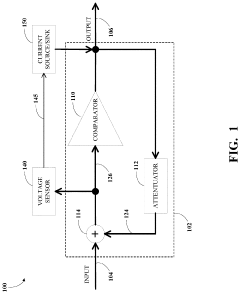
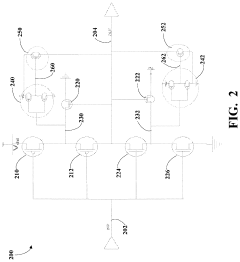
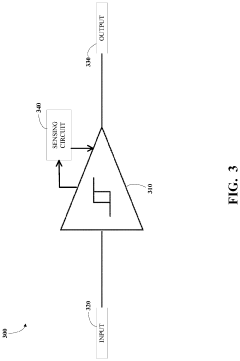
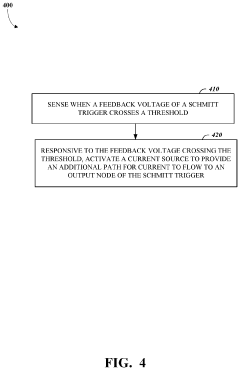
- The implementation of a low-swing Schmitt trigger circuit with additional parallel paths for current sourcing and sinking, utilizing transistors and voltage sensors to enhance state transitions even when input voltages are near threshold levels, thereby reducing delay and increasing switching speed.
Process for recovering a coded signal sequence
PatentInactiveEP0445170A1
Innovation
- A method and device that filter out the AC voltage component, detect peak values, form and multiply their difference by a constant factor to correct signal shifts, and convert signals into square-wave outputs using a Schmitt trigger, enabling the recovery of original signal sequences with commercially available reading devices.
Performance Metrics and Benchmarking Standards
Evaluating the performance of Schmitt Trigger circuits in signal reconstruction applications requires comprehensive metrics and standardized benchmarking approaches. The primary performance indicators include hysteresis width accuracy, which measures the precision of the voltage difference between the upper and lower threshold levels. This parameter directly impacts the circuit's noise immunity and signal discrimination capabilities in reconstruction scenarios.
Switching speed represents another critical metric, typically measured in nanoseconds or microseconds depending on the application domain. For high-frequency signal reconstruction, circuits with switching speeds below 10ns are generally preferred, while industrial control applications may tolerate speeds up to 100μs. The consistency of these switching times across temperature variations (-40°C to 125°C) provides valuable insight into the circuit's stability in diverse operating environments.
Power consumption efficiency, expressed in milliwatts or microwatts, has become increasingly important in portable and IoT applications. Modern Schmitt Trigger implementations for signal reconstruction should maintain power consumption below 5mW for battery-operated devices, with standby current draw not exceeding 10μA to ensure extended operational lifetimes.
Temperature coefficient of hysteresis (TCH) quantifies how the hysteresis window changes with temperature fluctuations. Industry standards typically specify TCH values below 0.05%/°C for precision applications. This metric is particularly relevant when reconstructing signals in environments with significant temperature variations.
Signal integrity preservation can be quantified through Total Harmonic Distortion (THD) measurements, with values below 0.1% considered excellent for high-fidelity signal reconstruction applications. Additionally, Common-Mode Rejection Ratio (CMRR) values exceeding 80dB indicate superior noise immunity characteristics essential for reconstructing signals in electrically noisy environments.
Standardized benchmarking protocols have emerged across different industries. The JEDEC JESD22 standards provide temperature cycling and environmental stress testing parameters, while IEC 62132 offers electromagnetic compatibility testing guidelines specifically applicable to Schmitt Trigger circuits in signal processing chains. IEEE 1241-2010 establishes terminology and test methods for analog-to-digital converters, which can be adapted for evaluating Schmitt Trigger performance in signal reconstruction pathways.
Switching speed represents another critical metric, typically measured in nanoseconds or microseconds depending on the application domain. For high-frequency signal reconstruction, circuits with switching speeds below 10ns are generally preferred, while industrial control applications may tolerate speeds up to 100μs. The consistency of these switching times across temperature variations (-40°C to 125°C) provides valuable insight into the circuit's stability in diverse operating environments.
Power consumption efficiency, expressed in milliwatts or microwatts, has become increasingly important in portable and IoT applications. Modern Schmitt Trigger implementations for signal reconstruction should maintain power consumption below 5mW for battery-operated devices, with standby current draw not exceeding 10μA to ensure extended operational lifetimes.
Temperature coefficient of hysteresis (TCH) quantifies how the hysteresis window changes with temperature fluctuations. Industry standards typically specify TCH values below 0.05%/°C for precision applications. This metric is particularly relevant when reconstructing signals in environments with significant temperature variations.
Signal integrity preservation can be quantified through Total Harmonic Distortion (THD) measurements, with values below 0.1% considered excellent for high-fidelity signal reconstruction applications. Additionally, Common-Mode Rejection Ratio (CMRR) values exceeding 80dB indicate superior noise immunity characteristics essential for reconstructing signals in electrically noisy environments.
Standardized benchmarking protocols have emerged across different industries. The JEDEC JESD22 standards provide temperature cycling and environmental stress testing parameters, while IEC 62132 offers electromagnetic compatibility testing guidelines specifically applicable to Schmitt Trigger circuits in signal processing chains. IEEE 1241-2010 establishes terminology and test methods for analog-to-digital converters, which can be adapted for evaluating Schmitt Trigger performance in signal reconstruction pathways.
Integration with Modern Digital Systems
The integration of Schmitt Trigger circuits with modern digital systems represents a critical advancement in signal processing technology. Contemporary digital systems, including IoT devices, high-speed communication networks, and advanced sensing platforms, increasingly operate in environments with significant noise interference and require robust signal conditioning. Schmitt Triggers provide essential hysteresis functionality that enables these systems to maintain signal integrity even under challenging conditions.
In FPGA and ASIC implementations, Schmitt Trigger circuits are now commonly embedded as standard input buffer components, offering designers ready-made solutions for signal reconstruction without requiring discrete component integration. This embedded approach significantly reduces board space requirements and simplifies design complexity while maintaining optimal performance characteristics.
Modern microcontrollers and digital signal processors (DSPs) frequently incorporate programmable threshold Schmitt Trigger functionality, allowing dynamic adjustment of hysteresis levels based on operating conditions. This adaptability enables systems to optimize noise immunity versus response time trade-offs in real-time, a crucial capability for applications operating across varying environmental conditions or signal quality scenarios.
The integration extends to mixed-signal systems where Schmitt Triggers serve as interface elements between analog sensors and digital processing units. In these applications, the trigger's ability to clean up noisy sensor outputs before digital conversion significantly improves system reliability and measurement accuracy. Advanced implementations utilize differential Schmitt Trigger configurations to enhance common-mode noise rejection in sensitive measurement systems.
Cloud-based IoT architectures benefit from Schmitt Trigger integration at the edge device level, where clean signal reconstruction enables more efficient data compression and transmission protocols. By eliminating spurious transitions before data digitization, these systems can reduce bandwidth requirements and extend battery life in remote sensing applications.
Emerging technologies like neuromorphic computing systems have begun incorporating Schmitt Trigger principles to model biological neuron firing thresholds. This biomimetic approach leverages the inherent hysteresis characteristics to create more efficient and noise-resistant artificial neural networks that better approximate biological information processing mechanisms.
As digital systems continue to miniaturize while operating at higher frequencies, the integration of Schmitt Trigger functionality becomes increasingly important for maintaining signal integrity across system boundaries and ensuring reliable operation in electromagnetically noisy environments.
In FPGA and ASIC implementations, Schmitt Trigger circuits are now commonly embedded as standard input buffer components, offering designers ready-made solutions for signal reconstruction without requiring discrete component integration. This embedded approach significantly reduces board space requirements and simplifies design complexity while maintaining optimal performance characteristics.
Modern microcontrollers and digital signal processors (DSPs) frequently incorporate programmable threshold Schmitt Trigger functionality, allowing dynamic adjustment of hysteresis levels based on operating conditions. This adaptability enables systems to optimize noise immunity versus response time trade-offs in real-time, a crucial capability for applications operating across varying environmental conditions or signal quality scenarios.
The integration extends to mixed-signal systems where Schmitt Triggers serve as interface elements between analog sensors and digital processing units. In these applications, the trigger's ability to clean up noisy sensor outputs before digital conversion significantly improves system reliability and measurement accuracy. Advanced implementations utilize differential Schmitt Trigger configurations to enhance common-mode noise rejection in sensitive measurement systems.
Cloud-based IoT architectures benefit from Schmitt Trigger integration at the edge device level, where clean signal reconstruction enables more efficient data compression and transmission protocols. By eliminating spurious transitions before data digitization, these systems can reduce bandwidth requirements and extend battery life in remote sensing applications.
Emerging technologies like neuromorphic computing systems have begun incorporating Schmitt Trigger principles to model biological neuron firing thresholds. This biomimetic approach leverages the inherent hysteresis characteristics to create more efficient and noise-resistant artificial neural networks that better approximate biological information processing mechanisms.
As digital systems continue to miniaturize while operating at higher frequencies, the integration of Schmitt Trigger functionality becomes increasingly important for maintaining signal integrity across system boundaries and ensuring reliable operation in electromagnetically noisy environments.
Unlock deeper insights with PatSnap Eureka Quick Research — get a full tech report to explore trends and direct your research. Try now!
Generate Your Research Report Instantly with AI Agent
Supercharge your innovation with PatSnap Eureka AI Agent Platform!