Boosting AMOLED life expectancy through enhanced thermal management.
JUL 17, 20259 MIN READ
Generate Your Research Report Instantly with AI Agent
PatSnap Eureka helps you evaluate technical feasibility & market potential.
AMOLED Longevity Challenges
AMOLED displays have revolutionized the mobile device industry with their vibrant colors, deep blacks, and energy efficiency. However, these displays face significant challenges in terms of longevity, primarily due to thermal management issues. The organic materials used in AMOLED panels are highly sensitive to temperature fluctuations, which can lead to accelerated degradation and reduced lifespan.
One of the primary challenges is the uneven heat distribution across the display panel. Certain areas, particularly those displaying bright or static content, tend to generate more heat than others. This localized heating can cause differential aging of the organic materials, resulting in color shifts and burn-in effects over time. The problem is exacerbated in high-brightness scenarios or when devices are used in direct sunlight, as the increased power consumption leads to higher heat generation.
Another significant challenge is the cumulative effect of heat exposure on the organic materials. Prolonged exposure to elevated temperatures can cause molecular changes in the emissive layers, leading to decreased luminous efficiency and color accuracy. This degradation is often irreversible and can significantly shorten the overall lifespan of the display.
The compact design of modern mobile devices further complicates thermal management. As manufacturers strive for thinner and lighter devices, the space available for heat dissipation becomes increasingly limited. This constraint makes it challenging to implement traditional cooling solutions effectively, necessitating innovative approaches to thermal management.
Moreover, the integration of AMOLED displays with other heat-generating components, such as processors and batteries, creates a complex thermal environment. The heat generated by these components can contribute to the overall thermal load on the display, potentially accelerating its degradation.
The variability in usage patterns also presents a challenge for AMOLED longevity. Different users may subject their devices to varying levels of screen brightness, ambient temperatures, and usage durations. This diversity makes it difficult to predict and mitigate thermal issues across a broad user base, necessitating robust and adaptive thermal management solutions.
Addressing these challenges requires a multifaceted approach, combining advancements in material science, panel design, and thermal management technologies. Innovations in heat-resistant organic materials, more efficient pixel structures, and advanced thermal spreading techniques are crucial for enhancing AMOLED longevity. Additionally, the development of intelligent power management systems that can dynamically adjust display parameters based on thermal conditions could play a significant role in extending the lifespan of AMOLED displays.
One of the primary challenges is the uneven heat distribution across the display panel. Certain areas, particularly those displaying bright or static content, tend to generate more heat than others. This localized heating can cause differential aging of the organic materials, resulting in color shifts and burn-in effects over time. The problem is exacerbated in high-brightness scenarios or when devices are used in direct sunlight, as the increased power consumption leads to higher heat generation.
Another significant challenge is the cumulative effect of heat exposure on the organic materials. Prolonged exposure to elevated temperatures can cause molecular changes in the emissive layers, leading to decreased luminous efficiency and color accuracy. This degradation is often irreversible and can significantly shorten the overall lifespan of the display.
The compact design of modern mobile devices further complicates thermal management. As manufacturers strive for thinner and lighter devices, the space available for heat dissipation becomes increasingly limited. This constraint makes it challenging to implement traditional cooling solutions effectively, necessitating innovative approaches to thermal management.
Moreover, the integration of AMOLED displays with other heat-generating components, such as processors and batteries, creates a complex thermal environment. The heat generated by these components can contribute to the overall thermal load on the display, potentially accelerating its degradation.
The variability in usage patterns also presents a challenge for AMOLED longevity. Different users may subject their devices to varying levels of screen brightness, ambient temperatures, and usage durations. This diversity makes it difficult to predict and mitigate thermal issues across a broad user base, necessitating robust and adaptive thermal management solutions.
Addressing these challenges requires a multifaceted approach, combining advancements in material science, panel design, and thermal management technologies. Innovations in heat-resistant organic materials, more efficient pixel structures, and advanced thermal spreading techniques are crucial for enhancing AMOLED longevity. Additionally, the development of intelligent power management systems that can dynamically adjust display parameters based on thermal conditions could play a significant role in extending the lifespan of AMOLED displays.
Market Demand Analysis
The market demand for enhanced thermal management solutions in AMOLED displays has been steadily increasing, driven by the growing adoption of AMOLED technology across various consumer electronics sectors. As AMOLED displays become more prevalent in smartphones, tablets, smartwatches, and televisions, manufacturers are facing increasing pressure to improve the longevity and performance of these devices.
The global AMOLED market has been experiencing significant growth, with projections indicating continued expansion in the coming years. This growth is primarily fueled by the superior visual quality, energy efficiency, and flexibility offered by AMOLED displays compared to traditional LCD technology. However, the widespread adoption of AMOLED displays has also brought attention to their vulnerability to heat-related degradation, which directly impacts their lifespan and overall performance.
Consumer expectations for longer-lasting devices have created a strong demand for solutions that can extend the life expectancy of AMOLED displays. This demand is particularly acute in the high-end smartphone market, where consumers are willing to pay premium prices for devices with superior display quality and durability. Manufacturers are under pressure to deliver products that maintain their visual performance over extended periods, making thermal management a critical factor in product development and marketing strategies.
The automotive industry has emerged as another significant driver of demand for enhanced thermal management in AMOLED displays. As vehicle manufacturers increasingly incorporate AMOLED technology into infotainment systems and digital dashboards, the need for robust thermal solutions becomes paramount. The harsh environmental conditions experienced by automotive displays, including extreme temperatures and prolonged exposure to sunlight, necessitate advanced thermal management techniques to ensure longevity and reliability.
In the wearable technology sector, particularly smartwatches and fitness trackers, the compact form factor presents unique challenges for thermal management. The limited space available for heat dissipation, combined with the close proximity to the user's skin, creates a strong market demand for innovative cooling solutions that can maintain optimal display performance without compromising user comfort or device aesthetics.
The growing trend towards foldable and flexible AMOLED displays has further intensified the need for advanced thermal management solutions. These cutting-edge display technologies are particularly susceptible to heat-related issues due to their complex structures and the mechanical stress involved in folding and unfolding. As a result, manufacturers are actively seeking thermal management innovations that can address these specific challenges and enable the widespread adoption of flexible display technologies.
The global AMOLED market has been experiencing significant growth, with projections indicating continued expansion in the coming years. This growth is primarily fueled by the superior visual quality, energy efficiency, and flexibility offered by AMOLED displays compared to traditional LCD technology. However, the widespread adoption of AMOLED displays has also brought attention to their vulnerability to heat-related degradation, which directly impacts their lifespan and overall performance.
Consumer expectations for longer-lasting devices have created a strong demand for solutions that can extend the life expectancy of AMOLED displays. This demand is particularly acute in the high-end smartphone market, where consumers are willing to pay premium prices for devices with superior display quality and durability. Manufacturers are under pressure to deliver products that maintain their visual performance over extended periods, making thermal management a critical factor in product development and marketing strategies.
The automotive industry has emerged as another significant driver of demand for enhanced thermal management in AMOLED displays. As vehicle manufacturers increasingly incorporate AMOLED technology into infotainment systems and digital dashboards, the need for robust thermal solutions becomes paramount. The harsh environmental conditions experienced by automotive displays, including extreme temperatures and prolonged exposure to sunlight, necessitate advanced thermal management techniques to ensure longevity and reliability.
In the wearable technology sector, particularly smartwatches and fitness trackers, the compact form factor presents unique challenges for thermal management. The limited space available for heat dissipation, combined with the close proximity to the user's skin, creates a strong market demand for innovative cooling solutions that can maintain optimal display performance without compromising user comfort or device aesthetics.
The growing trend towards foldable and flexible AMOLED displays has further intensified the need for advanced thermal management solutions. These cutting-edge display technologies are particularly susceptible to heat-related issues due to their complex structures and the mechanical stress involved in folding and unfolding. As a result, manufacturers are actively seeking thermal management innovations that can address these specific challenges and enable the widespread adoption of flexible display technologies.
Thermal Management Issues
Thermal management is a critical factor in determining the lifespan and performance of AMOLED displays. As these displays become increasingly prevalent in various devices, from smartphones to large-screen televisions, the challenges associated with heat dissipation have grown more complex. The primary issue stems from the organic materials used in AMOLED panels, which are highly sensitive to temperature fluctuations.
Excessive heat can accelerate the degradation of organic compounds, leading to reduced luminance, color shifts, and ultimately, shortened display lifespans. This degradation is particularly pronounced in blue subpixels, which typically have the shortest lifespan among the color components. The heat generated during operation not only affects the organic layers but also impacts other components such as the thin-film transistors (TFTs) and the encapsulation materials.
Another significant thermal management challenge is the non-uniform heat distribution across the display panel. Hotspots can form in areas of high pixel density or where certain colors are displayed more frequently, leading to localized degradation and potential image retention issues. This non-uniformity is exacerbated in flexible AMOLED displays, where the substrate materials and form factors introduce additional thermal considerations.
Power consumption is intrinsically linked to thermal management in AMOLED displays. Higher brightness levels and complex image processing algorithms contribute to increased power draw, which in turn generates more heat. This creates a feedback loop where thermal issues can lead to reduced efficiency, requiring more power to maintain the same brightness levels, and consequently generating even more heat.
The integration of AMOLED displays into various form factors and device types presents unique thermal challenges. For instance, foldable smartphones must contend with heat dissipation in compact, multi-layered structures, while large-format OLED TVs face issues related to scaling up thermal management solutions effectively. Additionally, the trend towards thinner and lighter devices limits the space available for traditional cooling solutions, necessitating innovative approaches to heat management.
Environmental factors also play a role in thermal management issues. Ambient temperature, humidity, and exposure to direct sunlight can significantly impact the operating temperature of AMOLED displays. Devices used in extreme conditions, such as automotive displays or outdoor signage, must be designed with robust thermal management systems to ensure longevity and consistent performance across a wide range of environmental conditions.
Excessive heat can accelerate the degradation of organic compounds, leading to reduced luminance, color shifts, and ultimately, shortened display lifespans. This degradation is particularly pronounced in blue subpixels, which typically have the shortest lifespan among the color components. The heat generated during operation not only affects the organic layers but also impacts other components such as the thin-film transistors (TFTs) and the encapsulation materials.
Another significant thermal management challenge is the non-uniform heat distribution across the display panel. Hotspots can form in areas of high pixel density or where certain colors are displayed more frequently, leading to localized degradation and potential image retention issues. This non-uniformity is exacerbated in flexible AMOLED displays, where the substrate materials and form factors introduce additional thermal considerations.
Power consumption is intrinsically linked to thermal management in AMOLED displays. Higher brightness levels and complex image processing algorithms contribute to increased power draw, which in turn generates more heat. This creates a feedback loop where thermal issues can lead to reduced efficiency, requiring more power to maintain the same brightness levels, and consequently generating even more heat.
The integration of AMOLED displays into various form factors and device types presents unique thermal challenges. For instance, foldable smartphones must contend with heat dissipation in compact, multi-layered structures, while large-format OLED TVs face issues related to scaling up thermal management solutions effectively. Additionally, the trend towards thinner and lighter devices limits the space available for traditional cooling solutions, necessitating innovative approaches to heat management.
Environmental factors also play a role in thermal management issues. Ambient temperature, humidity, and exposure to direct sunlight can significantly impact the operating temperature of AMOLED displays. Devices used in extreme conditions, such as automotive displays or outdoor signage, must be designed with robust thermal management systems to ensure longevity and consistent performance across a wide range of environmental conditions.
Current Thermal Solutions
01 Improving AMOLED display lifespan through pixel compensation
Various compensation techniques are employed to extend the life expectancy of AMOLED displays. These methods involve adjusting pixel voltages or currents to compensate for degradation over time, ensuring consistent brightness and color accuracy throughout the display's lifetime.- Improving AMOLED display lifespan through pixel compensation: Various techniques are employed to compensate for pixel degradation in AMOLED displays, thereby extending their lifespan. These methods include adjusting pixel driving voltages, implementing compensation algorithms, and using sensor feedback to detect and correct for pixel aging. Such approaches help maintain consistent brightness and color accuracy over time, ultimately prolonging the display's useful life.
- Enhancing AMOLED durability with advanced materials and structures: Research focuses on developing new materials and structural designs to improve the longevity of AMOLED displays. This includes the use of more stable organic compounds, improved encapsulation techniques to protect against moisture and oxygen, and novel pixel architectures that distribute stress more evenly. These advancements aim to slow down the degradation process and extend the overall lifespan of AMOLED displays.
- Optimizing power management for extended AMOLED lifespan: Efficient power management strategies are crucial for prolonging AMOLED display life. This involves implementing sophisticated power control algorithms, adaptive brightness adjustment based on ambient light and content, and selective pixel activation techniques. By reducing unnecessary power consumption and heat generation, these methods help minimize stress on the organic materials and extend the display's operational life.
- Predicting and monitoring AMOLED display lifespan: Advanced prediction models and monitoring systems are developed to estimate and track the lifespan of AMOLED displays. These systems use a combination of historical data, real-time performance metrics, and machine learning algorithms to forecast display degradation and remaining useful life. This information allows for proactive maintenance and helps in optimizing display usage patterns to maximize longevity.
- Thermal management for AMOLED display longevity: Effective thermal management is critical for extending the life expectancy of AMOLED displays. This involves designing efficient heat dissipation systems, implementing temperature-aware display controllers, and using materials with improved thermal properties. By maintaining optimal operating temperatures, these techniques help reduce thermal stress on the organic materials, slowing down degradation processes and increasing the overall lifespan of the display.
02 Enhancing OLED material stability
Research focuses on developing more stable OLED materials to increase the overall lifespan of AMOLED displays. This includes improving the chemical composition of organic light-emitting materials and implementing protective layers to prevent degradation from environmental factors.Expand Specific Solutions03 Thermal management for extended display life
Effective thermal management strategies are crucial for prolonging AMOLED display life expectancy. These include innovative heat dissipation designs and temperature control mechanisms to prevent premature aging of OLED materials due to excessive heat.Expand Specific Solutions04 Lifetime prediction and monitoring systems
Advanced prediction models and real-time monitoring systems are developed to accurately estimate and track the lifespan of AMOLED displays. These tools help in implementing timely maintenance and optimization strategies to extend the overall life expectancy of the displays.Expand Specific Solutions05 Power efficiency optimization for longevity
Improving power efficiency in AMOLED displays is a key factor in extending their lifespan. This involves optimizing driving circuits, implementing advanced power management algorithms, and developing low-power display modes to reduce overall stress on the OLED materials.Expand Specific Solutions
Key Industry Players
The AMOLED thermal management technology market is in a growth phase, driven by increasing demand for high-performance displays in smartphones, wearables, and automotive applications. The market size is expanding rapidly, with major players like Samsung Display, LG Display, and BOE Technology Group leading the charge. These companies are investing heavily in R&D to enhance AMOLED life expectancy through improved thermal management techniques. The technology's maturity is advancing, with established firms like Samsung and LG Display having a competitive edge due to their extensive experience. Emerging players such as Visionox and TCL CSOT are also making significant strides, indicating a dynamic and competitive landscape in this crucial display technology sector.
BOE Technology Group Co., Ltd.
Technical Solution: BOE has made significant strides in improving AMOLED life expectancy through enhanced thermal management. They have developed a multi-layer heat dissipation system that incorporates high thermal conductivity materials throughout the display structure[7]. This system includes a combination of graphene layers and metal heat sinks to efficiently channel heat away from critical components. BOE has also implemented advanced pixel driving circuits that reduce power consumption and heat generation at the pixel level[8]. Their thermal management strategy extends to the backplane design, where they have optimized the TFT layout to minimize hot spots. Additionally, BOE has introduced a novel encapsulation technique that not only protects OLED materials but also contributes to overall heat dissipation efficiency[9].
Strengths: Large-scale production capabilities, strong presence in the Chinese market. Weaknesses: Relatively newer to high-end AMOLED technology compared to Korean competitors.
Samsung Display Co., Ltd.
Technical Solution: Samsung Display has developed advanced thermal management solutions for AMOLED displays to boost their life expectancy. Their approach includes the use of heat-dissipating materials and innovative panel designs. They have implemented a multi-layer heat dissipation structure that efficiently spreads and dissipates heat generated during display operation[1]. This structure incorporates high thermal conductivity materials such as graphite sheets and copper layers. Additionally, Samsung has developed pixel-level thermal management techniques, optimizing the OLED stack to reduce heat generation at the source[2]. They have also introduced advanced thin-film encapsulation (TFE) technology that not only protects OLED materials from moisture and oxygen but also aids in heat dissipation[3].
Strengths: Industry-leading AMOLED technology, extensive R&D capabilities, and vertical integration. Weaknesses: High production costs and potential supply chain dependencies.
Innovative Cooling Techniques
Active matrix organic light emitting diode display
PatentInactiveUS20090201235A1
Innovation
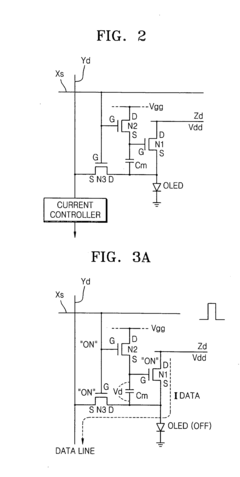
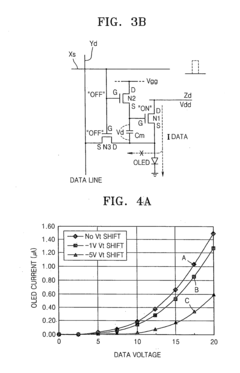
- An AMOLED display with a 3-transistor-1-capacitor structure using N-channel transistors, including a driving transistor, a switching transistor, and a programming transistor, along with a current controller, which determines the current flowing through the transistors to maintain uniform brightness by compensating for threshold voltage shifts, allowing for the use of amorphous silicon and simplifying the pixel structure.
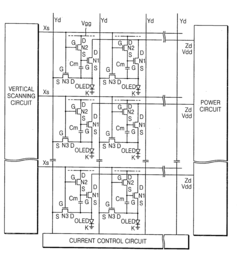
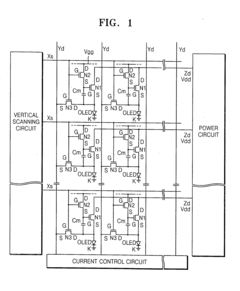
Pixel unit drive circuit capable of prolonging AMOLED panel service lifetime
PatentInactiveCN202584686U
Innovation
- An organic light-emitting diode light-emitting state control circuit is provided between the power supply voltage line and the organic light-emitting diode. The scanning voltage of the scanning signal line is used to control the on/off of the organic light-emitting diode, making full use of the afterglow effect of the luminescent material and the visual inertia of the human eye's photosensitivity. , reduce the current passing during the display data input time.


Material Science Advancements
Material science advancements play a crucial role in enhancing the thermal management of AMOLED displays, thereby boosting their life expectancy. Recent developments in this field have focused on innovative materials and structures that can effectively dissipate heat and protect sensitive organic components.
One significant advancement is the development of high thermal conductivity substrates. Traditional glass substrates have limited heat dissipation capabilities, leading to localized hot spots that can degrade OLED materials. Researchers have made progress in creating thin, flexible substrates with improved thermal conductivity, such as graphene-based materials and metal-doped polymers. These substrates can efficiently spread heat across the display surface, reducing thermal stress on individual pixels.
Another area of focus is the improvement of encapsulation materials. Advanced thin-film encapsulation techniques using alternating layers of inorganic and organic materials have shown promise in not only protecting OLEDs from moisture and oxygen but also in enhancing heat dissipation. These multi-layer structures can act as thermal barriers, preventing heat from accumulating in critical areas of the display.
The development of thermally conductive adhesives and bonding materials has also contributed to better thermal management. These materials, often incorporating nanoparticles or engineered polymers, provide improved heat transfer between layers of the display stack. By enhancing thermal coupling between components, these adhesives help to distribute heat more evenly and efficiently.
Advancements in electrode materials have led to the creation of transparent conductive films with superior thermal properties. Materials such as silver nanowires and carbon nanotubes offer excellent electrical conductivity while also providing better heat dissipation compared to traditional indium tin oxide (ITO) electrodes. These materials can help reduce resistive heating and improve overall thermal performance.
Research into phase-change materials (PCMs) has opened up new possibilities for dynamic thermal management in AMOLED displays. PCMs can absorb excess heat during peak operation and release it during cooler periods, effectively smoothing out temperature fluctuations. Integration of PCMs into display structures is an emerging area with potential for significant impact on thermal stability and device longevity.
Lastly, advancements in heat-resistant OLED materials themselves have contributed to improved thermal management. Development of more thermally stable emissive materials and charge transport layers has increased the temperature tolerance of OLED devices. This intrinsic improvement in heat resistance complements external thermal management strategies, further enhancing the overall life expectancy of AMOLED displays.
One significant advancement is the development of high thermal conductivity substrates. Traditional glass substrates have limited heat dissipation capabilities, leading to localized hot spots that can degrade OLED materials. Researchers have made progress in creating thin, flexible substrates with improved thermal conductivity, such as graphene-based materials and metal-doped polymers. These substrates can efficiently spread heat across the display surface, reducing thermal stress on individual pixels.
Another area of focus is the improvement of encapsulation materials. Advanced thin-film encapsulation techniques using alternating layers of inorganic and organic materials have shown promise in not only protecting OLEDs from moisture and oxygen but also in enhancing heat dissipation. These multi-layer structures can act as thermal barriers, preventing heat from accumulating in critical areas of the display.
The development of thermally conductive adhesives and bonding materials has also contributed to better thermal management. These materials, often incorporating nanoparticles or engineered polymers, provide improved heat transfer between layers of the display stack. By enhancing thermal coupling between components, these adhesives help to distribute heat more evenly and efficiently.
Advancements in electrode materials have led to the creation of transparent conductive films with superior thermal properties. Materials such as silver nanowires and carbon nanotubes offer excellent electrical conductivity while also providing better heat dissipation compared to traditional indium tin oxide (ITO) electrodes. These materials can help reduce resistive heating and improve overall thermal performance.
Research into phase-change materials (PCMs) has opened up new possibilities for dynamic thermal management in AMOLED displays. PCMs can absorb excess heat during peak operation and release it during cooler periods, effectively smoothing out temperature fluctuations. Integration of PCMs into display structures is an emerging area with potential for significant impact on thermal stability and device longevity.
Lastly, advancements in heat-resistant OLED materials themselves have contributed to improved thermal management. Development of more thermally stable emissive materials and charge transport layers has increased the temperature tolerance of OLED devices. This intrinsic improvement in heat resistance complements external thermal management strategies, further enhancing the overall life expectancy of AMOLED displays.
Energy Efficiency Strategies
Energy efficiency strategies play a crucial role in enhancing the thermal management of AMOLED displays, thereby extending their life expectancy. These strategies focus on optimizing power consumption and minimizing heat generation within the display system.
One key approach involves implementing advanced power management techniques at the pixel level. By utilizing dynamic voltage scaling, individual pixels can be operated at lower voltages when displaying darker colors or in low-brightness scenarios. This reduces overall power consumption and, consequently, heat generation. Additionally, employing selective pixel dimming in areas of the display that are not actively in use can further contribute to energy savings.
Another effective strategy is the integration of intelligent brightness control systems. These systems utilize ambient light sensors and user behavior analysis to automatically adjust display brightness to optimal levels. By avoiding unnecessary high-brightness operation, energy consumption is reduced, leading to improved thermal performance.
The development of more efficient OLED materials is also a significant factor in energy efficiency. Research into novel emissive materials with higher quantum efficiency can lead to displays that produce the same level of brightness with lower power input. This not only reduces energy consumption but also minimizes heat generation at the source.
Circuit-level optimizations present another avenue for improving energy efficiency. Implementing low-power driving circuits and advanced power supply designs can reduce energy losses in the display system. Techniques such as charge recycling in the display driver integrated circuits (DDICs) can recover and reuse energy that would otherwise be dissipated as heat.
Furthermore, the adoption of energy-efficient display architectures, such as those utilizing micro-LED technology in conjunction with OLED, can lead to significant power savings. These hybrid designs can leverage the strengths of both technologies to create displays that are more energy-efficient across various usage scenarios.
Lastly, software-based energy optimization techniques can complement hardware strategies. Implementing smart algorithms for content-adaptive power saving, such as adjusting color gamut and refresh rates based on displayed content, can lead to substantial energy savings without compromising user experience.
By combining these energy efficiency strategies, AMOLED displays can achieve significant reductions in power consumption and heat generation. This not only contributes to extended device battery life but also plays a crucial role in managing thermal issues, ultimately leading to improved AMOLED life expectancy.
One key approach involves implementing advanced power management techniques at the pixel level. By utilizing dynamic voltage scaling, individual pixels can be operated at lower voltages when displaying darker colors or in low-brightness scenarios. This reduces overall power consumption and, consequently, heat generation. Additionally, employing selective pixel dimming in areas of the display that are not actively in use can further contribute to energy savings.
Another effective strategy is the integration of intelligent brightness control systems. These systems utilize ambient light sensors and user behavior analysis to automatically adjust display brightness to optimal levels. By avoiding unnecessary high-brightness operation, energy consumption is reduced, leading to improved thermal performance.
The development of more efficient OLED materials is also a significant factor in energy efficiency. Research into novel emissive materials with higher quantum efficiency can lead to displays that produce the same level of brightness with lower power input. This not only reduces energy consumption but also minimizes heat generation at the source.
Circuit-level optimizations present another avenue for improving energy efficiency. Implementing low-power driving circuits and advanced power supply designs can reduce energy losses in the display system. Techniques such as charge recycling in the display driver integrated circuits (DDICs) can recover and reuse energy that would otherwise be dissipated as heat.
Furthermore, the adoption of energy-efficient display architectures, such as those utilizing micro-LED technology in conjunction with OLED, can lead to significant power savings. These hybrid designs can leverage the strengths of both technologies to create displays that are more energy-efficient across various usage scenarios.
Lastly, software-based energy optimization techniques can complement hardware strategies. Implementing smart algorithms for content-adaptive power saving, such as adjusting color gamut and refresh rates based on displayed content, can lead to substantial energy savings without compromising user experience.
By combining these energy efficiency strategies, AMOLED displays can achieve significant reductions in power consumption and heat generation. This not only contributes to extended device battery life but also plays a crucial role in managing thermal issues, ultimately leading to improved AMOLED life expectancy.
Unlock deeper insights with PatSnap Eureka Quick Research — get a full tech report to explore trends and direct your research. Try now!
Generate Your Research Report Instantly with AI Agent
Supercharge your innovation with PatSnap Eureka AI Agent Platform!